Travel Shoe Bags: Separating Footwear Without Wasting Suitcase Space
Product links are for reference. Verify current details on the retailer page before buying.
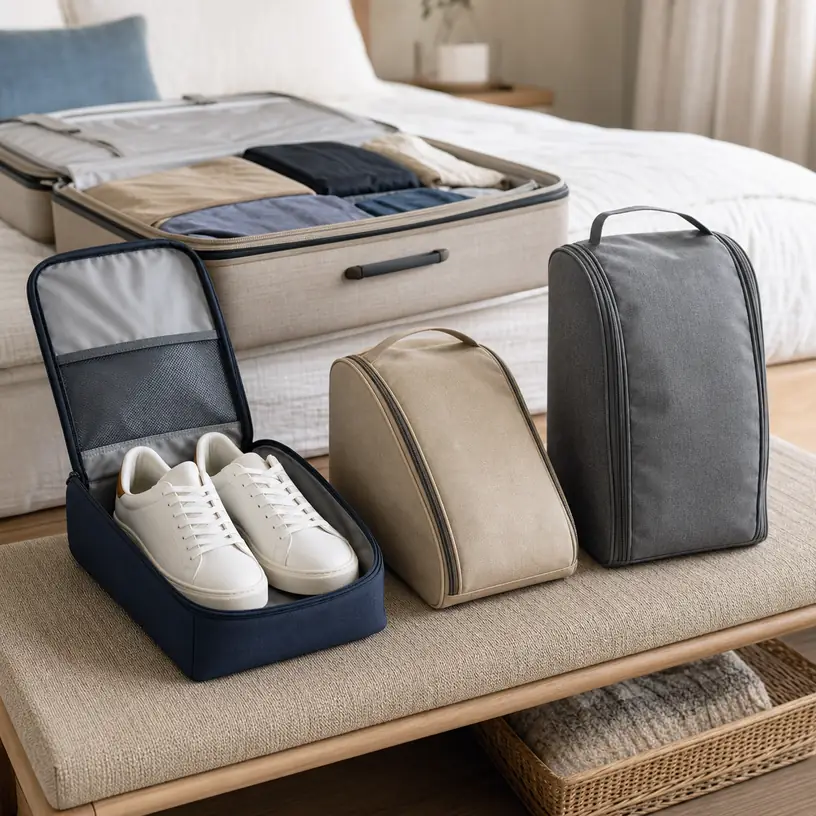
Illustrative image, not an official product photo.
Short answer
Choose a travel shoe bag around the largest pair that will actually make the trip, not around a generic shoe-size label. Measure each shoe’s sole length, widest point, and standing height, then allow room for the pair to settle without forcing the zipper around heels or bulky tread. Low sneakers may fit a flat zip pouch, while ankle boots, platform shoes, or two shoes packed side by side can require a taller, boxier shape. Also compare closure placement, empty bulk, carrying handle, current care instructions, and whether mesh or ventilation openings make sense for where the bag will sit. A shoe pouch separates surfaces and loose debris; it does not make damp footwear clean, dry, or odor-free.
Search reference
Travel shoe bags for suitcase packing
Compare listed interior dimensions with your longest and tallest pair, then check zipper layout, fabric, ventilation, care guidance, handle placement, and set configuration.
View matching optionsMake a footwear packing map first
Shoe bags look simple, but the object going inside is awkward: a pair is long, often widest at the forefoot, taller at the heel, and rarely forms a neat rectangle. Product photos can make an empty pouch appear spacious even when the zipper opening or upper corners limit what fits. A quick measurement of the intended shoes is more useful than choosing by color or by the number of bags in a set.
Place the pair in the arrangement you would use for packing. Shoes nested heel-to-toe usually create a narrower bundle, while side-by-side placement can be easier to load but needs more width. Measure that bundle at its longest, widest, and tallest points. If the footwear has stiff uppers, a prominent heel, thick tread, or hardware, avoid assuming it can be compressed into dimensions intended for flexible low-cut shoes.
Next, map the suitcase. Decide whether the pouch will lie flat along the base, stand against a side wall, or occupy the space between a packing cube and the case frame. A tall rectangular shoe bag may load easily but waste space around low sneakers. A soft drawstring sack conforms to unused corners but provides less control over how the soles and uppers meet. The right format is the one that fits both the footwear bundle and a specific place in your normal luggage.
Who this is for
- Travelers who want a removable layer between shoe soles and clothing, accessories, or the suitcase lining.
- People packing a second pair for work, an event, a gym visit, or a change between walking and dress shoes.
- Households that want each traveler’s footwear contained separately when several suitcases are packed together.
- Anyone who prefers to lift a complete pair out of luggage without searching for two individually wrapped shoes.
- Travelers willing to clean and dry footwear before packing rather than treating the pouch as a substitute for shoe care.
What to verify before buying
- Usable dimensions: Look for internal or clearly defined bag measurements and compare all three dimensions with the packed pair. Exterior length alone does not describe heel or toe clearance.
- Opening and zipper path: Check whether the lid opens across three sides, along the top, or through a narrower end panel. The opening must accommodate the widest part of the shoe without excessive bending.
- Bag shape: Flat envelopes suit different footwear from gusseted boxes. Confirm whether the side panels stand at their listed depth once loaded.
- Fabric description: Review current material wording, lining details, seam construction, and any water-resistance language. Do not interpret ordinary fabric or mesh as waterproof containment.
- Ventilation: Identify where mesh panels, eyelets, or other openings are positioned and consider whether they could expose nearby luggage contents to loose debris or moisture.
- Care method: Confirm whether the pouch is wipe-clean, hand-washable, or machine-washable according to current instructions. Check any drying restrictions as well.
- Set composition: Verify the quantity and each size in a multipack. A large set is useful only when its mix fits the shoes and travelers in your packing plan.
- Handle and identification details: Inspect handle attachment, label windows, and viewing panels if you expect to carry the bag separately or distinguish several similar pouches.
Match the pouch shape to the shoes
Flat zip pouches for low-profile pairs
An envelope-style bag can be an efficient choice for slippers, sandals, flats, and some low sneakers because it adds little structure of its own. Look at the zipper opening carefully. A pouch may have enough overall length yet remain difficult to load if the opening stops short of the corners or if the zipper must curve tightly around a thick sole.
A flat bag also encourages the two shoes to rest directly against one another. Decide whether sole-to-sole, heel-to-toe, or a thin internal separator works for the materials involved. Decorative surfaces, light-colored uppers, and projecting hardware may need more deliberate placement than durable casual footwear. Follow the shoe maker’s storage guidance when available.
Gusseted bags for everyday sneakers
A gusset creates depth and can give a pair a more predictable footprint inside the suitcase. This format is often easier to stack beside packing cubes because it loads like a soft rectangular block. However, listed capacity should still be checked against the shoe bundle. The gusset may taper near the toe, and a lid that looks tall in the center may offer less clearance around the zipper seam.
Inspect how the bag behaves when partly filled. Stiff panels preserve the shape but occupy space even without shoes. Very soft panels pack down between uses, though the pouch may slump while it is being loaded. Neither construction is automatically better; the useful choice depends on whether predictable stacking or minimal empty bulk matters more.
Taller formats for boots and raised heels
Ankle boots and other high-profile footwear need standing height as well as sole length. Some tall shoe bags orient footwear upright, while others place one shoe along each side. Study the loading diagram and compare it with the pair’s shaft height, heel profile, and rigidity. Folding a soft boot shaft may be acceptable for some footwear but unsuitable for another pair, so check relevant care guidance rather than assuming.
High heels can create concentrated pressure at the heel tip and an uneven bundle around the toe box. A generic tall pouch organizes the pair but does not necessarily protect its shape. If the shoes are delicate or highly structured, compare a fitted shoe case or the original suitable storage instead of relying on a thin travel bag.
One shared bag or one pouch per shoe?
Packing both shoes in one bag keeps the pair together and reduces the number of closures to manage. It works well when the shoes can be arranged without one sole rubbing an upper. Before departure, try the intended heel-to-toe layout and close the pouch without forcing it. If the zipper path presses directly against a heel or toe, a larger shape may be preferable to pulling harder on the closure.
Individual pouches let each shoe fill a narrow gap in the suitcase and prevent the two shoes from touching. They also make it easier to place footwear around wheel housings or along opposite edges. The tradeoff is tracking two bags and making sure both return after the trip. A set with distinct colors, labels, or another simple identification method can help when multiple travelers use similar pouches.
Some multipacks combine several sizes. That can serve a household packing sandals, sneakers, and boots, but size labels are not standardized. Read the dimensions of every included piece rather than assuming all bags in a set hold the same class of footwear. If only one size works, unused pouches add storage clutter rather than travel value.
Ventilation is a packing decision, not a cure
Mesh panels and eyelets allow more air exchange than a fully enclosed fabric wall, but ventilation does not make wet shoes ready for luggage. Footwear should be cleaned as appropriate, allowed to dry, and checked for trapped debris before it goes into a suitcase. Packing damp items can affect both the pouch and neighboring contents regardless of the marketing language used for the bag.
The placement of openings matters. A large mesh top makes identification easy but reduces separation from the rest of the suitcase. Small openings near the upper side may offer a different balance. If the pouch sits beside clean clothing, consider whether fine dust, sand, or moisture could pass through. A more enclosed wipeable bag may be easier to isolate after a messy outing, while a breathable pouch may suit clean, dry indoor shoes.
No soft shoe bag should be assumed to contain a liquid spill or provide complete odor control. Keep damp, muddy, or strongly soiled footwear out of packed luggage until it has been handled appropriately. If an unexpected wet pair must travel, use a packing method suitable for the situation and unpack it promptly rather than leaving it sealed for storage.
Closure, handles, and care details that earn their space
A three-sided zipper creates a wide lid and lets you place shoes rather than push them through an end opening. It also adds a longer track that can catch if the bag is overfilled. Check zipper position with the planned shoe layout: tread, laces, and heel tabs should remain clear of the slider. Dual pulls can make access flexible, but they do not increase the bag’s usable dimensions.
A short grab handle is useful for lifting the pouch out of a deep case or carrying it from a hotel room to a gym locker. Look at where the handle joins the body and how the loaded bag hangs. A handle on a soft lid may tip the contents differently from one attached to an end panel. Unless the current specifications support it, do not treat a small organizer handle as a feature for prolonged carrying.
Care instructions deserve attention before the first trip. A fabric that can be wiped after routine use may be enough for clean city shoes. A household packing hiking or sports footwear may value a washable construction, but zippers, coatings, stiffeners, and viewing windows can limit the permitted method. Follow the listed instructions, empty debris outdoors where appropriate, and let the pouch dry fully before it returns to a drawer or suitcase.
A simple loading routine
Clean and dry the footwear according to its own care requirements. Remove loose material from tread, fasten straps, and secure laces so they cannot enter the zipper. Arrange the shoes exactly as they were positioned for measurement. If you use a divider, shoe cover, or shape support, include it in the fit test rather than adding it after selecting the bag.
Load the pouch without forcing the corners, then run a finger safely along the inside edge to confirm fabric or laces are clear of the zipper. Close it while the bag rests on a stable surface. Place the packed pouch in its planned suitcase position and complete the rest of the load. A shoe bag buried under heavy rigid items can still transfer pressure to the footwear inside.
At the destination, remove the shoes and inspect the pouch. Let both air as appropriate before repacking. Keeping a small routine—clean, dry, arrange, close, position—does more for orderly luggage than expecting the organizer to correct footwear that was packed wet or dirty.
Who should skip it
- Travelers wearing one pair for the entire trip may not need a dedicated organizer at all.
- A disposable or washable wrapping method may be simpler for an occasional trip if storage space at home is limited.
- Delicate, structured, or valuable shoes may need a fitted protective case rather than a soft pouch.
- Very muddy or wet footwear should not be placed directly into regular luggage merely because a shoe bag is available.
- Travelers who already use a suitcase compartment designed for footwear may find another layer redundant.
Limitations
- Size labels such as small, large, or men’s and women’s do not replace actual interior measurements.
- A soft pouch separates surfaces but does not prevent crushing, scuffing, shape loss, or impact in every packing arrangement.
- Mesh and ventilation openings can allow fine debris or moisture to reach adjacent contents.
- Water-resistant wording does not establish waterproof containment unless the current specification explicitly says so.
- Dark or opaque fabric can make similar bags hard to identify when several travelers use the same set.
- A gusseted or structured bag occupies suitcase volume even when the footwear inside is low-profile.
- Washability depends on the complete construction, including zippers, coatings, windows, handles, and internal stiffeners.
- Search listings, set quantities, dimensions, and materials can change; verify the current details before ordering.
Alternatives to compare
- A suitcase with a built-in shoe compartment when its location and dimensions suit the pairs you travel with.
- Separate washable drawstring sacks for flexible placement and minimal empty bulk.
- A fitted hard or semi-structured shoe case for footwear that needs more shape protection.
- Shower caps or another simple reusable sole-covering method for occasional packing, provided the fit and material are appropriate.
- Wearing the bulkiest suitable pair in transit and packing only a low-profile change of shoes.
- Reducing the footwear list so one versatile pair can cover more of the itinerary.
FAQ
What size travel shoe bag do I need for sneakers?
Measure the sneakers arranged as they will sit in the pouch, including sole length, combined width, and maximum height. Compare those numbers with usable interior dimensions and inspect the zipper opening. A shoe-size range alone cannot account for thick soles, wide toe boxes, or raised heel tabs.
Is it better to put both shoes in one bag?
One bag keeps a pair together and can create a tidy rectangular unit, provided the shoes fit without a sole rubbing a vulnerable upper. Separate pouches are useful when each shoe must fill a different suitcase gap or when you want the shoes isolated from one another. Try both layouts with the actual pair before deciding.
Should a travel shoe bag have mesh ventilation?
Mesh can help with identification and air exchange, but it also reduces the barrier between footwear and nearby contents. Use it for clean, dry shoes when that tradeoff fits the packing plan. Ventilation is not a substitute for cleaning and drying footwear before it enters luggage.
Can travel shoe bags go in a washing machine?
Only when the current care instructions permit machine washing. Fabric, coatings, zipper construction, clear windows, handles, and internal panels can all affect the approved method. Follow the product guidance and allow the bag to dry fully before storing or repacking it.
Do shoe bags keep the inside of a suitcase clean?
They provide a removable layer between footwear and the suitcase, which can help contain ordinary surface contact and some loose debris. They cannot guarantee containment of fine sand, moisture, mud, or odors, especially when the bag has mesh panels or is damaged. Clean and dry shoes first, and inspect the pouch after use.