Luggage Straps for Suitcases: Measure the Packed Case First
Product links are for reference. Verify current details on the retailer page before buying.
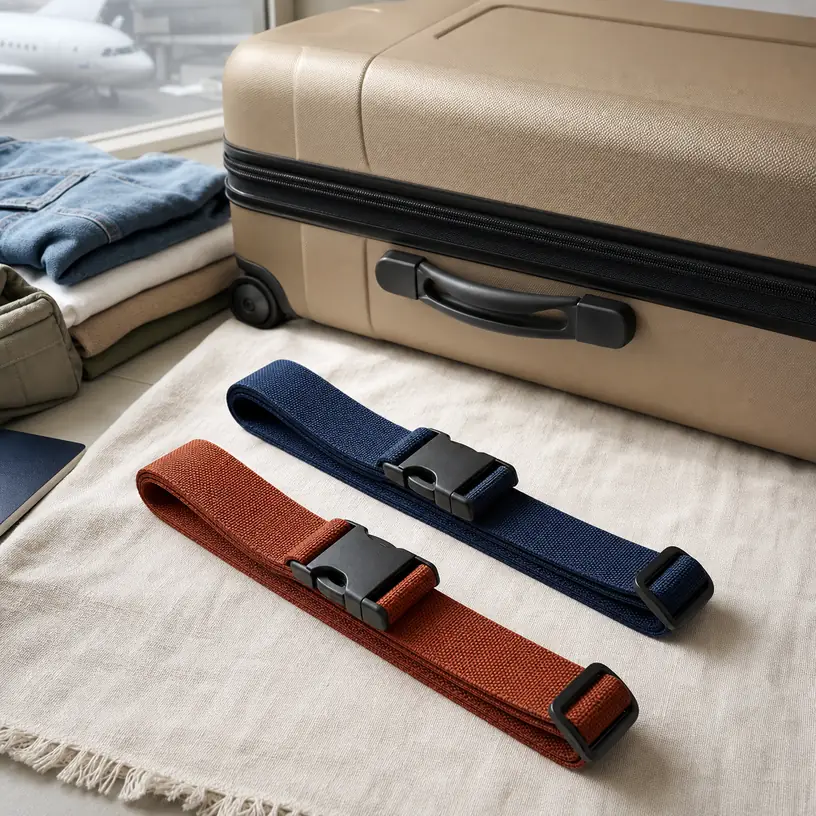
Illustrative image, not an official product photo.
Short answer
Measure the suitcase as it will actually travel before choosing a luggage strap. Pack and close the case, decide whether the belt will run around its height or width, and measure that complete route while avoiding wheels, feet, handles, and retractable-handle hardware. Then compare the measurement with the strap’s stated adjustment range, leaving enough room to open and close the buckle without relying on an extreme end of that range. A useful strap also needs a buckle that lies flat, an adjuster that holds its position, and a keeper that controls the loose tail. Treat it as an external organizing accessory and a visual identifier—not as a guarantee against opening, loss, damage, or unauthorized access.
Search reference
Adjustable luggage straps for suitcases
Compare adjustment range, webbing width, buckle layout, tail keepers, identification details, and set quantity against the packed cases you plan to use.
View matching optionsDraw the strap route before measuring
A suitcase is not a simple box once its wheels, feet, side handle, top handle, zipper path, and telescoping tubes are taken into account. The shortest circumference may be a poor strap route if the belt would sit against a wheel or slide over a rounded corner. Put the closed suitcase upright and trace the intended path with a flexible measuring tape. The tape should lie where the webbing can stay flat without blocking parts needed for normal lifting and rolling.
Measure a soft-sided or expandable case in the packing state you expect to use. An empty case can be noticeably smaller than a filled one, and opening an expansion panel changes the route again. If you alternate between compact and expanded configurations, record both circumferences and check that one strap can accommodate the full interval. For hard-shell luggage, note whether pronounced ribs, tapered sides, or highly rounded corners encourage a belt to migrate.
The advertised strap length may refer to the webbing end to end, the useful closed loop, or a broad adjustment range. Those are not interchangeable. Look for a clear minimum and maximum fitted circumference, then choose a route that falls comfortably inside it. A buckle forced to close at maximum extension leaves little tolerance for packing changes; a strap reduced to its minimum may create a long loose tail or place the adjuster awkwardly against the case.
Who this is for
- Travelers who want a removable belt around a zippered or latched suitcase as an additional external organizing measure.
- Households with similar-looking cases that can use a distinct strap color or pattern as one identification cue.
- People who occasionally use a suitcase expansion panel and are willing to readjust the belt after packing.
- Travelers replacing a worn strap whose buckle, stitching, adjuster, or webbing no longer inspires confidence.
- Anyone prepared to remove, inspect, and refit the accessory for each trip rather than leaving it permanently tightened on an empty case.
What to verify before buying
- Closed-loop adjustment range: Compare both the stated minimum and maximum with your measured packed circumference. Confirm what the seller’s length specification actually describes.
- Webbing width and route clearance: Check that the belt can lie flat between raised features and does not interfere with wheels, feet, handles, zipper access, or retractable-handle movement.
- Buckle design: Inspect how the two halves join, where release points sit, and whether the buckle will rest against a relatively flat part of your suitcase.
- Adjustment hardware: Look for a clear threading path and a means of retaining the free end. The strap should not depend on a dangling tail staying out of the way by chance.
- Stitching and end finishing: Review close images and current construction details around buckle attachments, loops, labels, and cut webbing ends.
- Set configuration: Verify whether the listing contains one belt, two independent belts, or an integrated cross-strap assembly. Count alone does not explain how the pieces connect.
- Identification features: Check the size and placement of any label window or writing panel, as well as the instructions for marking it. A bright belt does not replace a secure luggage tag.
- Lock wording: If a buckle includes a lock, confirm its operation, key or combination requirements, and current inspection-related claims. Do not assume a lock prevents removal or guarantees suitcase security.
- Care and storage: Find the approved cleaning method and any guidance on drying, folding, buckle care, or exposure to heat and moisture.
One belt, two belts, or an integrated cross?
A single belt uses the least storage space and is quick to fit. It can create one visible band around the case and may help keep the two sides drawn together, but it supports only one axis. Its route needs to be chosen carefully: a vertical loop may pass near top and bottom handles, while a horizontal loop can approach side handles, expansion zippers, or wheel housings. The better direction is the one that stays clear and stable on your particular suitcase.
Two independent straps let you run one in each direction or use one on each of two cases. Crossing them can reduce movement in more than one axis, but the overlap introduces another raised area and two buckles must be positioned. Independent straps can also drift apart because nothing connects them at the intersection. Fit the complete arrangement at home and roll, lift, and set down the case to see whether either belt shifts toward an edge.
An integrated cross design connects the horizontal and vertical sections at a central point. That connection can make alignment more predictable, yet it also makes sizing more specific: both loops and the location of their intersection must match the suitcase. Check whether each direction adjusts separately and whether the connected section will sit on a smooth panel rather than over a handle recess, zipper junction, or shell contour.
More webbing is not automatically more useful. Each added buckle, adjuster, and crossing point needs somewhere to rest without becoming a protrusion. If one correctly routed strap addresses your organizing goal, a complicated harness may add fitting time and storage bulk without solving a separate problem.
Put the buckle where it can lie flat
The buckle is usually thicker and less flexible than the webbing. Position it on a broad face of the suitcase when the product instructions allow, rather than at a sharp corner or directly beneath a carry handle. A buckle on the bottom can strike the floor; one next to a wheel may interfere with rolling; one over a zipper can complicate access during an inspection or repacking stop.
Before tightening, straighten every twist in the webbing. Feed slack through the adjuster gradually and keep the buckle centered in its planned area. The goal is a snug belt that stays in place during ordinary handling, not maximum compression. Overtightening can distort a soft case, press on contents, pull the belt toward a narrow point, or load the buckle and seams unnecessarily.
After closing the buckle, inspect the free tail. A separate elastic loop, sliding keeper, or compatible retaining detail can keep excess webbing close to the belt. Verify that the keeper still works at your setting—some arrangements look tidy near the middle of the range but leave too much material when fitted to a smaller carry-on. Do not knot the tail or alter the threading unless the maker directs it, because improvised routing can make release and readjustment difficult.
Color helps identification, but use more than one cue
A contrasting strap can make a plain suitcase easier to notice among similar cases, especially when the belt runs across a large visible panel. However, common colors and patterns are shared by many travelers, and an external strap can shift or go missing. Confirm identity using the luggage tag and other appropriate details before taking a bag from a carousel.
If the strap has an address or name panel, decide what information you are comfortable displaying publicly and follow the product’s marking directions. Check whether the panel remains visible after fitting and whether writing can transfer to the case. A label window should hold its insert securely without creating a flap that catches on nearby objects.
Color can also serve a household packing system: one shade for each traveler or a matching pair for a two-bag set. Record which strap belongs to which case before departure. That simple step is more dependable than trying to remember whether a loose belt was fitted to the large checked bag or the smaller case on the return trip.
Fit and inspect it before travel day
Pack the suitcase normally, close all primary fasteners, and route the open strap around the planned path. Keep it clear of moving and lifting parts. Adjust the loop until it is snug, connect the buckle according to its instructions, and secure the free end. Check all sides rather than judging the fit from the front.
Now use the suitcase. Extend and retract the telescoping handle, lift from every intended carry handle, roll across a clean indoor floor, and place the case upright and flat. The strap should not move into a wheel, cover a grip, drag on the floor, or slide abruptly toward a tapered end. Open and refit it once as practice so the threading and buckle are familiar before a busy departure.
Inspect the webbing for cuts, heavy abrasion, fraying, pulled fibers, contamination, or permanent creases. Look closely at stitching, buckle edges, release tabs, adjustment bars, and any lock or label component. Replace a damaged accessory rather than expecting a knot, tape, or travel-day repair to restore its original construction.
At the destination, remove the strap before opening the suitcase. Check whether it picked up moisture or debris, clean it only as directed, and let it dry completely before storage. Loosening it rather than leaving it cinched around an empty soft case also avoids storing the luggage under unnecessary compression.
Keep inspection and carrier handling in mind
A luggage strap does not exempt a bag from security screening or carrier procedures. Personnel may need to open or remove it, and external accessories can be lost or damaged during handling. Review current airline, airport, and security guidance for your route and luggage type before departure. If a product makes a specific inspection-compatible lock claim, verify that wording and understand how the mechanism is intended to be used.
Do not use the belt to attach a loose item to the outside of checked luggage unless the carrier permits that arrangement and the product is expressly intended for it. A jacket, shoe pouch, bottle, or small bag trapped under ordinary webbing can shift or create a snag. Keep the strap itself streamlined, with no dangling tail, decorative charm, or improvised loop.
The belt also does not change baggage size or weight rules. Compression around a bulging soft case may alter its shape without making the packed item compliant, and an extra accessory contributes some weight. Measure and weigh luggage in its final travel configuration, then verify current carrier limits separately.
Who should skip it
- Travelers whose suitcase maker or carrier advises against external straps or whose case offers no route clear of functional hardware.
- Anyone expecting a removable belt to prevent theft, guarantee closure, or protect a suitcase from impact and rough handling.
- Minimal packers using a secure small carry-on who would gain little from another item to fit, remove, and store.
- Owners of heavily tapered, irregular, or feature-covered luggage on which a flat belt cannot remain positioned.
- Travelers who cannot manage the buckle or adjustment hardware comfortably; a difficult fastener is unlikely to become easier in a crowded terminal.
Limitations
- A strap may loosen, shift, snag, break, be cut, or be removed during transit.
- It cannot guarantee that a zipper, latch, seam, or overpacked case will remain closed.
- Bright webbing is only one visual cue and cannot establish that a suitcase belongs to you.
- Locking buckles do not make the webbing tamper-proof or the suitcase secure against every form of access.
- Generic length labels may omit the practical closed-loop range, buckle position, or amount of loose tail at smaller settings.
- One fit may not work for both empty and expanded states or for suitcases with different proportions.
- External hardware can add a protruding point even when the webbing itself sits flat.
- Airline, airport, and inspection practices can change and may differ by route; check current guidance before traveling.
Alternatives to compare
A suitcase with a closure and latching system that suits your travel pattern avoids adding a separate belt, though its condition still needs inspection. A zipper-pull fastener or suitable lock addresses a different point on compatible luggage; verify current screening and carrier guidance rather than treating it as equivalent to a circumference strap. A distinctive luggage tag and subtle identifier can help with recognition without wrapping the case. An internal compression panel or packing system organizes contents without adding external hardware. If an aging suitcase repeatedly bulges, opens, or sheds components, replacing or repairing the luggage appropriately may be more sensible than using a strap to compensate for structural wear.
FAQ
How do I measure a suitcase for a luggage strap?
Pack and close the suitcase, choose a route that clears wheels, handles, feet, and retractable hardware, then measure the full circumference along that route with a flexible tape. Compare the result with the stated closed-loop adjustment range, not merely the strap’s total end-to-end length. Measure again if you use an expansion panel.
Should a luggage strap go around the height or the width?
Use the direction that gives the strap a flat, stable route without blocking functional parts. The best orientation varies with handle placement, wheel housings, shell shape, zipper layout, and expansion panels. Test the fitted case by rolling and lifting it before the trip.
How tight should a suitcase strap be?
It should be snug enough to stay on its planned route during an at-home handling check, while still allowing the buckle and adjuster to operate normally. Do not pull it so tightly that it distorts the case, compresses contents excessively, strains hardware, or slides toward a narrower part of the luggage.
Are two luggage straps better than one?
Two straps can support two axes or serve two separate suitcases, but they also add another buckle, adjuster, and potential snag point. Use two only when each has a clear route and purpose. An integrated cross design should be checked for independent adjustment and correct intersection placement.
Does a luggage strap keep a suitcase from opening?
A strap can provide an additional external band around a suitcase, but it cannot guarantee that the case stays closed or that the belt remains attached. It does not repair a damaged zipper, latch, seam, or shell, and it should not be treated as theft prevention. Inspect the luggage itself and follow current carrier guidance.