Getting a Cat to the Vet Starts with the Right Soft-Sided Carrier
Product links are for reference. Verify current details on the retailer page before buying.
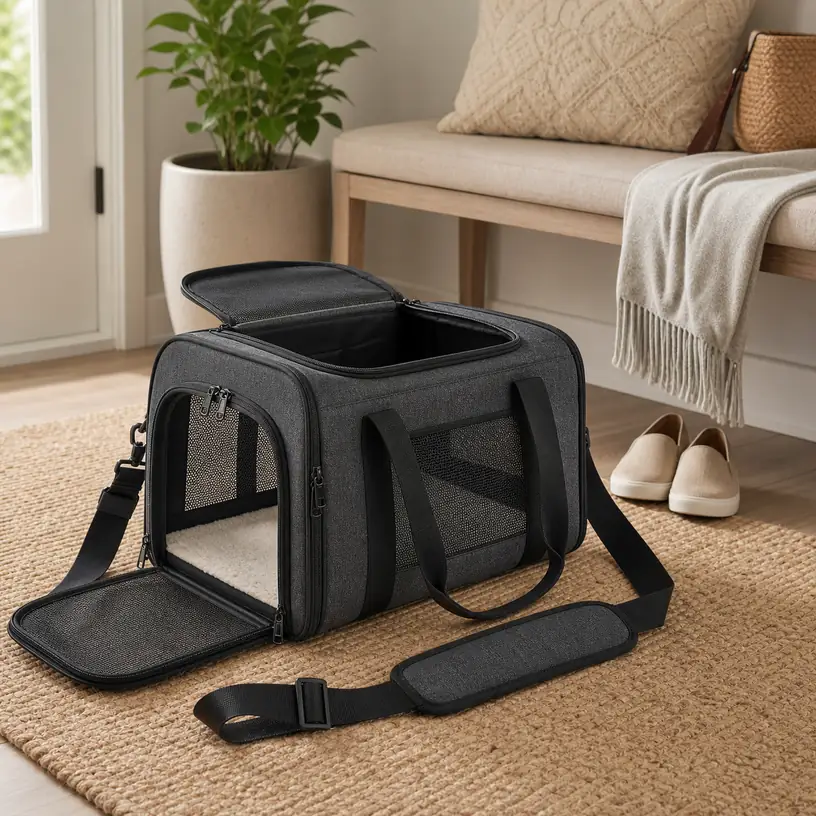
Illustrative image, not an official product photo.
Short answer
For routine vet visits, a soft-sided cat carrier should let the cat stand in a natural position, turn around, and lie down without leaving so much empty space that the interior feels unstable during movement. Measure the cat rather than relying on a broad weight label, then compare usable interior dimensions, top and side access, the firmness of the floor, zipper security, ventilation, and the way the carrier can be supported with two hands. A removable top or wide top entry can give a veterinarian another route to the cat, while a rigid insert under a washable pad helps prevent the carrier from folding around the animal. Confirm vehicle placement and restraint guidance separately; soft fabric and a shoulder strap do not make a carrier crash-tested.
Search reference
Soft-sided cat carriers for vet visits
Compare usable interior measurements, opening layout, mesh coverage, floor support, closures, cleaning instructions, and safe handling for your cat's usual trip.
View matching optionsStart with the cat, doorway, and route to the car
Carrier shopping is often reduced to maximum pet weight, but weight says little about body length, shoulder height, or the room a cat needs to change position. Measure from the nose to the base of the tail while the cat is standing naturally, and note the height to the top of the head or ears. Compare those numbers with the usable interior, allowing room for the floor pad and any inward-sloping walls. Exterior dimensions can include pockets, handles, and framing that do not benefit the animal.
Then walk the real route from the room where the carrier will be loaded to the vehicle or clinic. Check narrow doorways, stairs, building elevators, and the vehicle door opening. A carrier that fits the cat but collides with every stair rail will be awkward to keep level. If two people normally travel together, decide who carries the cat and who manages doors, paperwork, or other pets before the appointment day.
The best opening arrangement depends on how the cat enters and how clinic staff can access the animal. A wide top entry can make it easier to lower a calm cat while supporting the body. A large end or side door allows the carrier to remain on a stable surface during entry. Multiple openings provide options, but each one also adds zippers and seams that need inspection.
Floor support matters more than plush padding
A soft carrier still needs a stable base. Look for a removable insert that spans the floor without a large gap at the edges. Lift the empty carrier by its handles and watch whether the bottom bows. A pad can improve traction and absorb a small accident, but thick padding cannot compensate for a weak insert that flexes under the cat.
The floor assembly should be easy to take apart and put back correctly. Check whether the fabric cover, pad, and structural board have separate care instructions. A cardboard-like insert may have different cleaning limits from a plastic panel, and listing photos alone may not identify the material. Verify current construction details rather than assuming that every removable base can be washed as one piece.
Give the cat a predictable surface. A loose blanket can bunch near the door or cover part of a ventilation panel, so trim the setup to the available floor and avoid filling the carrier with bulky bedding. If the cat has a history of urinating or vomiting in transit, discuss preparation with the veterinary clinic and choose a floor configuration that can be removed without forcing hands close to a frightened cat.
Openings, mesh, and closures work as a system
Mesh panels should provide airflow and let you observe the cat, but more exposed mesh is not automatically calmer. Some cats settle when part of the carrier is visually covered, provided ventilation remains unobstructed and the added cover cannot overheat the interior. Look at the location of each panel and confirm that pockets, luggage sleeves, flaps, or your hand position will not block it.
Inspect how doors close. Zipper pulls that meet at one point may be easy to operate, but a determined paw can sometimes work at a gap. Check for a purpose-built way to secure paired pulls without improvising a cord that could create a snag. Clips, buckles, and locking features should close completely and remain reachable to the caregiver. Test every closure at home before the cat enters.
A small interior tether is sometimes shown as a convenience feature. Do not attach it to a cat’s collar, and do not assume it is a travel restraint. Follow the product instructions and veterinary guidance. Loose straps or hardware inside the occupied space should not create an entanglement point.
Who this is for
- Cat caregivers preparing for routine veterinary appointments or short, planned transfers.
- Households that need a carrier lighter and easier to store than many rigid-shell designs.
- Cats that can remain safely contained behind fabric, mesh, and zippered closures without chewing or forcefully clawing through them.
- People who want top and side access options so the carrier can accommodate different loading approaches.
- Apartment residents who must carry the cat through hallways, stairs, or elevators and can keep the base supported.
- Buyers willing to leave the carrier open at home so it becomes a familiar object before travel.
Who should skip it
- Skip a soft carrier if the cat persistently bites, claws, or pushes through mesh, fabric, zippers, or seams.
- A cat requiring a more protective enclosure, medical support, or a clinic-directed transport setup may need a different design.
- Do not choose a model that forces the cat to crouch continuously or cannot support the body without sagging.
- Avoid carriers that cannot be positioned in the vehicle according to the carrier instructions and vehicle manual.
- Air travel involves carrier-specific and airline-specific rules that can change; a carrier chosen for vet trips should not be assumed suitable for a flight.
- A caregiver who cannot lift and stabilize the occupied carrier should arrange help or compare an appropriate alternative rather than relying on a shoulder strap alone.
What to verify before buying
- Usable interior fit: Compare interior length, width, and height with the cat’s standing and resting dimensions, not just a weight range.
- Door geometry: Check the fully open dimensions of each top, end, or side entrance and whether the panel stays out of the way during loading.
- Floor construction: Identify the structural insert, edge support, pad attachment, and how much the base flexes when occupied.
- Closure security: Review zipper paths, paired-pull retention, clips, seams, and any gaps a paw or nose could work against.
- Ventilation: Confirm mesh location on all sides and how ventilation changes when the carrier is carried, placed in a vehicle, or partially covered.
- Handle attachment: Look at where short handles and shoulder-strap hardware connect to the body, and verify the stated load guidance.
- Vehicle instructions: Read both the carrier directions and vehicle manual for placement and securing; a luggage sleeve or strap loop is not proof of crash performance.
- Cleaning sequence: Check which parts are removable, which can be washed, and how the insert, pad, mesh, and seams must be dried.
- Storage shape: If the carrier folds flat, confirm how it is restored to its intended structure and whether braces or inserts can be misplaced.
- Condition on arrival: Inspect mesh, stitching, zipper stops, clips, handles, wire framing, and interior surfaces before introducing the cat.
Carrying and vehicle setup deserve a rehearsal
Load the carrier on the floor rather than holding it in midair. Once the door is closed and every zipper is secured, support the base with one hand while using the handles with the other. Keep the carrier level and close to the body. A shoulder strap can free one hand briefly, but an occupied soft carrier may tilt or swing if supported from a single point.
Practice with a weighted object before the first trip to learn how the base behaves on stairs and around corners. Do not rehearse by repeatedly loading a reluctant cat. Instead, let the empty carrier remain in a familiar room, place ordinary bedding or a familiar-smelling pad inside when appropriate, and allow voluntary exploration without turning every approach into a departure.
In the vehicle, use a stable location permitted by the manufacturer and vehicle guidance. Keep the carrier away from active airbag deployment zones, direct sun, heating vents, and loose cargo. Do not open it outdoors or inside an unsecured vehicle, even if the cat appears calm. When you reach the clinic, carry the enclosure from below rather than treating a long strap as the only support.
Make clinic access part of the buying decision
A carrier is not only a container for the drive. It becomes part of the examination process. Some soft carriers allow the top panel to open broadly; others have a removable or unzippered upper section. That can let clinic staff assess a cat while it remains on the padded base, depending on the cat, carrier, and clinic procedure. Ask your veterinary clinic what features they find practical before purchasing for a cat that becomes highly fearful during handling.
Avoid products that depend on a tiny doorway for every interaction. Reaching through a narrow opening can put the caregiver’s hands directly in front of a stressed cat and makes it harder to support the body evenly. At the same time, an abundance of panels is only useful if the carrier remains structurally stable after one is opened.
Label the carrier in a way that does not obstruct ventilation or closures. Keep current contact information available, but do not hang tags or accessories inside where they could snag. Bring any clinic-requested records separately so the exterior pockets are not overfilled and pressed into the cat’s space.
Cleaning and storage after the appointment
Remove loose fur and debris before using moisture, then follow the care directions for each component. Pay attention to zipper tape, mesh edges, pad seams, and the channel where a floor insert sits. Surface wiping may not be enough after urine, feces, vomit, or a contagious illness; ask the clinic about appropriate cleaning and replacement when needed.
Dry every layer fully before reassembly. Moisture can remain between the pad cover and insert even when the visible surface feels dry. Check that the structural panel lies flat, the pad does not slide, and all folding braces or frames return to their intended position.
Store the carrier where it can stay clean and where the cat can encounter it safely between trips. Frequent folding saves space but adds setup steps, so inspect the shape and closures every time it is unfolded. Replace the carrier if mesh tears, a zipper separates, the frame deforms, the base loses support, or cleaning can no longer restore a usable surface.
Limitations
- Soft walls provide less rigid protection from crushing, impact, and falling objects than a compatible hard-shell enclosure.
- Weight ratings do not establish interior comfort, door fit, handle durability, or suitability for a particular cat.
- Mesh improves airflow but can be damaged by teeth, claws, abrasion, or a failed seam.
- A flexible base may sag even when the cat is below the stated load limit.
- “Airline approved” wording does not guarantee acceptance by a specific airline, route, aircraft, or current policy.
- Shoulder straps, luggage sleeves, and seat-belt loops do not by themselves establish crash-tested performance.
- An anxious or medically unwell cat may need transport planning from a veterinarian rather than a different carrier feature.
- No carrier removes the need to inspect closures, support the base, control doors, and supervise the trip.
Alternatives to compare
A two-piece hard-shell carrier may provide firmer walls and a base that is easier to wipe, and some models allow the top to be removed for clinic access. It is usually bulkier to store and can be awkward on stairs. A carrier with a removable full top can reduce the need to pull a cat through a small door, provided every fastener closes securely after reassembly. A pet stroller with a secure internal enclosure may help a caregiver who cannot carry a suitable load, but it brings wheel, doorway, vehicle-storage, escape, and clinic-space considerations. For a cat with severe travel distress or mobility needs, ask the veterinary clinic about preparation, timing, handling, and the most appropriate enclosure rather than changing equipment without guidance.
FAQ
Is a soft-sided carrier large enough if my cat is under its weight limit?
Not necessarily. The cat still needs usable length, width, and height for a natural standing posture, a turn, and a resting position. Compare the measured cat with the interior dimensions after the floor pad is installed; treat weight as only one limit.
Is a top-opening carrier easier for a cat that resists the front door?
It can provide another loading route and may allow more even body support, but the opening must be wide enough and the carrier must rest on a stable surface. Do not suspend the carrier while lowering the cat, and ask the clinic about handling advice for a cat that panics or becomes aggressive.
Can I secure a soft cat carrier with the vehicle seat belt?
Only use a belt path or securing method specifically described by the carrier maker and compatible with the vehicle manual. A loop shown in a product photo does not establish crash protection. Keep the carrier out of airbag deployment areas and follow current instructions for placement.
Should I cover the mesh panels during a vet trip?
Some cats appear calmer with less visual exposure, but ventilation must remain open and temperature must stay safe. Use only a breathable, securely placed cover when appropriate, monitor the cat, and never wrap the carrier so tightly that airflow is reduced.
How do I clean a carrier after an accident?
Separate the pad, cover, and structural insert as directed, remove debris, and follow the stated cleaning method for each material. Dry all hidden layers completely before reassembly. Ask the veterinary clinic for cleaning guidance after a contagious illness or when ordinary care instructions seem insufficient.
Can I use the same soft carrier for airline travel?
Do not assume so. Airline rules, aircraft space, route restrictions, documentation, and carrier requirements can differ and change. Confirm the exact current policy directly with the airline before travel, even when a listing uses airline-related wording.