Rolling Pins for Home Baking: Match the Shape to the Dough
Product links are for reference. Verify current details on the retailer page before buying.
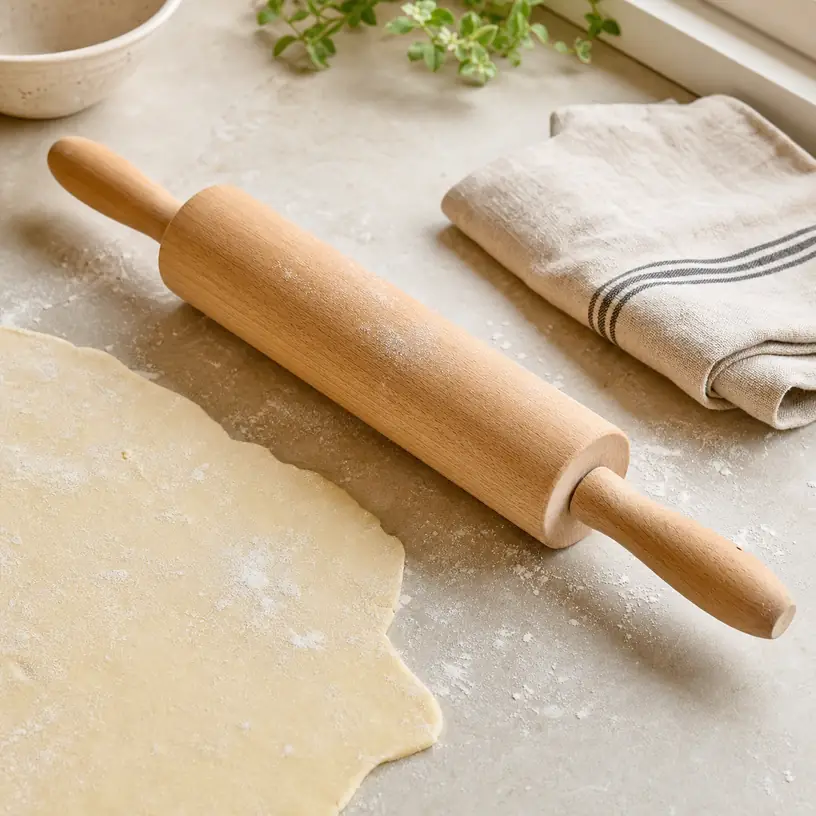
Illustrative image, not an official product photo.
Short answer
A useful rolling pin should suit both the dough you make and the clear counter space you have. A straight dowel gives the hands direct feedback and offers one continuous rolling surface. A handled pin keeps the hands in a familiar position while the barrel turns, but its bearings, handles, and axle add parts to inspect and clean. Tapered pins are easy to steer through curves, while straight sides help when you want an even strip or broad sheet. Compare usable rolling length rather than total length, then consider diameter, weight, surface texture, care instructions, and where the pin will live between baking sessions.
Search reference
Rolling pins for home baking
Compare dowel, tapered, and handled designs against your work surface, usual batch size, preferred grip, cleaning routine, and storage space.
View matching optionsBegin with the dough, not the material
A rolling pin is simple enough that material can dominate the shopping page, but shape and working dimensions usually make a better first filter. Think about the task that sends you looking for the pin. Large batches of cookies need enough usable length to cross a broad piece of dough without leaving repeated ridges. A small pastry round benefits from control when turning and thinning the edges. Pizza, flatbread, pasta, decorative dough, and laminated pastry each place different demands on the tool and may also call for recipe-specific technique.
Measure the uninterrupted counter or board area where you actually roll. Include the room required for your hands, not just the dough. A pin that looks compact in isolation can become awkward beside a wall, sink, appliance, or raised board edge. Conversely, a very long tool may add no practical rolling area if its ends constantly hit nearby objects. If you use a rimmed board or a pastry mat, check how the pin’s handles or tapered ends interact with those boundaries.
Then note the largest sheet you make regularly. The relevant product dimension is the barrel or central working section that touches the dough. Overall length may include handles, rods, knobs, or narrow tapers that do not provide the same contact. Listings do not always label these dimensions consistently, so compare diagrams and current specifications carefully.
Who this is for
- Home bakers replacing a short bottle, glass, or improvised roller with a dedicated tool.
- Cookie and pastry makers who want a working length suited to their usual batch rather than the largest pin that fits a cabinet.
- Cooks choosing between the direct feel of a dowel and the separate grips of a rotating handled pin.
- Bakers who need a second pin for a different task, such as a tapered shape for round dough alongside a straight pin for broad sheets.
- Anyone reorganizing a small baking station and willing to measure the counter, drawer, or hanging space before buying.
Who should skip it
- Skip an oversized pin if most of your work is a single small crust or a narrow strip of dough on a compact board.
- Do not choose a heavy stone or metal option solely for appearance if lifting, stopping, or storing it would be uncomfortable.
- Avoid an unfinished wooden tool if your routine requires soaking or machine washing; follow the stated care method for the actual pin instead.
- A pin with thickness rings is a poor match when the ring settings do not correspond to the recipes you follow or when the guides reduce usable width too much.
- If limited hand movement makes two-handed rolling difficult, consider whether a press, pasta machine, or another task-specific tool would be easier to use.
What to verify before buying
- Usable rolling length: Distinguish the dough-contact area from the complete end-to-end measurement.
- Body shape: Confirm whether the working surface is straight, gently tapered, or shaped in another way and decide how that suits your common dough.
- Maximum diameter: A thick dowel changes hand position; measure a familiar cylindrical item if the listed diameter is hard to visualize.
- Weight: Check the actual stated weight and consider both downward pressure during rolling and the effort required to lift and reposition the pin.
- Grip and movement: For handled models, look at handle size, clearance, axle construction, and whether the barrel is intended to rotate freely.
- Surface and seams: Inspect descriptions for coatings, texture, joints, engraved measurement marks, or crevices where flour and dough could collect.
- Care instructions: Verify washing, drying, conditioning, rust-prevention, dishwasher, and temperature guidance for the specific construction.
- Guide rings: Check included thicknesses, measurement units, how firmly the rings attach, and how much rolling width remains between them.
- Storage: Measure the full tool, including handles, and confirm whether any hanging feature is intended to support its weight.
Straight dowel, tapered pin, or rotating barrel?
A straight dowel is one solid cylinder or a cylinder-like body without separate handles. Your palms move across its surface while rolling, so pressure and dough thickness can be felt directly. Its uninterrupted length is useful across wide sheets, and the lack of an axle means fewer moving joints. The tradeoff is that a thick or slick dowel may feel unfamiliar, especially to someone accustomed to holding handles. Diameter, surface finish, and the user’s hand size all affect comfort.
A tapered pin narrows toward the ends. Moving one hand through a slightly longer stroke can help steer the pin around a circular piece of dough. That makes the form appealing for pie and other round work, though technique still matters. Because the ends narrow, only the center offers the maximum diameter and pressure profile. Look for a clear drawing of the taper and total working length instead of assuming all tapered pins have the same proportions.
A handled rolling pin has a barrel that turns around a central rod or axle while the hands hold separate grips. It can feel intuitive for long back-and-forth passes and keeps flour off the palms. The barrel length, not the distance across the handles, determines the broadest uninterrupted pass. Check that your fingers have clearance from the counter and that the handles suit your grip. Bearings or bushings should move as described, but the care instructions may limit soaking or dishwasher use because water and residue can reach the joints.
None of these designs is automatically the right one for every baker. If possible, mimic the hand position with objects of similar diameter before ordering. A straight cardboard tube can suggest whether a dowel feels too thick, while the handles of an existing kitchen tool can help you judge grip length. This will not reproduce weight or balance, but it can expose an obvious mismatch.
Material changes weight, feel, and upkeep
Wood is common because it offers a warm grip and a surface that is neither identical to polished metal nor stone. Species, grain, finish, and construction vary, so broad material labels do not define care. Confirm whether a particular pin is sealed, unfinished, laminated, or made from one piece, and follow its cleaning and conditioning directions. Wood should not be assumed dishwasher-safe, and prolonged soaking can be unsuitable. Inspect a new pin for rough areas or damage before it touches food.
Metal pins can have a smooth surface and may be designed to cool before use, but construction matters. A hollow pin and a solid pin will not feel alike, and not every product is intended for refrigeration or freezer exposure. Verify the stated material, seams, end caps, filling instructions if any, and cleaning guidance. Condensation can affect flour and dough behavior, so a cold surface is a technique choice rather than a universal advantage.
Stone pins often emphasize mass and a cool-feeling surface. That weight can provide steady pressure, yet it also makes the tool harder to stop, lift, and move to a sink or shelf. Stone can chip or damage another surface if dropped, and handles, axles, or stands may need separate care. Check the complete weight rather than judging from photos, and plan a low, stable storage location.
Silicone-covered or synthetic-surface pins may be marketed around release and cleanup, but coatings are not all the same. Review food-contact wording, temperature limits, seam construction, permitted cleaning methods, and what lies beneath the outer surface. Even a low-stick surface may still need flour according to the recipe, and soft coatings can be vulnerable to cuts or abrasion from nearby utensils.
How weight and diameter affect a rolling session
A heavier pin contributes more downward force before you deliberately press. That may help with firm dough, but it can also thin soft areas faster than expected or make frequent lifting tiring. A light pin is easier to reposition and can offer delicate control, though the user supplies more of the working pressure. Neither description establishes quality. Match mass to the dough, the length of the session, and what is comfortable for the person doing the baking.
Diameter changes leverage and hand posture. A slim pin can be nimble for small pieces but may require more revolutions or shorter strokes. A large-diameter dowel raises the hands farther above the counter and can cover distance smoothly, while also demanding a broader grip. Handled pins need enough clearance beneath the grips so knuckles do not brush the worktop.
Balance is difficult to judge from a single listing image. On a dowel, consistent shape and material distribution matter. On a rotating model, the barrel should remain centered and move without the handles loosening during normal use as defined by its instructions. Check the return terms before buying when weight, grip, or movement cannot be assessed in person.
Thickness rings and measurement marks
Removable guide rings lift the main barrel above the counter to target a nominal dough thickness. They can help with cookies and crackers when uniformity matters, but they only work while both rings stay on a level surface. A small board, mat edge, pile of flour, or counter seam can tilt the pin. Rings also reduce the effective width available for dough, and soft pieces may shift or compress differently under pressure.
Compare the included ring sizes with your recipes and confirm whether dimensions are shown in inches, millimeters, or both. If the listing provides only color coding, consider how you will identify the rings later. Check how they attach, whether replacements are available, and whether the pin can be used comfortably without them.
Printed or engraved ruler marks may help estimate width, but their location can also create texture where dough touches the pin. They do not measure thickness unless the product includes a separate mechanism for that purpose. Treat markings as a convenience to verify, not a substitute for a ruler, dough guides, or the recipe’s visual and tactile cues.
Cleaning and storage deserve a plan
Remove dough according to the maker’s instructions rather than reaching immediately for a sharp scraper that could gouge wood or cut a coating. Pay attention to the ends of a dowel, the edge of a sleeve, and the gaps beside rotating barrels. Flour can hide in joints even when the central surface looks clean. Wash only by the stated method, dry thoroughly, and apply any recommended maintenance at the specified interval.
Storage should protect the rolling surface from knife edges, moisture, falls, and the weight of other cookware. A long pin tossed into a crowded utensil drawer can jam the drawer or damage its surface. A stable shelf, deep drawer, or suitable hanging point can work, but verify that a loop or handle is designed for hanging. Heavy pins are generally better kept low, where a slip has less distance to travel.
If a pin comes with a stand, include the stand’s footprint in your measurement. Counter storage keeps the tool accessible but also exposes it to cooking splatter and sunlight. A cloth bag may reduce dust while trapping moisture if the tool is put away before it is fully dry. The simplest safe storage method is the one you can follow after every baking session.
Limitations
- One rolling pin may not feel equally controlled on tiny pastry rounds, broad cookie sheets, firm pasta dough, and soft laminated dough.
- Material names alone do not establish exact weight, surface finish, food-contact construction, or cleaning requirements.
- Guide rings target a spacing from the counter but cannot correct an uneven surface or guarantee uniform dough after it springs back.
- A cold pin does not replace recipe temperature control, and condensation may alter how the dough and flour behave.
- Handles and rotating parts add grip options but also create joints that need inspection and product-specific care.
- The comfortable weight and diameter for one baker can be tiring or awkward for another, particularly during large batches.
Alternatives to compare
- Dough guide strips used with an existing straight pin when repeatable thickness is the main concern.
- A compact pastry roller for small pans, edges, or limited work areas.
- A tortilla or dough press for recipes designed around pressing rather than rolling.
- A manual pasta machine for creating repeatable narrow sheets appropriate to the recipe.
- A clean, suitable cylindrical substitute for occasional use, provided its material, surface, and shape are safe for food preparation.
FAQ
Is a dowel or handled rolling pin easier for beginners?
It depends on the grip that feels natural. A handled pin separates the hands from the moving barrel, while a dowel places the palms directly on the tool for immediate pressure feedback. Compare diameter, weight, usable length, and hand position rather than treating either style as universally easier.
What length rolling pin should I choose for cookies?
Measure the widest sheet of cookie dough you normally roll and the clear width of your work area. Then compare that with the pin’s usable rolling surface, not just its overall length. Leave room for both hands and for repositioning the dough without striking nearby objects.
Does a marble or metal rolling pin need to be chilled?
Only if the specific product instructions and the recipe support chilling. Confirm permitted temperatures and cooling methods first. A cool pin can gain condensation, and temperature-sensitive dough still requires appropriate handling of the ingredients, room, and work surface.
Are rolling pin thickness rings accurate?
Rings can establish a nominal gap when both ends travel on the same flat surface. Their result can be affected by an uneven counter, a mat edge, flour buildup, dough spring-back, or rings that shift. Verify the ring dimensions and check the dough with the method your recipe recommends.
Can a wooden rolling pin go in the dishwasher?
Do not assume so. Wood construction and finishes vary, and heat, prolonged water exposure, and detergent may be unsuitable. Follow the current care instructions for the exact pin; hand cleaning and prompt drying are common requirements but still need product-specific confirmation.