A Battery Organizer Case for the Junk Drawer: Capacity, Layout, and Safety Notes
Product links are for reference. Verify current details on the retailer page before buying.
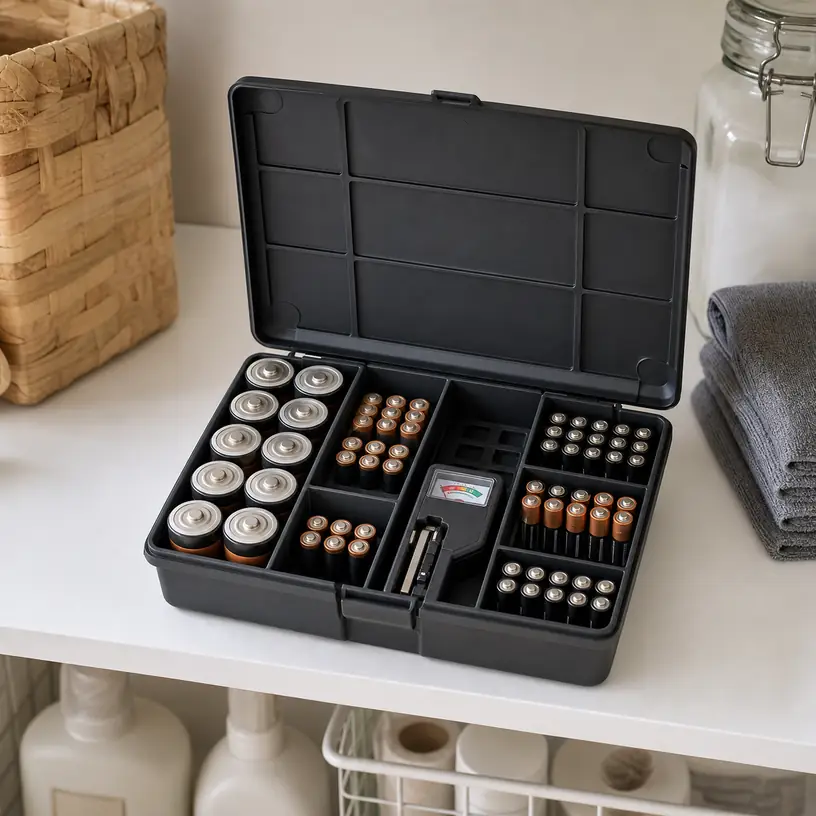
Illustrative image, not an official product photo.
Short answer
A battery organizer case is useful when loose household batteries are scattered between a junk drawer, tool box, and utility shelf. Choose around the cell sizes you actually keep—not the largest advertised total capacity. The most practical case will fit its storage location, hold each battery securely enough to prevent a jumble, leave room to separate fresh cells from used ones, and open without spilling its contents. A built-in or removable tester can be convenient, but its supported battery types and required operating steps need to be checked rather than assumed.
Search reference
Household battery organizer case options
Compare current layouts for AA, AAA, 9V, C, D, and coin-size cells, then check closed dimensions, latch design, tester details, and whether the case is intended for a drawer, wall, shelf, or travel kit.
View matching optionsCount the batteries you keep, not the empty slots in a photo
Battery organizers often emphasize total capacity, but the shape of that capacity matters more. A household that mainly uses AA and AAA cells for remotes, toys, flashlights, and computer accessories needs a different layout from one that also keeps 9V, C, D, camera, or coin-size batteries. Before shopping, gather the unopened and loose cells you already own and make a quick count by size. That five-minute inventory can prevent buying a large case with many compartments you will never use and too few slots for the batteries you replace most often.
Also consider how quickly your supply turns over. A compact drawer insert may be enough if you replenish batteries in small packs. A deeper hard-sided case can make sense for storm supplies, multiple children’s toys, seasonal decorations, or a workshop, but extra capacity can encourage keeping old cells long after their history is clear. Organization should make rotation easier, not simply hide a bigger stockpile.
The case format changes the routine. Flat organizers are easy to scan in a shallow drawer. Upright cases use less shelf width but may require removing batteries from rows to see what remains. Carrying cases add a handle and closure for moving supplies between rooms. Wall-mountable designs free drawer space, although mounting hardware, loaded weight, and placement need careful review.
Who this is for
- Households that regularly use several sizes of replaceable batteries and want one known storage location.
- Parents organizing batteries for toys while keeping the case in an appropriate place that children cannot access.
- People building a labeled utility shelf, storm-supply cabinet, workshop drawer, or home maintenance kit.
- Anyone who wants to separate fresh batteries from cells awaiting proper recycling or disposal.
- Buyers who would use a compatible tester to check an uncertain battery before discarding or installing it.
Who should skip it
- Skip a large organizer if you only keep one small unopened pack at a time; the original packaging may already be the simpler storage method.
- Do not treat a basic household organizer as protection for damaged, leaking, swollen, recalled, or unusually hot batteries.
- Avoid open trays in areas accessible to young children or pets, especially when coin or button cells are present.
- Choose storage designed for your specific rechargeable battery system if cells need matched sets, charging records, or specialized transport protection.
- Do not use a general organizer as a shipping container unless its current documentation explicitly supports that use and applicable carrier rules are followed.
What to verify before buying
- List the exact battery sizes you own and compare that mix with the number of dedicated slots for each size.
- Measure the organizer’s closed length, width, and height against the drawer, cabinet, shelf, or wall area where it will live.
- Check whether batteries snap into individual recesses, slide into channels, or sit loosely beneath a lid.
- Review the closure, hinges, handle, and orientation to judge what could happen if the loaded case is picked up or stored vertically.
- Confirm which battery types an included tester supports, whether it is removable, and how its readings are described in the instructions.
- Look for a practical way to distinguish fresh cells from used, uncertain, or rechargeable ones; separate compartments or your own labels can help.
- Verify whether wall-mount hardware is included and suitable for the wall and loaded weight rather than relying on the empty-case weight.
- Read the current care and safety guidance for both the organizer and every battery type you plan to store.
Drawer, shelf, wall, or carry case?
For a kitchen or office junk drawer, outside dimensions are the first filter. Measure the drawer at its narrowest usable point and account for screw heads, curved sides, dividers, and items stored above the organizer. A case that technically fits may still jam if its handle or latch catches the drawer frame. Check closed height as well as the footprint.
A shelf case benefits from a clear or easily scanned lid, but visibility should not override placement. Store batteries in a cool, dry location away from direct heat, moisture, metal clutter, and curious children. A strong handle is useful when the organizer must move, yet the latch and hinge become more important when a full case is carried. Look at how the batteries are retained if the case is turned upright rather than judging it only while flat.
Wall storage can keep a crowded workbench clear. It also concentrates the weight on the mounting points, so confirm the intended mounting method and choose hardware appropriate for the wall. Place the organizer where it will not be knocked, heated, splashed, or mistaken for something children may open. If a design can be used either flat or wall-mounted, check whether cells remain secure in both orientations.
Portable organizers work best when every cell has a defined recess and the lid closes without pressing on the battery terminals. If you only need a few spares for a flashlight or camera, a smaller battery holder may be more appropriate than carrying a household-size assortment. Air travel and shipping can involve battery-specific restrictions, so a convenient handle does not automatically make a case suitable for those purposes.
Slot design and sorting habits
Individual recesses make remaining quantities easy to see and reduce the chance that loose batteries roll together. They can also be frustrating when tolerances are tight or when wrapped rechargeable cells differ slightly from common disposable-cell dimensions. Product photos may suggest a fit without documenting it, so check current dimensions and compatibility wording, especially for less common sizes.
Coin and button cells require particular care because their small size presents a serious ingestion hazard. A shallow open pocket is not the same as child-resistant storage. If your household uses these cells, consider keeping them in intact original packaging or another secure, appropriately placed container rather than assuming every mixed battery organizer is suitable.
Sorting by condition is just as important as sorting by size. Avoid mixing fresh and used cells in one unlabeled row. A small removable bin or a separate clearly marked container can hold depleted batteries until they are taken to a collection or disposal location that follows local guidance. Damaged or leaking batteries need handling based on the battery manufacturer’s instructions and local requirements, not routine storage in the organizer.
Rechargeable and single-use cells can look similar at a glance. Dedicated rows or simple labels reduce mix-ups, particularly when several people replace batteries around the home. If devices require matched sets, keep those sets grouped in a way that preserves their identity rather than scattering them across open slots.
Is an included battery tester worth having?
A tester can help when a loose battery has an uncertain history or when a device stops working and you want to narrow down the cause. Convenience depends on access: a removable tester is easier to hold against some cell types, while a fixed tester is harder to misplace. Neither format is useful unless it supports your batteries and its instructions explain how to position them and interpret the display.
Tester results are not a complete assessment of battery condition, remaining runtime, or safety. Different devices place different demands on cells, and a simple reading may not predict performance under load. Never test a battery that appears damaged, leaking, swollen, corroded, or unusually warm. Follow the battery and tester manufacturers’ current instructions, and keep contact points from becoming another place where loose metal items collect.
Limitations
- Advertised capacity may count many slots for sizes you rarely use and very few for the sizes you buy most often.
- Plastic latches, hinges, handles, and tight-fitting recesses can wear, so current construction details and return terms are worth checking.
- An organizer can reduce clutter but cannot make damaged batteries safe or replace battery-specific handling guidance.
- Mixed-format cases may not fit every rechargeable cell, specialty battery, protected cell, or battery still in retail packaging.
- A tester provides limited information and should not be treated as a guarantee of remaining runtime or battery condition.
- A portable-looking case may still be unsuitable for air travel, mailing, or other transport governed by specific battery rules.
Alternatives to compare
- Original retail packaging for a small supply that turns over regularly.
- A shallow labeled drawer insert when batteries never need to leave one cabinet.
- Small rigid battery holders for flashlight, camera, camping, or emergency-kit spares.
- Separate containers for rechargeable sets when charge cycles and pairing matter.
- A dedicated, clearly marked collection container for spent cells awaiting recycling or disposal according to local guidance.
FAQ
Should batteries stay in their original packaging?
Original packaging can be a sensible choice for a small supply because it keeps battery types identified and terminals separated. An organizer becomes more useful when you maintain several opened packs or sizes, provided the cells are stored according to their current manufacturer guidance.
Can I mix rechargeable and single-use batteries in one organizer?
They can share a case only if they remain clearly separated and identified. Do not mix rechargeable and single-use cells within a device, and preserve matched rechargeable sets when the device or charger instructions call for them.
Is a battery organizer child-resistant?
Do not assume it is. A latch or zipper intended to stop spills may not be child-resistant, and coin or button cells present a serious ingestion hazard. Store the entire organizer in an appropriate location inaccessible to children and follow product-specific safety guidance.
How should I separate fresh batteries from used ones?
Use different labeled rows, compartments, or containers so uncertain and depleted cells cannot drift back into the fresh supply. Keep batteries awaiting recycling or disposal in a setup consistent with local rules and manufacturer instructions.
Does every battery tester work with rechargeable batteries?
No. Supported chemistries, sizes, voltage ranges, and reading methods vary. Check the tester’s current documentation for the exact cells you own, and do not rely on a simple reading as a full measure of condition or remaining runtime.