Choosing a Purse Organizer Insert That Fits Without Swallowing the Bag
Product links are for reference. Verify current details on the retailer page before buying.
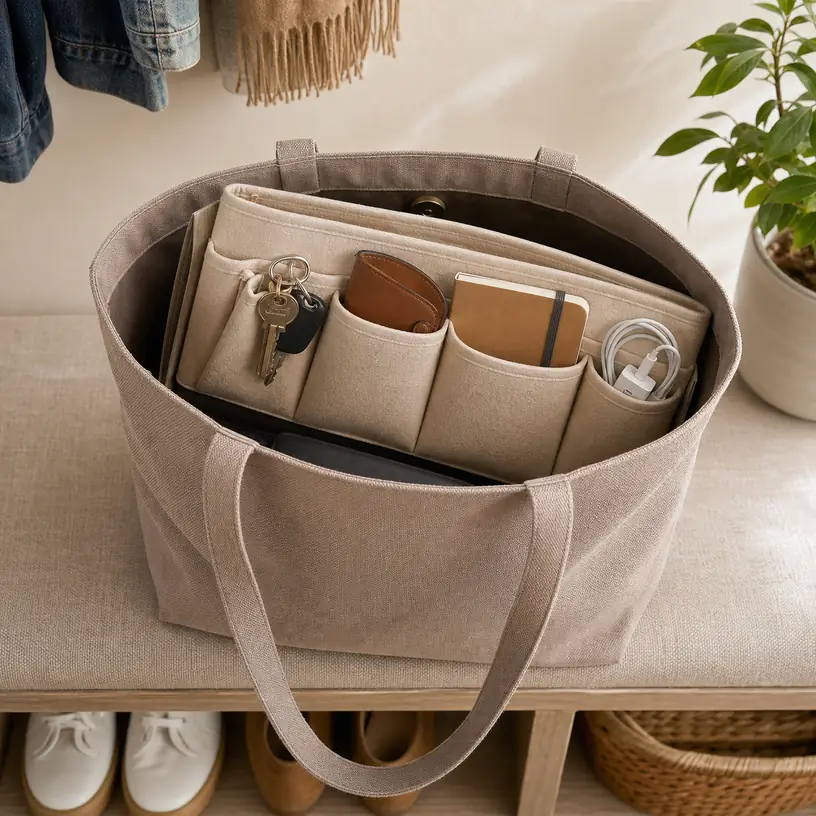
Illustrative image, not an official product photo.
Short answer
A purse organizer insert works best when it leaves enough room for the bag to close, flex, and sit comfortably rather than filling every available inch. Measure the usable interior at the base, the narrowest point, and the opening—not just the bag’s advertised outside dimensions. Then map your daily items to the pocket layout, paying particular attention to bottle compartments, zipper access, key attachment points, and objects that are too bulky for small pockets. Compare the insert’s empty weight, wall stiffness, handles, removable sections, and care instructions. The goal is a layout you can see and transfer easily, not the largest possible number of compartments.
Search reference
Purse organizer insert options
Compare outside dimensions, wall structure, pocket openings, empty weight, transfer handles, and cleaning guidance against a bag you already use.
View matching optionsEmpty the bag before measuring it
Handbag size labels are an unreliable shortcut for insert fit. Two totes described with similar outside dimensions can have very different interiors because of thick seams, a tapered profile, a recessed zipper, a structured base, or a lining that hangs inward. An insert selected from the bag’s widest outside measurement may buckle at the corners or prevent the top from closing.
Start by removing everything, opening the bag fully, and checking how the interior changes from bottom to top. Measure the flat usable length and width at the base without forcing the lining outward. Then measure the interior height to the lowest closure, zipper track, snap, or inward-folding section. If the bag narrows near the top, record that narrower span too. The insert has to pass through the opening and sit below the closure, not merely fit the floor.
A simple cardboard mock-up can reveal more than a size name. Fold a strip or small open box to the listed insert dimensions and place it gently inside the empty bag. Do not stretch leather, fabric, seams, or hardware to make the mock-up fit. Check whether the bag can close, whether the handles still fall naturally, and whether there is room to reach any built-in zipper pocket. This also shows how much unstructured space will remain around the insert for a scarf, compact umbrella, or other item that does not belong in a narrow pocket.
Who this is for
- People who regularly lose small items at the bottom of a roomy tote, work bag, or unstructured handbag.
- Anyone who moves a similar daily kit between compatible bags and wants to lift most of it in one step.
- Buyers who prefer removable organization over adding adhesive accessories or permanently altering a bag.
- Bag owners who want frequently used items kept upright, separated, and easier to see.
- Travelers using a personal-item tote who need a predictable place for documents, cables, and small essentials while keeping the main compartment flexible.
What to verify before buying
- Finished outside dimensions: Use the assembled insert measurements, including any protruding handles or pockets, and compare them with the bag’s usable interior.
- Shape at the base and top: Check for tapering, rounded corners, side wings, or a wider upper edge that may not match the bag profile.
- Actual pocket openings: Count alone is not useful; confirm width, depth, gussets, closures, and whether bulky items can enter without distorting nearby sections.
- Insert height: Make sure the organizer sits below the bag’s zipper or snap and does not expose private contents above an open tote.
- Wall structure: Determine whether the insert is soft, reinforced, or intended to stand upright, and consider how that will change the bag’s drape.
- Empty weight: Add it to the weight of the bag and normal contents before deciding whether the finished load will remain comfortable.
- Transfer handles: Check whether they lie flat when not in use, remain reachable when loaded, and interfere with the bag closure.
- Built-in bag access: Confirm that the insert will not cover a key leash, interior zipper pocket, charging pass-through, or other feature you use.
- Removable sections: Verify how dividers or center pouches attach and whether the remaining fasteners will catch on belongings when a section is removed.
- Care instructions: Review the stated textile, reinforcement, spot-cleaning or washing guidance, drying method, and restrictions before putting cosmetics or drinks inside.
Let your everyday items design the pockets
Before comparing listings, arrange your normal bag contents on a table. Group items by how you reach for them, not simply by size. Keys, transit cards, glasses, phone, and lip balm may need one-handed access. Charging cables and backup items can sit deeper. A notebook or tablet needs a broad uninterrupted section rather than several stitched pockets. Receipts and loose papers need a deliberate destination or they will simply migrate around the insert.
Measure a few objects that create fit problems. A wide sunglasses case can be too thick for a flat slip pocket. A bottle may fit by diameter but extend above the insert, where it can tip when the bag moves. A large phone can enter a pocket yet be hard to grasp if the opening is tight. Cosmetics in round cases often occupy more width than their individual measurements suggest when grouped together. Compare these real dimensions with pocket details when provided; do not infer scale from staged photos.
More pockets can make organization worse if every compartment is narrowly assigned. Empty stitched sections consume space and can hide small objects in several possible locations. A useful arrangement often combines a few visible perimeter pockets with one open center. That center can adapt to a lunch container, headphones, folded shopping bag, small camera, or other item whose shape changes from day to day.
Think about orientation too. If you naturally carry the bag on one shoulder, decide which side should hold a phone or keys. A pocket that faces the wrong way may require turning the whole insert. If the organizer includes two similar rows, use one side for items needed outside the home and the other for items used at a desk or destination. A consistent map is often more valuable than a specialized compartment for every object.
Structure changes the bag, not just the contents
Soft inserts conform to irregular bags and take little room when partly empty. They can be easier to move through a narrow opening, but shallow pockets may collapse together and a full bottle can pull one wall inward. Very flexible organizers may need the bag itself to provide support. If the tote is intentionally slouchy, this may preserve its appearance better than a rigid insert.
Reinforced inserts create clearer compartments and can give an unstructured tote a flatter base or more upright sides. That can be useful when you want the contents to remain visible. It also changes the silhouette and may press outward at the corners. Stiff panels can make a soft bag look boxy, increase the distance your hand must travel around the insert, or concentrate pressure on the lining. Match the organizer to the bag construction rather than assuming more stiffness is automatically an upgrade.
Observe how the insert sits when the bag is lifted. A base that fits while the bag rests on a table may shift when the handles pull the sides inward. Leave some breathing room so seams are not held under constant outward pressure. If the bag has feet or a shaped bottom, confirm that the insert does not create an uneven load above them.
Color affects visibility but also care. A lighter interior can make dark objects easier to locate in a deep tote, while a dark textile may show some powders and lint more clearly. Neither choice guarantees easier maintenance. Consider whether the fabric is likely to contact pens, cosmetics, snacks, or a damp umbrella, and follow the stated cleaning instructions rather than assuming a removable organizer is machine washable.
Plan the transfer, not only the storage
One appeal of an insert is moving a familiar set of belongings between bags. For that to work, the other bags need compatible openings, heights, and base shapes. Measure every bag you intend to use instead of choosing an organizer around the largest one and expecting it to serve all of them. A smaller insert can transfer more easily, but it will leave gaps in a large tote; decide whether those gaps are useful or annoying.
Handles make lifting easier only when they remain accessible and support the loaded insert as intended. Low fabric tabs may disappear beneath a notebook. Tall loops can tangle with the handbag handles or get caught in the zipper. Check how the handles fold and whether they crowd the center when not in use. Lift the insert with two hands when appropriate, keep the bag on a stable surface, and avoid treating a pocket or divider as a carrying handle unless it is designed for that purpose.
Not everything should transfer automatically. Remove expired transit slips, opened snacks, unneeded keys, and destination-specific objects instead of allowing the insert to become a portable junk drawer. Keep sensitive documents and valuable items under your control, particularly when moving between open bags. An organizer improves placement; it does not secure an open tote against loss or access.
Weight and comfort still come first
An insert makes unused space easier to fill, which can quietly increase the total carried weight. Check the organizer’s own weight, then weigh or estimate the complete daily load according to your needs. The presence of a bottle pocket is not a reason to carry a larger bottle than is comfortable, and a padded device sleeve does not establish that the bag or its handles are suitable for a particular device load.
Distribute denser objects near the bottom and avoid putting all heavy items along one side. A lopsided insert can twist inside the bag and make a shoulder strap feel less stable. Keep rigid or sharp-edged items from pressing directly against delicate lining. If the bag becomes uncomfortable, edit the contents rather than relying on additional dividers to make the weight feel organized.
Check the loaded bag in normal use: closed, lifted, set on a chair, and carried with the clothing you typically wear. The insert should not force a zipper, push a snap open, or make objects protrude where they can catch. Comfort depends on the entire bag, strap, load, and carrying duration; the organizer cannot correct handles that are too narrow or a bag that is already too heavy.
Who should skip it
- Skip an insert when a compact handbag already has well-placed built-in compartments and little unused interior room.
- Choose simple zip pouches if your daily contents change substantially and fixed pockets would remain empty or constrain larger items.
- Avoid a stiff organizer when preserving a soft bag’s drape is more important than making it stand upright.
- An insert may be a poor match for bags with very narrow openings, unusual curves, central dividers, or closures that sit low inside.
- Do not use an organizer as a substitute for a protective case, approved insulated container, leak-resistant vessel, or secure closure where one is actually needed.
Limitations
- Size labels such as small, medium, and large are not standardized across organizers or handbags.
- Pocket count does not show whether openings and depths suit the objects you carry.
- A structured insert can alter a bag’s silhouette and place pressure on its lining or corners.
- Soft organizers may slump, shift, or lose pocket shape when the bag is partly empty.
- The insert adds weight and can encourage carrying more than is comfortable.
- Transfer handles, zipper sections, and removable dividers can consume usable interior space.
- Fabric care and stain resistance vary; removable does not necessarily mean machine washable.
- An insert organizes belongings but does not make an open bag secure, weatherproof, spill-proof, or protective enough for fragile electronics.
Alternatives to compare
- Two or three zip pouches grouped by task, which adapt easily when contents change but require opening each pouch.
- A small key clip or leash for the single item that repeatedly disappears, provided it attaches in a way intended for the bag.
- A slim document folder for receipts and papers when loose sheets are the main source of clutter.
- A dedicated bottle sleeve that fits the vessel and bag when upright drink storage is the only missing feature.
- A bag with suitable built-in pockets and closure if the current tote’s overall layout, weight, or security is the underlying problem.
- A compact packing cube for occasional travel organization when the insert would not be used during ordinary days.
FAQ
How much smaller should a purse organizer be than the bag?
There is no universal clearance because bags taper, flex, and close differently. Measure the usable interior at the base, the narrowest section, and the opening, then choose an insert that can sit without stretching the lining or obstructing the closure. A cardboard mock-up based on the listed dimensions can help reveal whether enough room remains.
Should the insert be as tall as the tote?
Usually it should remain below the lowest zipper, snap, or folding section and allow you to reach the contents comfortably. A tall insert can add privacy in an open bag, but it may cover built-in pockets or make the bag difficult to close. Compare the finished height with the actual interior rather than the outside bag height.
Is a felt organizer better than a nylon or fabric one?
The material label alone does not determine fit or usefulness. Compare wall stiffness, thickness, empty weight, edge finishing, pocket construction, and care instructions. A reinforced textile may hold its shape, while a thinner fabric may preserve more room and flexibility; the better choice depends on the bag and load.
Can one organizer fit several handbags?
It can if the bags have compatible base dimensions, openings, heights, and closure clearance. Measure each intended bag. An insert sized for the largest tote may not enter a smaller bag, while a compact one may slide around or leave substantial gaps in a larger tote.
Will a purse organizer protect against spills?
Do not assume so. Pockets can keep items separated, but seams, zippers, fabric, and reinforcement may allow liquid through. Use an appropriate closed container for drinks or cosmetics, follow the organizer’s care instructions, and remove spills promptly from both the insert and the bag.