Loose-Leaf Tea Infuser Baskets: Fit, Mesh, and Cleanup
Product links are for reference. Verify current details on the retailer page before buying.
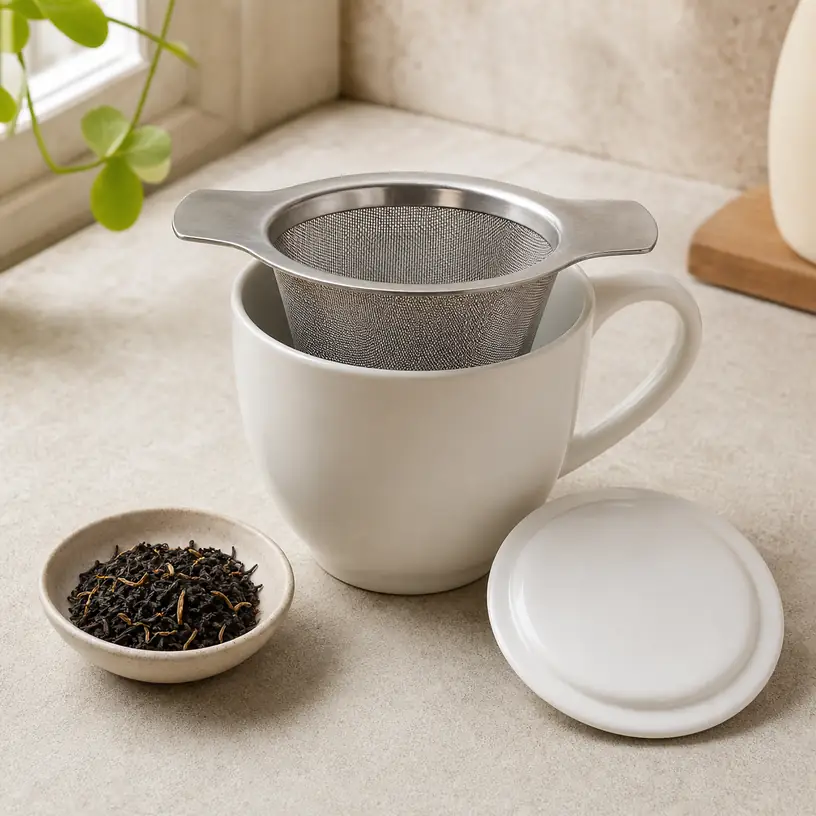
Illustrative image, not an official product photo.
Short answer
For most mug-by-mug brewing, a broad basket infuser is easier to fill and empty than a small tea ball because it gives leaves more room while keeping them contained. The useful dimensions are the ones that connect the basket to your own drinkware: its rim must span the cup opening, its body should sit below the waterline without touching the bottom, and its handles must remain easy to lift. Fine mesh helps with small particles, but a basket also needs open area for water flow and seams that do not trap wet leaves. A lid can reduce heat loss during steeping and may double as a drip rest afterward, provided its shape works both ways.
Search reference
Compare loose-leaf tea infuser baskets
Check rim span, basket depth, mesh construction, lid design, handle clearance, and cleaning guidance against the cups or teapot you already use.
View matching optionsA basket has to fit two spaces at once
An infuser can look compact on a product page and still be a poor match for a favorite mug. It needs to bridge the opening securely while leaving enough of the basket inside the vessel for water to surround the leaves. If the support arms barely catch the rim, an accidental bump can tip the basket. If the basket is too shallow for a tall mug, part of the tea may sit above the water. If it is too deep, its base may press against the cup and reduce circulation around the lowest leaves.
Measure the inside opening of the smallest and largest vessels you expect to use. Then note their usable depth from rim to bottom and whether the lip is unusually thick, flared, or uneven. A handle that works on a straight ceramic mug may interfere with a travel-cup rim or teapot lid. Manufacturer dimensions should be checked carefully because listings may report the full handle-to-handle width rather than the basket diameter that enters the cup.
Capacity is not simply a question of how much dry tea fits inside. Leaves expand as they steep, and different cuts occupy space differently. Leaving room around them generally makes the basket easier to rinse and less likely to overflow when lifted. Choose for your usual serving size and brewing method rather than trying to maximize the stated capacity.
Who this is for
- People who brew one mug or a small pot from loose tea and want a reusable alternative to disposable filters.
- Households with several straight-sided mugs that can share one removable basket.
- Tea drinkers who want to lift the leaves out at the end of a timed steep instead of leaving them in the vessel.
- Anyone who finds a narrow tea ball awkward to load, empty, or scrub around its hinge.
- Small kitchens where a basket, lid, and resting dish can take the place of a dedicated brewing pot.
Who should skip it
- Choose disposable paper filters if containing very fine sediment and minimizing cleanup matter more than reusability.
- Use a teapot with a compatible built-in filter if you routinely brew several servings at once.
- Skip a rigid basket if your everyday vessel has an opening or lid system that does not provide a safe support point.
- Consider a handled strainer used during pouring if you prefer leaves to move freely in the entire pot.
- Avoid buying from photos alone when the listing does not provide enough dimensions to establish cup compatibility.
What to verify before buying
- Basket diameter and depth: Compare the part that enters the vessel—not only the overall dimensions—with your mug or teapot opening and water level.
- Support span: Confirm how far the arms or rim extend and whether they rest securely on both sides without blocking a drinking handle or teapot feature.
- Mesh scale: Look for clear photos and wording about the perforations, especially if you brew small-cut leaves or blends with fine particles.
- Seams and edge construction: Check where mesh joins the frame and whether folded edges, joints, or corners appear accessible for rinsing.
- Lid purpose: Determine whether a lid is included, how it sits during steeping, and whether it is shaped to hold the wet basket afterward.
- Handle temperature and grip: Review the design and current use instructions; do not assume every protruding handle stays cool or is intended for bare-hand lifting.
- Material description: Verify the exact material wording for the basket, frame, lid, and any silicone or plastic parts instead of inferring composition from color.
- Cleaning directions: Confirm whether hand washing or dishwasher cleaning is recommended and whether all pieces separate for care.
Mesh fineness is a tradeoff, not a finish line
A finer screen can retain more small fragments, yet no reusable infuser guarantees a completely sediment-free cup. Very small openings may drain slowly or hold particles against the surface, particularly when tea is densely packed. Larger perforations usually rinse more readily, but tiny leaf pieces and powdered ingredients can escape. Match the filter to what you brew most often rather than assuming the finest-looking mesh is universally superior.
Construction deserves equal attention. An apparently smooth basket may still have a rolled rim or lower seam where damp fragments collect. A reinforced frame can help the basket keep its shape, while excessive interior ledges make it harder to tap leaves into a compost or waste container. Inspect listing images for the transition from the base to the sidewall and for any brackets entering the brewing area.
Water flow also depends on how much of the basket is perforated. A deep basket with mesh only near the upper walls behaves differently from one with an open base and sides. Once the correct fit is established, compare the distribution of openings and leave expansion room during use. Follow the tea seller’s preparation guidance for quantity, water, and time rather than treating the infuser itself as a brewing recipe.
The lid can earn its storage space
A fitted lid may help retain warmth and keep the top of the basket covered while tea steeps. After lifting the infuser, turning that lid over can provide a convenient place for drips—if it is wide and stable enough for the basket. This two-stage use is worth checking in product photos because a domed cover, shallow saucer, and locking lid do not serve the same purpose.
Consider the removal sequence before choosing a design. You should be able to uncover the mug, lift the basket, and set it down without reaching across steam or carrying a dripping insert across the counter. A lid with a tiny knob may be harder to handle with wet fingers, while a broad flat cover may need more storage room. If no resting piece is included, an ordinary small plate can be a simpler alternative than paying for a feature that does not fit your routine.
Cups that already have their own lids require extra scrutiny. The infuser handles may prevent the vessel lid from closing, and the included infuser lid may not seal the mug. Treat claims about heat retention conservatively and verify how the exact pieces are intended to be arranged.
Cleanup begins before the leaves dry
A basket is easiest to maintain when it is emptied soon after use. Let excess liquid drain, move the spent leaves to the waste or compost stream accepted in your area, and rinse the mesh from both sides before fragments dry in place. Follow the stated care instructions for deeper cleaning and for any stains or buildup; abrasive tools and cleaning products can affect materials and finishes differently.
Wide openings simplify this routine because a spoon or gentle stream of water can reach the base. Hinges, latches, and narrow necks introduce places that are harder to inspect, which is one reason basket formats often suit daily brewing. Still, double-wall mesh, folded rims, or attached decorative parts can add their own hidden areas.
Storage should allow the infuser to dry fully. Nesting it inside the wet mug saves counter space but can hold moisture around both items. Keep the lid nearby so it does not become a mismatched saucer, and avoid stacking heavy utensils on fine mesh that could be bent out of shape.
Limitations
- Even fine mesh may allow some tea dust or tiny particles into the drink.
- Search results mix cup baskets, teapot inserts, tea balls, novelty strainers, and pouring strainers with different jobs.
- A wide support rim does not guarantee compatibility with every mug, insulated tumbler, or teapot lid.
- The infuser does not determine suitable water temperature, tea quantity, or steep time; those choices depend on the tea and preparation guidance.
- Wet leaves and mesh still require prompt emptying, rinsing, and complete drying.
- A single-mug basket may be inefficient when several servings need to be prepared together.
Alternatives to compare
- Disposable paper tea filters for easier disposal and stronger containment of fine particles.
- A tea ball or tong infuser for occasional brewing when compact storage matters more than leaf expansion room.
- A teapot with a removable infuser when several cups are usually served at once.
- A brewing mug supplied with a specifically fitted basket and lid when compatibility is the main concern.
- A pour-through tea strainer for brewing leaves loose in a pot and filtering only when serving.
- A French press reserved for tea if its capacity, filter style, and cleaning routine suit the household.
FAQ
How do I know whether an infuser basket will fit my mug?
Measure the mug’s inside opening and usable depth, then compare those numbers with the basket body and the support span. Check how a thick or flared rim affects the handles, and make sure the basket can reach the normal water level without resting awkwardly on the bottom.
Is fine mesh always better for loose-leaf tea?
Fine mesh is helpful for small-cut leaves, but it can drain more slowly and take more effort to rinse. Larger openings may suit broad whole leaves. Choose the balance that fits your usual tea, and expect some fine sediment with any reusable screen.
Does the basket need a lid?
No, but a lid can help cover the vessel during steeping and may serve as a drip rest after the basket is removed. Verify both functions from the current design, since not every included cover is stable when turned over.
How much tea should go into a basket infuser?
Use the preparation guidance for the specific tea and serving size, and leave space for the leaves to expand. Do not fill the basket simply because extra dry tea fits; crowding can make water circulation and cleanup more difficult.
Can I put a metal tea infuser in the dishwasher?
Only if the current care instructions say that all of its materials and parts are dishwasher compatible. Check the basket, frame, lid, grips, and any coating separately rather than assuming the metallic appearance answers the question.