Socket Organizers for Toolbox Drawers: Rails, Trays, and Fit Checks
Product links are for reference. Verify current details on the retailer page before buying.
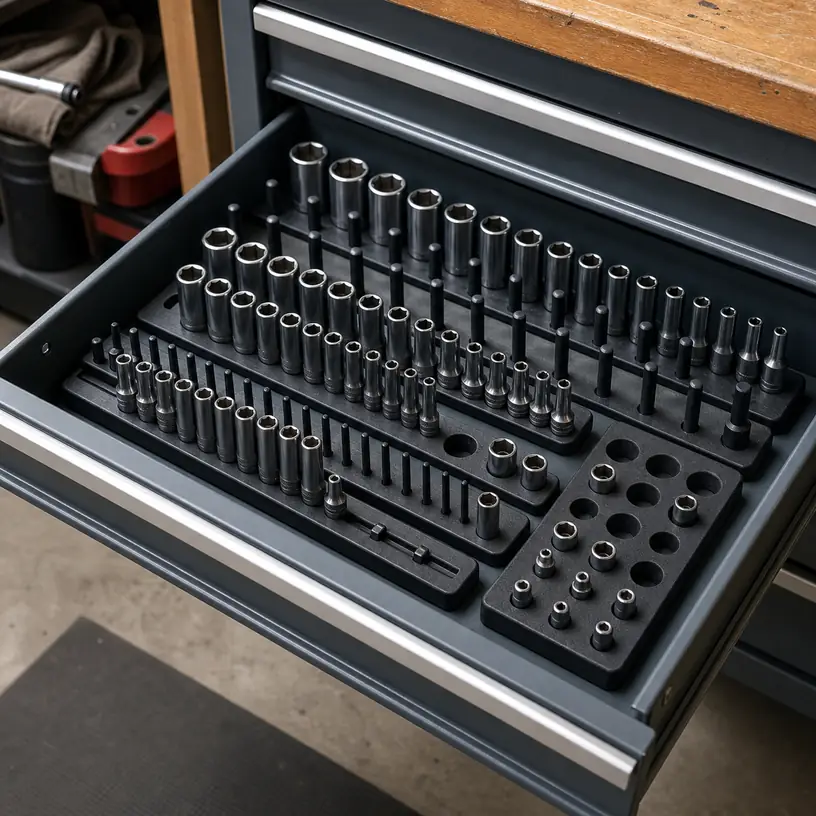
Illustrative image, not an official product photo.
Short answer
Choose a socket organizer by mapping the sockets and the drawer, not by buying the tray with the largest stated capacity. Count shallow and deep sockets separately, note each drive size, and decide whether metric and SAE sets should have distinct rows. Then compare the organizer’s loaded height with the drawer’s usable clearance. Rails save space and can be rearranged, while molded or post-style trays make missing sockets easier to spot. Retention matters if the drawer is opened abruptly or the set travels; quick one-handed removal matters more in a toolbox that stays level on a bench.
Search reference
Socket organizer options for toolbox drawers
Compare rail, post, tray, and magnetic layouts after counting your drive sizes and measuring drawer height, width, depth, and liner thickness.
View matching optionsBegin with a socket map
Empty capacity figures hide the details that determine whether an organizer will work. A collection may combine 1/4-inch, 3/8-inch, and 1/2-inch drive sockets; shallow and deep bodies; metric and SAE sizes; impact sockets; spark-plug sockets; and a few extensions or adapters. A tray with many posts for one drive size can still leave half the collection loose.
Lay the sockets out on a towel or drawer liner and make four basic groups: drive size, measurement system, depth, and special purpose. Count each group, then note sockets whose outside diameter or length differs noticeably from the rest. This inventory shows whether a premade graduated tray matches the collection or whether adjustable rails would use space more efficiently.
The same map can establish a retrieval order. Frequently used sockets can sit near the front of the drawer, with deep or less common sizes behind them. Metric and SAE rows can run in separate directions or use visibly different holders. A layout should reduce searching without making it difficult to return a socket to the correct place.
Who this is for
- Home mechanics who want to see missing sockets before closing the toolbox.
- DIY users combining several incomplete sets in one drawer.
- Workshop owners separating metric, SAE, shallow, deep, and impact sockets.
- People replacing loose factory cases that waste drawer space or no longer match the collection.
- Anyone arranging a rolling cabinet where sockets shift when drawers open and close.
Who should skip it
- Keep a fitted case if the complete socket set regularly travels and the case already retains every piece securely.
- A very small set may need only a compact clip rail or the holder included with the sockets.
- Foam cut to a specific collection may be a better choice when visual inventory and a fixed position for every tool matter more than future rearrangement.
- Do not assume a standard organizer will fit oversized, pass-through, insulated, specialty, or unusually shaped sockets.
- If several people carry subsets to different work areas, one large drawer tray may be less practical than separate portable rails.
What to verify before buying
- Socket inventory: Count each drive size and count shallow and deep sockets separately. Include special sockets only after checking their dimensions.
- Usable drawer area: Measure between the drawer sides and from the liner to the lowest obstruction above the drawer, not just the cabinet’s nominal dimensions.
- Loaded height: Add the organizer base or post height to the length of the tallest socket in its intended orientation.
- Retention method: Check whether sockets use spring clips, twist-lock studs, friction posts, magnets, or gravity alone, and whether the mechanism suits stationary or mobile storage.
- Post and clip compatibility: Confirm the drive sizes provided and whether clips or posts can be added, removed, or replaced.
- Socket spacing: Compare outside diameters so adjacent large sockets do not collide even if the drive fittings line up.
- Labeling: Determine whether size markings are fixed, supplied as labels, writable, or absent, and whether they match the way you sort the collection.
- Base stability: Look at feet, magnets, mounting holes, tray shape, and compatibility with the drawer liner.
- Material and care: Review the current product description for construction, cleaning guidance, magnet precautions, and restrictions involving impact sockets or other heavy tools.
- Room to grow: Reserve a few useful positions, but do not sacrifice most of a drawer to drive sizes you are unlikely to add.
Rails, trays, posts, and magnets solve different problems
A clip rail uses individual holders along a narrow bar. It is often the easiest format to rearrange as the collection changes, and several short rails can fit around ratchets or extensions. The tradeoff is that clips may slide when a socket is pulled, and size identification depends on the layout or added labels. Check whether the clips are replaceable and whether the rail can be lifted without the sockets detaching.
A twist-lock rail is intended to grip sockets until they are rotated for removal. That extra retention can help in a portable box or rolling cabinet, but it adds a deliberate step at the start and end of a job. Confirm the direction and amount of movement required and consider whether tightly spaced large sockets leave enough room for a hand to turn them.
A post-style tray places sockets upright over drive-size posts, often in graduated rows. It provides an obvious empty position and can make size order easy to scan. Upright deep sockets consume considerable vertical clearance, however. Fixed rows also become inefficient when the collection has duplicates, skipped sizes, or a distribution unlike the tray’s preset pattern.
A molded tray with recessed pockets can hold sockets lower and may reduce top-heavy movement. Pocket diameter is critical: an opening shaped for one outside diameter may not accept another socket with the same drive size. Because sockets from different series do not share one universal body shape, compare actual measurements rather than relying only on the printed size sequence.
A magnetic organizer can stabilize metal sockets and sometimes keep the tray from shifting on a suitable steel drawer. Magnet strength, surface contact, socket weight, and drawer material all affect the result. A magnetic label does not establish secure transport, and magnetic accessories should be kept away from items whose makers warn against magnetic exposure. Verify whether the base may mark a painted surface and whether debris can collect underneath it.
Drawer clearance is a three-dimensional measurement
Width and depth decide whether the organizer footprint fits, but height is the common surprise. Toolbox listings may describe drawer depth without accounting for the liner, internal rails, rolled edges, a lock bar, or the underside of the drawer above. Measure the real space at several points with the drawer installed.
For upright storage, place the tallest intended socket on a temporary block approximating the organizer’s base or post. Slowly close the empty drawer while observing from the side where possible. Do not force it. Leave clearance for normal movement and for sockets that may not sit fully down on a post. Deep sockets that are too tall can often lie on horizontal rails, while shallow sockets remain upright.
Also check access above each row. A layout may clear the closed drawer yet place a tall socket under the cabinet frame where it cannot be lifted straight off its post. Pull the drawer to its normal stop and identify any area that remains covered. Low-profile storage or infrequently used tools belong in that rear zone.
Retention should match how the toolbox moves
A stationary chest on a level bench has different needs from a service cart crossing thresholds. Light friction may be sufficient when the organizer never tilts and the priority is quick removal. A rolling cabinet benefits from enough grip to prevent sockets from hopping posts when a drawer shuts, but excessive retention can lift a loose tray or make small sockets awkward to remove.
For a portable box, judge the complete system rather than the holder alone. Ask whether the rail has a handle or end stops, whether every socket remains attached when the rail is turned, and whether the rail itself is secured inside the case. A tray that grips sockets firmly can still slide around and strike other tools.
Drawer liners add friction but also reduce clearance and can compress unevenly under narrow feet. Magnetic bases require a compatible surface; a thick liner between the magnet and steel may reduce holding force. Adhesive or screw mounting creates a more permanent layout but makes future changes harder. Follow the organizer and toolbox instructions before drilling, attaching hardware, or placing magnets on finished surfaces.
Plan labels around the way you work
Printed size markings are most useful when they remain visible with sockets installed. Check whether the tray’s sequence includes the sizes you own and whether separate metric and SAE markings are easy to distinguish in the drawer’s lighting. Fixed labels can become misleading when a missing size, duplicate, or specialty socket changes the row.
Adjustable rails can be organized from small to large, but a socket’s stamped marking may face away after it clips into place. Position the rail and rotate sockets so common sizes can be identified from the normal standing angle. Writable end labels, color accents, or labeled drawer zones can separate drive sizes without attaching something to every socket.
Leave a deliberate empty position only when its purpose is clear. A labeled gap can indicate a socket currently in use or missing; several unexplained gaps recreate the search problem the organizer was meant to solve. Photographing the finished layout can help other household members return tools without turning the drawer into a rigid display.
Make room for ratchets without wasting the drawer
Sockets are only part of a working set. Ratchets, extensions, universal joints, adapters, breaker bars, and torque tools also need accessible storage. A wide tray that fills the drawer may organize sockets beautifully while forcing their companion tools into another cabinet.
Sketch the drawer on paper and reserve a strip for the longest ratchet or extension before selecting a tray. Several independent rails can form a border around larger tools, and low-profile socket rows can leave a central section open. If a torque wrench has specific storage instructions or a protective case, follow those rather than squeezing it into the remaining gap.
Future expansion deserves a realistic allowance. Extra clips on an adjustable rail are useful when a commonly used drive size grows. Large banks of fixed empty posts are less helpful if they displace tools used every day. Modular sections make it easier to add one row or move specialty sockets into a separate drawer later.
Limitations
- Drive size describes the square connection, not the socket’s outside diameter, body length, or fit in a molded pocket.
- Fixed trays may include positions that do not match an incomplete, mixed, or specialized collection.
- Upright deep sockets can exceed drawer clearance even when the organizer itself has a low base.
- Magnets, clips, and twist locks vary in holding behavior; no format should be assumed secure for transport without checking the current instructions.
- Printed labels can be difficult to read in a crowded or dim drawer and may not follow a preferred size sequence.
- Plastic clips and posts can wear or break, while exposed metal rails may need care in a damp workspace.
- An organizer improves visibility but does not replace inspection, cleaning, or the tool maker’s storage and use guidance.
Alternatives to compare
A fitted blow-molded case protects a matching set and makes transport straightforward, although it may use drawer space inefficiently. Custom-cut foam gives every tool a visible outline and can include ratchets and extensions, but changing the collection requires recutting or replacing the insert. Magnetic socket strips can mount on a compatible vertical surface and free a drawer, provided the location and retention are appropriate. Portable socket rails suit users who take selected drive sizes to a vehicle or workbench. For a small mixed collection, labeled divided bins may be flexible, though they offer less immediate size identification.
FAQ
Should deep sockets stand upright in a toolbox drawer?
Only when the socket plus organizer fits below the drawer above with comfortable clearance and can be lifted from the open drawer. Horizontal rails or low-profile pockets are often easier to fit when deep sockets approach the available height.
Are magnetic socket organizers secure enough for a rolling tool cabinet?
That depends on the magnet, contact surface, liner, socket weight, and how the cabinet moves. Confirm the organizer’s current use guidance and test the loaded layout carefully before relying on it; a magnetic base and socket retention are separate issues.
Can metric and SAE sockets share one organizer?
They can, but distinct rows or clearly marked zones reduce selection mistakes. Make sure the organizer’s labels match your socket sequence, or choose an adjustable format that lets you create your own order.
How many empty positions should a socket tray have?
Reserve enough positions for likely additions in the drive sizes you actually use. A few planned spaces can help, but a much larger fixed tray may waste room needed for ratchets, extensions, or other tools.
Why will a socket fit the post but not the tray?
The square drive connection may match while the socket body is too wide for adjacent positions or a molded recess. Measure outside diameter and length, especially for impact, deep, spark-plug, and other specialty sockets.