Choosing a Precision Screwdriver Set Without Guessing at the Bits
Product links are for reference. Verify current details on the retailer page before buying.
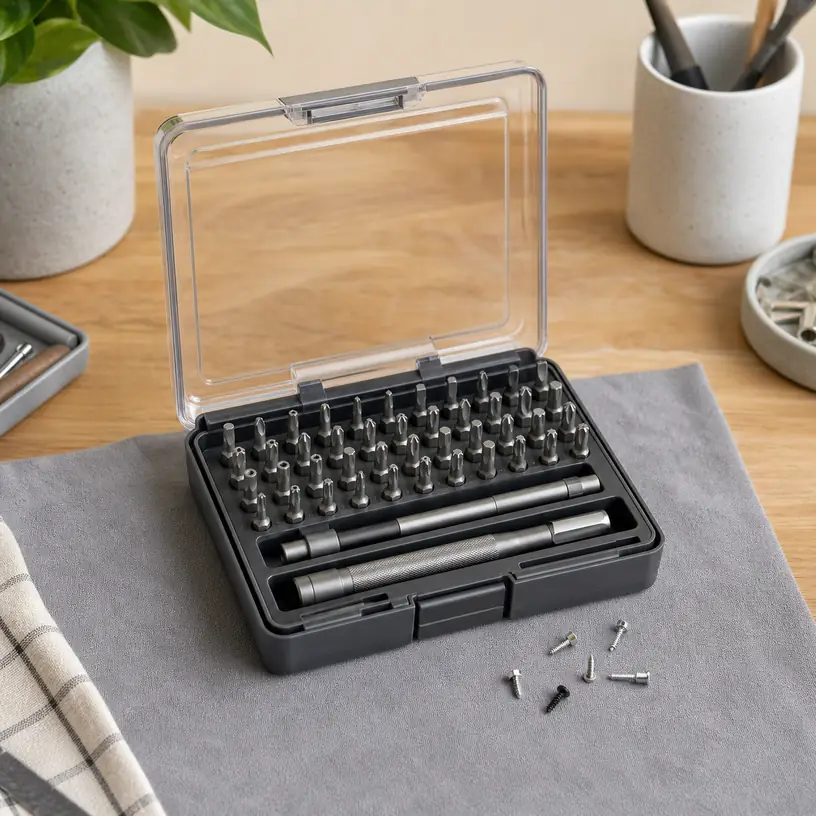
Illustrative image, not an official product photo.
Short answer
Choose a precision screwdriver set from the screws outward, not from the advertised bit count inward. Inspect the items you are realistically allowed and prepared to repair, identify their fastener profiles and sizes from reliable documentation, and note whether those screws sit at the surface or down narrow recesses. Then compare bit accuracy, shaft reach, handle control, case labeling, and the availability of replacement bits. A compact set with the right ten well-fitting bits can be more useful than a large kit padded with duplicates and accessories. It should also be treated as a turning tool, not as permission to open batteries, powered equipment, safety-critical assemblies, or products whose service instructions call for specialist procedures.
Search reference
Precision screwdriver set options
Compare kits by the fastener families you encounter, access depth, handle feel, and how clearly each small bit is identified and replaceable.
View matching optionsStart with one real repair
The biggest number on a screwdriver case is usually its piece count, but piece count says little about whether the kit fits the fastener in front of you. A set may include many uncommon profiles, repeated sizes, opening picks, sockets, and extensions while omitting the long, narrow bit needed to reach a recessed screw. Begin with a concrete job such as tightening eyeglass hardware, opening an approved battery compartment, adjusting a small household item, or servicing equipment under its published instructions.
Look at the fastener under bright light or modest magnification. Do not identify it from a blurred product photo or force the closest-looking bit into place. Cross-shaped, slotted, hexagonal, star-shaped, five-point, three-wing, and security fasteners each exist in multiple sizes and variations. The device maker’s service material, parts diagram, or tool list is a better reference than visual guesswork. If a screw is damaged, corroded, coated over, or unusually resistant, stop before a small mismatch becomes a stripped recess.
Access matters alongside profile. Measure or estimate the diameter of the opening around a recessed screw, the depth below the surface, and any obstruction near the fastener. A correctly shaped bit may still fail to reach if its working end is short and the holder is too wide. Conversely, a very long bit can flex or feel less controlled during a delicate surface-level job. The right geometry lets the bit sit fully in the recess while the handle remains clear of surrounding parts.
Who this is for
- Households that regularly encounter small screws in eyewear, toys, battery doors, hobby items, computer accessories, and other permitted user-serviceable products.
- Makers who need a compact manual driver for light assembly, adjustment, prototyping, or careful bench work.
- People replacing a random collection of loose micro drivers with a labeled case that makes sizes easier to identify and return.
- Repair beginners willing to consult service guidance, organize removed screws, and stop when a task exceeds their skill or equipment.
- Tool-bag users who want low-speed hand control for small fasteners rather than the bulk and force of a powered driver.
Who should skip it
- Anyone expecting one generic kit to authorize or safely cover every phone, computer, appliance, watch, vehicle, or electrical repair.
- Work on energized equipment, damaged rechargeable cells, pressurized devices, mains-powered products, or other hazards that require qualified service procedures.
- Safety-critical, calibrated, warrantied, sealed, medical, or regulated equipment when its maker or workplace procedure restricts user servicing.
- Jobs that call for a documented torque value; an ordinary precision handle does not provide verified torque control.
- Heavy, seized, structural, impact-rated, or high-torque fasteners better matched to full-size tools and an appropriate removal plan.
- Buyers who only need one known driver size and would gain more from a good dedicated screwdriver than a broad kit.
What to verify before buying
- Exact profiles and sizes: Match the listing’s individual bit table to the service instructions or known fasteners, not merely to a device category printed on the case.
- Bit standard and replacements: Check whether the bits use a common shank format, whether individual replacements are sold, and whether the maker states compatibility clearly.
- Working length: Verify the length and diameter of the exposed bit or shaft for recessed screws, narrow openings, and fasteners beside raised edges.
- Bit labeling: Look for readable size markings on the bit, holder, tray, or case so similar tips are not chosen by trial and error.
- Tip fit and finish: Product information should distinguish the profile and size precisely; decorative color bands and material buzzwords do not prove accurate engagement.
- Handle dimensions: Compare diameter, grip surface, rotating end cap, shaft retention, and overall length with the control and hand position your tasks require.
- Retention method: Determine whether bits are held mechanically, magnetically, or by both, and whether that arrangement is suitable around the item being serviced.
- Extensions and sockets: Confirm their actual dimensions, connection method, load limits, and whether extra joints will still fit into the repair area.
- Case layout: Check whether every bit has a labeled location, the tray holds pieces during transport, and the lid can close without loose parts moving between slots.
- Included accessories: Identify which picks, tweezers, cups, brushes, or prying tools are actually included and whether their intended use is explained.
- Care instructions: Verify guidance for cleaning, corrosion prevention, storage, damaged-bit inspection, and any limits on magnetized components.
Bit count can hide the useful details
A large assortment has value when it expands genuine coverage, but it can also make selection slower. Read the inventory line by line. Separate the entries into three groups: profiles required for known tasks, sizes likely to support adjacent household jobs, and pieces with no current purpose. This turns a headline such as “many pieces” into a practical map of what the case can do.
Look for unexplained duplicates. A repeated bit may be a welcome spare for a frequently used small size, yet it should not be mistaken for wider compatibility. Adapters, extension shafts, a handle, and a storage tool may also count as pieces. None of that is inherently misleading if the contents are listed clearly; it simply means two kits with the same total can contain very different working selections.
The profile name alone is incomplete without size. A too-small tip concentrates load at a few points and may cam out, while an oversized tip will not seat fully. Place the tool squarely into the recess and check for full engagement before turning. If it rocks, sits high, or requires downward force just to remain aligned, reassess the size and condition of both parts. The correct response to resistance is diagnosis, not more wrist force.
Security-style bits deserve the same restraint. Their presence in a set does not mean every protected product is intended for consumer access. Some fasteners discourage casual opening because important hazards, calibration, sealing, or service obligations lie beyond the cover. The product’s instructions and applicable rules take priority over the fact that a matching bit happens to be available.
Reach, handle shape, and control work together
Precision fasteners reward alignment. A rotating end cap lets the palm apply gentle axial pressure while the fingers turn the body, which can help keep the shaft centered. Handle diameter changes leverage: a wider grip may be comfortable and easy to rotate, but it can also make it easier to apply more torque than a tiny fastener or plastic boss can tolerate. A very slim handle offers feedback but may fatigue the fingers during repeated work. Choose for control, not maximum force.
The bit holder should retain a bit reliably while still allowing deliberate removal. Magnetic retention is convenient for bit changes and may help with compatible steel screws, but it does not hold every alloy and should not replace a parts tray. Follow equipment guidance where magnetic tools are limited. If the set includes a magnetizer or demagnetizer, verify its instructions rather than assuming a bit’s magnetic state has no consequence.
Rigid extensions add reach but also add another connection where play can develop. Flexible shafts can approach a fastener around a mild obstruction, yet their bend may reduce alignment and feedback. They are not universal solutions for tight screws. Test an extension first on an accessible, low-risk fastener of the same type and use only within the tool maker’s stated limits.
Deep recesses often expose the difference between interchangeable bits and dedicated precision drivers. An interchangeable bit may have a broad shoulder near the tip or meet a holder that cannot enter the opening. A dedicated long-shaft driver can be the simpler answer for a frequently serviced recessed fastener. Check the complete working geometry instead of assuming an extension creates the same access.
A case is part of the tool
Tiny bits are easy to swap, drop, and misidentify. A useful case makes the correct size visible before work begins and makes a missing piece obvious before the lid closes. Printed labels beside each slot are easier to scan than a legend placed elsewhere, provided the bits cannot migrate to neighboring positions during transport. Contrast and text size matter when several dark metal tips look nearly identical.
Try to picture the case during the job, not just on a shelf. Will it remain open on a shallow desk? Can a bit be lifted without spilling the row beside it? Is there a stable place for removed screws that does not mix them with unused bits? A separate divided tray, magnetic parts bowl where appropriate, labeled paper diagram, or small bags may still be needed to preserve the order and position of hardware.
Good organization also prevents improvisation. When a bit is returned to its labeled location after use, wear or damage is easier to notice. Rounded edges, chips, twisting, rust, and a loose shank are reasons to replace the bit rather than conceal it in the set. Keeping the tool clean and dry protects both fit and identification markings.
Small repairs still need a safe boundary
A precise tool does not make every object a beginner project. Before opening anything, disconnect power using the manufacturer’s procedure, remove accessible energy sources only when instructed, and allow specified waiting time. Rechargeable batteries can remain hazardous even when a device appears off. Do not pry, puncture, bend, heat, compress, or short a cell, and stop if a battery is swollen, leaking, unusually hot, damaged, or has an unfamiliar removal method.
Opening clips and adhesives create risks that a screwdriver list does not describe. A kit may include picks, suction cups, spudgers, or tweezers, but bundled accessories should not be treated as evidence that a particular disassembly is safe. Check the repair documentation for hidden cables, glass, spring-loaded parts, seals, replacement adhesives, static-control requirements, and reassembly tests.
For electronics work, a label such as “ESD” or an included wrist strap is not enough to establish a complete static-control setup. Sensitive work may require a defined bench, grounding method, verified equipment, handling procedure, and training. Follow the component or workplace instructions. If those requirements are unclear, use an appropriate repair service rather than experimenting on valuable or safety-related equipment.
Screw organization protects the item as much as the screws. Similar-looking fasteners can differ in length, thread, shoulder, or coating. Returning a longer screw to a shallow hole may damage material below it. Photograph approved disassembly stages, map each screw to its location, and never rely on memory after mixing a pile. Thread each screw gently by hand with the item supported; resistance can indicate misalignment, the wrong fastener, or damaged threads.
A practical first-use check
- Compare the case inventory with the seller’s list and confirm that labels match the physical positions.
- Inspect the handle, holder, bits, extensions, and accessories for looseness, chips, corrosion, or shipping damage.
- Choose a clean, unpowered, permitted practice item with an accessible fastener and clear instructions.
- Identify the exact profile and size before lifting a bit from the tray.
- Seat the bit fully, hold the shaft in line with the screw, and turn slowly without using an extension at first.
- Place removed hardware into a mapped or labeled location rather than the open bit tray.
- Reinstall according to the product instructions, stopping when seated or at the specified torque rather than adding an extra hard twist.
- Wipe and inspect the bit, return it to its marked slot, account for every screw and tool piece, and close the case carefully.
This short routine reveals practical problems early: unreadable labels, excessive holder play, a handle that is hard to control, or bits that do not reach the intended fastener. Discovering those issues during a simple approved task is better than finding them halfway through a delicate disassembly.
Limitations
- No assortment covers every proprietary, regional, historical, or newly introduced fastener.
- A matching profile can still be the wrong size, length, shoulder shape, or access geometry.
- Small bits wear and can twist, chip, corrode, or round when fit or torque is poor.
- Ordinary precision handles do not verify tightening torque and should not substitute for specified torque tools.
- Magnetic retention works only with compatible materials and may be restricted by some equipment procedures.
- Extensions and flexible shafts can add reach while reducing rigidity, alignment, and tactile feedback.
- Bundled prying and handling accessories vary in suitability and do not establish a safe repair method.
- Opening a product can affect seals, calibration, service coverage, safety checks, or reassembly requirements.
- The set cannot replace technical instructions, hazard controls, replacement parts, skill, or qualified service.
Alternatives to compare
A dedicated long-shaft precision screwdriver can provide better reach and fewer connections for one recurring fastener size. An individual high-quality micro driver avoids paying for unused profiles when the requirement is already known. A manual bit driver with a larger common bit format may suit medium-size household screws that are too large for a precision kit. A torque-limiting driver is the relevant comparison when instructions specify a controlled tightening value. For routine equipment care, a manufacturer-recommended service tool or approved repair kit may supply the exact geometry and process support that a general assortment lacks. If the task involves hazards, sealed assemblies, or uncertain damage, compare the cost and turnaround of a qualified repair service instead of expanding the tool case.
FAQ
How many bits should a precision screwdriver set have?
There is no ideal total. List the exact profiles and sizes for two or three realistic repairs, add useful neighboring sizes, and compare that list with the kit inventory. Ten relevant, accurately labeled bits may serve better than a much larger assortment dominated by duplicates, unknown profiles, or accessories you will not use.
Can a precision screwdriver set be used for phone or laptop repair?
Only when the specific model’s service guidance permits the work and identifies the required tools, parts, hazard controls, and reassembly checks. Fasteners, adhesives, clips, batteries, displays, and static-control needs vary by model. A matching bit is just one requirement and does not make internal repair safe or appropriate.
Are magnetic precision screwdriver bits safe around electronics?
Do not apply a universal rule. Magnetic retention can help hold compatible screws, but equipment and component instructions may restrict magnetic tools or define handling controls. Verify the guidance for the exact item and use a non-magnetic tool when required. Magnetism also does not replace proper screw organization.
Why does the correct-looking bit keep slipping?
It may be the wrong size or variation, may not be seated fully, or may be blocked by debris, coating, wear, or poor access. The screw recess or bit could already be damaged, and the fastener may be thread-locked or tightened beyond what the small tool should handle. Stop before applying more force, reassess the documented profile and size, and choose an appropriate removal method or service provider.
Is a flexible extension useful for recessed screws?
It can help reach around a modest obstruction when the set is designed for that use, but bending reduces rigidity and can make it harder to keep the bit square. It will not solve a narrow opening that the bit holder cannot enter, nor is it appropriate for high resistance. A rigid extension or dedicated long-shaft driver may provide better control.