Stop Guessing at the Drain: How to Size a Shower Hair Catcher
Product links are for reference. Verify current details on the retailer page before buying.
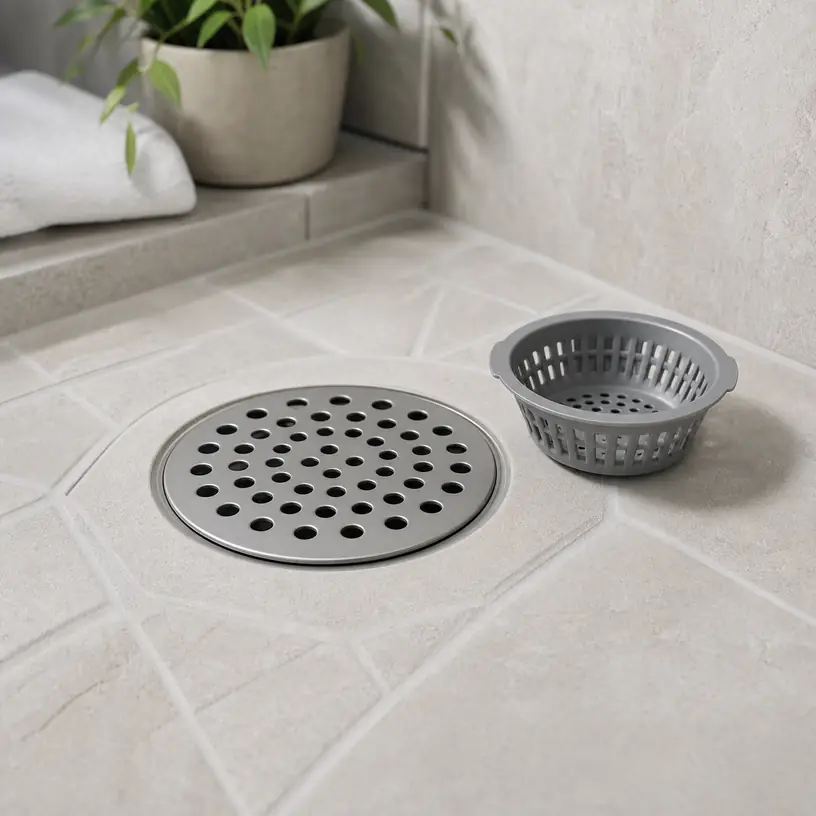
Illustrative image, not an official product photo.
Short answer
A shower drain hair catcher is only useful when its shape matches the drain, it stays put under running water, and it can be cleared before buildup slows the flow. Begin with the drain itself: note whether it is round, square, flat, raised, recessed, or controlled by a stopper, then measure the opening and the clear surface around it. Flat screens need enough level area to seal or grip; insert baskets need verified clearance below the opening; domed covers need room around a raised drain. Favor a design that can be lifted without tools and cleaned without handling sharp edges. After installation, watch the first full shower to confirm that water drains freely and does not pool into a walking area.
Search reference
Shower drain hair catcher options
Compare flat screens, raised covers, and insert baskets only after measuring the drain opening, the surrounding surface, and any stopper or grate that must remain accessible.
View matching optionsPhotograph the drain before shopping
Drain accessories are often shown alone against a plain background, which makes incompatible shapes look interchangeable. A quick overhead photo of your own shower provides a better reference. Include a ruler in the frame and capture the entire drain, nearby grout lines, screw heads, the edge of the recess, and any movable stopper. If the grate can be removed according to its instructions, measure beneath it only when that is necessary for the type you are considering; do not dismantle plumbing merely to estimate fit.
Record more than the visible opening. A cover needs enough overlap to keep hair from slipping around its edge, but an oversized cover may ride on grout, a curved shower base, or a drain frame instead of sitting flush. For an insert, the relevant dimensions include the narrowest entry point, usable depth, and any crossbars or stopper hardware below. A nominal drain size is not a guarantee that every catcher with the same label will fit.
The water path is part of the measurement. Observe where the spray and runoff approach the drain. A lightweight cover may shift when water strikes from one side, while a raised rim can redirect water toward a low spot. The goal is not simply to cover the hole; it is to collect hair without creating an obstacle that makes the shower floor drain less predictably.
Who this is for
- Households that want a removable first line of capture before loose hair reaches an accessible shower drain.
- Renters seeking a nonpermanent option that does not require altering the grate or drain assembly.
- Buyers replacing a screen that slides, curls at the edge, empties poorly, or is awkward to clean.
- Shared bathrooms where a visible catcher and an agreed cleanup routine are easier to manage than an out-of-sight insert.
- People who can inspect the catcher regularly and remove collected material before water flow is restricted.
Who should skip it
- A hair catcher is not a fix for a drain that is already slow, blocked, leaking, loose, damaged, or producing persistent odor; those conditions call for appropriate diagnosis and maintenance.
- Skip add-on covers that interfere with a required stopper, accessible-shower feature, drain grate, or manufacturer-specified component.
- A screen is a poor fit when it rocks on pronounced tile texture, broad grout channels, or a strongly curved shower base.
- Anyone unable to bend safely or perform frequent cleanup may need a different maintenance arrangement rather than a small floor accessory.
- Do not install a design that creates a raised edge, unstable surface, or pooling where feet normally stand.
What to verify before buying
- Drain geometry: Identify a flat grate, recessed opening, raised rim, linear channel, or stopper-operated drain before comparing catcher styles.
- Measured fit: Check the product’s complete dimensions, including outer width, inner opening, height, insert depth, and required overlap.
- Stopper interaction: Confirm whether the shower has a lift, twist, push, toe-touch, or other mechanism that must still move freely.
- Surrounding surface: Look at slope, tile texture, grout lines, screw heads, and curves that could keep a flat edge from making contact.
- Flow openings: Compare the open area and layout with the expected shower runoff, while recognizing that collected hair will reduce flow between cleanings.
- Staying method: Determine whether the catcher relies on weight, suction, a flexible skirt, an insert fit, or another mechanism, and check its surface requirements.
- Removal and cleaning: Look for a reachable tab or rim, accessible interior, rounded edges, and care directions that suit the planned cleanup routine.
- Current materials: Verify the stated construction, cleaning limits, and replacement guidance instead of judging flexibility or corrosion behavior from appearance.
- Included pieces: Confirm whether adapters, plugs, weights, baskets, covers, or cleaning tools shown in the listing are included with the selected option.
- Safety and drain guidance: Follow the shower and drain manufacturers’ instructions and do not block required openings or alter fixed plumbing components.
Match the catcher style to the drain
Flat screens need a flat landing zone
A flat screen or flexible cover is the simplest style to evaluate from above. It rests over the grate and catches material at the surface. This can make cleanup visible and avoid inserting a part below the drain opening. The tradeoff is dependence on the floor around the drain. Deep grout lines, mosaic tile, a raised grate, or a changing slope can leave channels under the edge.
Measure the uninterrupted area around the drain rather than the shower floor as a whole. The cover should overlap the openings without touching a wall, track, or abrupt curve. If suction cups or a tacky underside are part of the design, verify which clean, smooth surfaces they are intended to contact. A product that grips glazed tile may behave differently when its contact points fall across grout or a textured shower pan.
Raised covers need room around the obstruction
A domed or tent-like catcher can bridge a drain that rises above the surrounding surface or has a central stopper. Its internal height and width must clear the hardware throughout normal movement. The outside footprint still needs a stable landing area, and the openings must remain exposed rather than pressed against the stopper or rim.
This style can protrude farther into the shower. Check its position relative to the usual standing area and the path used to enter or exit. A cover that technically fits but is repeatedly kicked out of place will not provide reliable capture. Color contrast may also matter in a household where a low floor object is otherwise difficult to see.
Insert baskets depend on hidden clearance
Basket and plug-style catchers sit partly below the opening, keeping the shower floor less cluttered. Compatibility is less obvious because internal crossbars, screws, pipe transitions, or stopper parts can reduce the available space. Match all listed dimensions to measurements you can obtain safely, and confirm whether the original grate is meant to stay, be removed, or is incompatible with the product.
An insert also hides collected material. That can look tidier between cleanings, but it makes a routine more important. Choose a version with a secure, accessible lift point and do not force it past an obstruction. If removal requires prying with an improvised sharp object, the fit or design is unsuitable for easy household upkeep.
Flow matters more after the first shower
A clean catcher represents its highest-flow condition. As hair and soap residue gather across the openings, water has fewer paths through. Small perforations may capture fine material near the surface but can require frequent clearing. Larger slots can preserve more open area while allowing smaller debris through. No pattern eliminates the need to watch drainage during use.
Test cautiously after placing the catcher. Make sure it is seated as intended, run the shower, and observe from a stable position. Water should move toward the drain without spreading into a dry zone or rising around the feet. Recheck with the normal spray direction because a gentle test at the faucet may not represent runoff during a full shower. Stop using the accessory if it shifts unpredictably, backs up water, or creates a slip or trip concern.
Cleaning frequency depends on the household, hair length and shedding, the catcher’s open area, and what else enters the drain. A calendar estimate is less reliable than a visual rule: clear it before accumulated material covers a meaningful portion of the openings or flow begins to change. In a shared shower, decide who checks it and where waste is discarded so the task does not wait until pooling appears.
Make cleanup easy enough to repeat
A catcher that is unpleasant to empty tends to remain full. Look for a part that lifts without placing fingertips under a sharp grate or into standing water. Smooth, accessible surfaces are easier to wipe than deep internal ribs. Removable pieces should separate and reassemble according to their directions without becoming loose in the drain.
Let the shower cool and drain, then remove captured hair and debris using a method consistent with the product’s care instructions. Dispose of the material in household waste rather than washing it back through the openings. Rinse or clean the catcher as directed, inspect it for distortion or damaged edges, and return it only when both the drain area and the accessory are in suitable condition.
The drain still needs its normal care. A hair catcher does not capture dissolved residue, all lint, or every small particle, and it does not replace maintenance recommended for the shower and plumbing. Avoid combining tools or cleaning substances in ways that conflict with drain, surface, or product instructions. Persistent slow flow after the catcher is removed points to a separate issue.
Limitations
- Hair can pass around an edge, through larger openings, or under a cover that does not sit evenly.
- Every catcher loses usable flow area as material accumulates, so performance depends on timely cleanup.
- Flexible covers may shift or lift, while rigid inserts may fail to fit hidden drain hardware.
- A product that fits one nominally similar drain may not fit another with different grout, slope, grate, or stopper details.
- Raised covers and lifting tabs can become foot-level obstacles in compact shower spaces.
- Materials, surface grip, and care requirements vary; visual appearance does not establish compatibility or durability.
- A removable catcher cannot resolve an existing clog, plumbing defect, leak, odor source, or drainage design problem.
Alternatives to compare
A replacement grate with an integrated removable basket may offer a more secure fit when it is specifically compatible with the drain assembly, though installation and maintenance requirements should be confirmed. A linear-drain basket or strainer is shaped for a channel rather than a round center drain. A disposable mesh insert may simplify handling for some compatible drains but creates recurring waste and still needs reliable removal. A tub strainer designed around a stopper can suit a combined bath and shower where the drain must still close. If water remains slow with every accessory removed, the alternative is not another screen—it is appropriate drain inspection and maintenance.
FAQ
How do I measure a shower drain for a hair catcher?
Measure the visible opening or grate, then the clear flat area available around it. Note outer shape, recess depth, raised rims, grout lines, slope, screw heads, and stopper movement. For an insert, also verify the narrowest entry width and usable depth without forcing or dismantling fixed plumbing.
Should a shower hair catcher sit over or inside the drain?
That depends on the drain. A flat cover can work when there is a broad, level landing area; a raised cover can clear some protruding stoppers; and an insert can reduce floor clutter when the opening and hidden clearance are compatible. Choose by measured geometry rather than appearance alone.
Why is water pooling around a new drain catcher?
The catcher may be undersized, misaligned, obstructed by collected material, or too restrictive for the runoff. It may also be rocking on grout or blocking part of the grate. Remove it if pooling affects the walking area, check the drain without the accessory, and address any underlying slow-drain problem separately.
How often should a shower drain hair catcher be cleaned?
Inspect it often enough that hair never covers a substantial part of the flow openings. The interval varies by household and catcher design, so visible accumulation and changing drainage are more useful signals than a fixed schedule. Shared bathrooms benefit from assigning the check to a regular cleaning routine.
Will a hair catcher fix an already slow shower drain?
No. It may help intercept new loose hair, but it does not remove an existing blockage or repair a drain. If flow remains slow when the catcher is removed, investigate the drain according to appropriate maintenance guidance rather than covering it with another accessory.