A Better Read on the Cold: Refrigerator and Freezer Thermometers for Home Kitchens
Product links are for reference. Verify current details on the retailer page before buying.
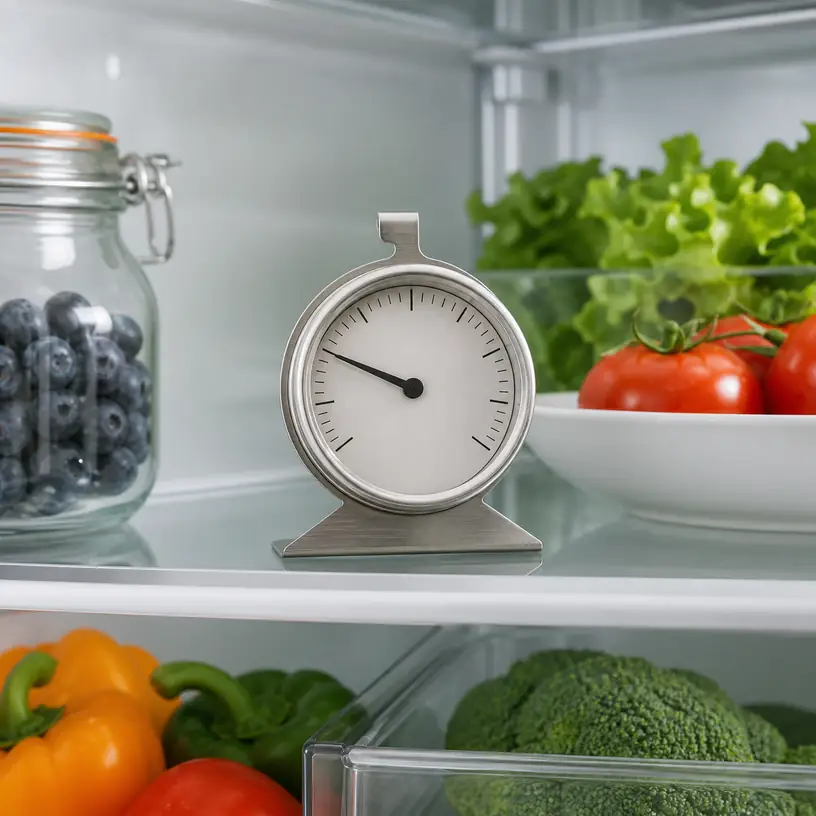
Illustrative image, not an official product photo.
Short answer
A refrigerator or freezer thermometer gives you an independent reading inside an appliance, which is more useful than judging coldness by the control dial or by touching a container. Choose one that covers the temperatures you need to monitor, remains readable in its planned location, and can stand, hang, or attach without blocking vents or interfering with food. An analog dial avoids batteries and can be easy to check at a glance; a digital model may provide larger numbers, minimum-and-maximum memory, or an alarm. Those extras only help if the controls make sense and the device is rated for the compartment. Buy for a specific placement, allow the reading to stabilize, and compare it with the appliance manual and current food-storage guidance rather than treating one quick glance as a complete diagnosis.
Search reference
Refrigerator and freezer thermometer options
Compare rated temperature range, display visibility, placement hardware, stated accuracy, alert behavior, power needs, and cleaning instructions for the compartment you plan to monitor.
View matching optionsStart with one shelf, not a feature list
Open the appliance and decide where a thermometer could remain visible without being knocked over, buried by groceries, or pressed against a wall. A crowded refrigerator may need a compact hanging model at the front of a middle shelf. A chest freezer can call for a display that is readable from above. A small dorm-style refrigerator may have no sensible place for a wide dial, while an upright freezer basket can make a loose digital unit disappear under packages.
That location shapes the buying decision. A broad dial is useful only when the markings can be seen through the shelf arrangement. A magnetic back requires a suitable metal surface and permission from the appliance instructions. A hook must fit the shelf wire or edge without hanging into a drawer. A stand needs a flat surface and enough depth to resist sliding when the door closes.
Also decide what question you want the thermometer to answer. Routine monitoring, checking a newly installed appliance, observing a garage freezer during seasonal weather, and investigating uneven refrigerator zones are different jobs. A simple dial can cover a stable visual check. Minimum-and-maximum memory may be more helpful when you want to know what happened between checks, while an audible alert may matter only if it can be heard where the appliance sits.
Who this is for
- Households that want a reading independent of an appliance’s numbered or unlabeled control setting.
- Renters checking an unfamiliar refrigerator without altering the appliance.
- People organizing a refrigerator and trying to identify a practical, consistently cold shelf for particular foods.
- Owners of an upright or chest freezer who want an easy visual check during normal use.
- Households setting up a replacement appliance and following the maker’s stabilization instructions.
- Buyers who can place the device safely, keep the display visible, and respond appropriately when readings change.
Who should skip it
- Skip a loose display if the compartment is so crowded that the device will be buried, broken, or routinely moved; improve access or choose a securely compatible mounting style first.
- Do not use an ordinary refrigerator thermometer as a substitute for a calibrated instrument where a business, laboratory, medication, or regulated process has specific monitoring requirements.
- A wireless sensor system may be more suitable when the essential job is receiving alerts outside a detached garage, basement, or other remote location.
- Do not assume a general indoor thermometer can tolerate freezer conditions, condensation, or food-area cleaning; use a model rated for the intended environment.
- If the appliance has persistent temperature problems, damaged seals, unusual cycling, water leakage, or a fault warning, a consumer thermometer does not replace the appliance manual or qualified service.
- Skip alarm features when no one in the household can reliably hear, interpret, test, and reset them.
What to verify before buying
- Rated range: Confirm that the full stated operating and measuring ranges include the refrigerator or freezer conditions you need to observe.
- Stated accuracy: Look for a clear accuracy specification and note whether it applies across the whole range or only within a narrower band.
- Display resolution: Determine whether the scale or digital step is fine enough for useful decisions without implying greater accuracy than the specification supports.
- Viewing angle: Check digit height, dial diameter, color contrast, glare, and whether the display remains legible from the direction the door opens.
- Mounting choices: Verify the dimensions and operation of the stand, hook, clip, suction cup, or magnet instead of assuming it will fit your shelf.
- Compartment compatibility: Look for explicit refrigerator and freezer suitability as needed, including any limits for moisture or condensation.
- Response and stabilization: Review the maker’s guidance for placement and how long the unit should remain undisturbed before interpreting a reading.
- Min/max memory: Check whether values persist until manually cleared, reset after a battery change, or include a time reference.
- Alarm controls: For digital models, verify thresholds, sound level, delay behavior, mute function, and the indication for an active or silenced alert.
- Power source: Confirm battery type, expected replacement procedure, low-battery indication, and whether settings survive a battery change.
- Cleaning guidance: Read what can be wiped, what must stay dry, and whether the device may be immersed; do not infer washability from a sealed-looking face.
- Calibration or checking instructions: Determine whether the maker provides a user check, an adjustment method, or a service recommendation.
Analog and digital displays solve different annoyances
An analog appliance thermometer is mechanically simple to read: open the door, locate the pointer, and compare it with the scale. It does not need a battery, and color bands can make a routine glance quick. The tradeoffs are physical size, small printed increments, parallax when viewed from an angle, and a pointer that may take time to settle after a large change. Inspect product dimensions, not only close-up images, because a dial that fills a listing photo can be modest inside a deep refrigerator.
Digital displays can offer larger numerals and avoid interpreting the space between scale marks. Some record minimum and maximum readings, which can reveal variation that is absent during a brief door opening. Others add alarms. These functions introduce menus, batteries, icons, reset behavior, and sometimes separate operating and display-temperature limits. A screen that becomes faint or slow in deep cold can be frustrating even when the sensor still works, so freezer suitability should be explicit.
Neither display type is inherently the correct one for every kitchen. A simple analog model may be the better tool for an appliance checked during daily cooking. A digital unit with memory can be more informative when you are comparing locations over a day. An alert is useful only when its threshold can be set appropriately, false alarms are understood, and someone is close enough to act.
Placement changes what the number means
Temperatures inside a refrigerator are not perfectly uniform. Door shelves experience warm air during opening, vents can create colder local zones, drawers alter circulation, and tightly packed containers can restrict airflow. A reading beside a vent should not automatically be treated as the temperature of every shelf. The appliance manual may identify airflow paths and recommended loading practices, so consult it before deciding that one location represents the whole cabinet.
For a first check, place the thermometer where it reflects the food-storage area you care about and where it will not touch the cooling surface, wall, or a cold package unless the instructions call for that method. Keep it away from a direct blast from a vent. Leave enough space for air to move around it, then allow the reading to settle for the period specified by the thermometer and appliance makers.
If you suspect an uneven cabinet, move the same thermometer between planned locations one at a time and give each position a comparable stabilization period. Changing location, shelf load, control setting, and door-opening pattern all at once makes the readings difficult to interpret. Write down the position, time, and relevant changes rather than relying on memory.
Freezers pose a visibility problem as well as a temperature problem. A thermometer hidden at the bottom of a chest freezer will rarely be checked. Secure placement near the top can improve access, but it must not obstruct the lid, hinge, baskets, or safe loading. In an upright freezer, avoid a loose unit that can fall when a drawer is pulled forward.
Read trends before reacting to one moment
Opening a door lets warmer room air enter, and loading unfrozen groceries changes conditions. Defrost cycles and compressor operation can also create variation. A number observed immediately after one of these events may not describe the appliance’s established condition. Follow the appliance instructions after installation, loading, a control adjustment, cleaning, or a power interruption before drawing conclusions.
Trend information is where minimum-and-maximum memory can earn its place, but memory needs context. A recorded high may reflect a long grocery-loading session, a door left ajar, a power event, or normal operation within the product’s stated behavior. Clear the memory deliberately at the start of a known observation period and note when you did it. A value with no time stamp cannot tell you exactly when or for how long the condition occurred.
Current U.S. federal food-safety guidance commonly calls for keeping a refrigerator at 40°F (4°C) or below and a freezer at 0°F (-18°C). Consult current guidance and your appliance manual for your circumstances, especially after a power interruption or when deciding whether food remains suitable. A consumer thermometer supplies evidence; it does not determine food safety by itself.
When two thermometers disagree, do not average them and assume the result is correct. First give both units enough time in the same location, compare their specifications, check battery condition where applicable, and follow their stated checking or calibration procedures. A large or persistent disagreement is a reason to investigate the instruments and appliance, not to select the more reassuring number.
Alarms need a response plan
An alarm can draw attention to a change while the door is closed, but only if the threshold, delay, and reset behavior are understood. A model may sound immediately, wait through a delay, or continue showing an alert icon after the temperature returns. Read the current instructions before choosing a threshold, and test the sound and controls as directed.
Consider the room. An alarm inside a closed basement freezer may be inaudible upstairs. A loud signal in a compact apartment may trigger frequently during ordinary loading if the delay is too short. A remote sensor can address distance, but then wireless range, receiver location, pairing, battery status, and notification delivery become part of the system.
Make a short response checklist before relying on an alarm: confirm the door is closed, check for an obvious power issue, avoid unnecessary opening, consult the appliance manual, and follow current food-safety guidance. Repeated alerts without an obvious cause call for troubleshooting or service rather than continually widening the alarm range.
Cleaning and battery access matter over time
Spills and condensation can make a display hard to read. Place the thermometer away from leaking packages and follow the maker’s cleaning directions. “Water resistant” and “washable” are not interchangeable; many electronic displays should be wiped but never submerged. An analog housing can also trap moisture or residue around a seam even though it has no battery compartment.
For a battery-powered model, check whether the compartment can be opened without a tiny loose screw falling near food. Replace batteries according to the instructions and keep spare cells stored appropriately outside the appliance. A low-battery symbol is valuable only if it is visible during routine checks. If the screen fades, segments disappear, or readings behave erratically, treat the device as unreliable until the power and operation are checked.
Inspect hooks, stands, clips, and magnets while cleaning. A bent hook can let the unit drop onto glass; a weakened suction cup can release without warning; a folding stand can collect residue. Reposition the thermometer after restocking so its display and airflow remain unobstructed.
Limitations
- A single thermometer reports conditions near its sensor, not every shelf, drawer, package, or corner of the appliance.
- Consumer accuracy and resolution vary, and a detailed display does not guarantee a highly accurate measurement.
- Door opening, loading, defrost cycles, airflow, and placement can cause readings to change.
- Minimum-and-maximum memory may not show when a value occurred or how long it lasted.
- An audible alarm cannot help if it is out of hearing range, muted, poorly configured, or powered by a depleted battery.
- A magnet, hook, clip, or stand may not fit every appliance interior even when it appears versatile in photos.
- Condensation and spills can affect readability and may damage models not designed for that exposure.
- A refrigerator or freezer thermometer does not replace current food-safety guidance, appliance troubleshooting, or qualified repair.
Alternatives to compare
An appliance’s built-in display is convenient and may integrate with its own controls, but check the manual to understand what it measures and whether it shows a set point or a sensed temperature. A wireless refrigerator or freezer monitor can place a receiver or notification outside the compartment, making it more suitable for a remote garage or basement appliance. A data logger records readings over time and can provide more context, though setup, export, sensor placement, and calibration require additional work. An infrared thermometer measures surface temperature rather than the air or internal temperature of food, so it answers a different question. A food probe thermometer is intended for appropriate food-temperature checks and should not be treated as a permanent compartment display unless its instructions explicitly support that use.
FAQ
Where should I put a refrigerator thermometer?
Choose a visible location in the food-storage area you want to monitor, away from direct contact with a wall, cooling surface, vent blast, or recently chilled package unless the instructions specify otherwise. Do not block airflow. Follow the appliance and thermometer placement guidance, then allow the reading to stabilize before interpreting it.
Can the same thermometer be used in a refrigerator and a freezer?
Only if its stated measuring and operating ranges cover both environments. Check freezer suitability, display performance, condensation limits, mounting method, and battery guidance. A model can display low numbers without necessarily being designed to operate reliably at freezer temperatures.
Is an analog or digital refrigerator thermometer easier to use?
Analog models avoid batteries and can support a quick visual check, while digital models may offer larger numerals, memory, and alarms. Ease depends on display angle, lighting, controls, placement, and how often you need trend information. Choose the simplest format that answers your monitoring question.
Why does the temperature change after I open the door?
Room air enters when the door opens, while the sensor’s response and location affect how quickly the display changes. Loading groceries and moving the thermometer can add more variation. Close the door, avoid repeated checking, and wait for the stabilization period recommended by the relevant instructions.
Do I need a thermometer with minimum-and-maximum memory?
It is useful when you want to observe variation between checks or compare appliance locations over a defined period. Reset the memory at a known time and keep notes, because many models record the extreme values without showing exactly when or how long they occurred.
What should I do if two appliance thermometers disagree?
Place them together, allow adequate stabilization time, compare their accuracy specifications, check batteries, and use any manufacturer-provided check or calibration procedure. Do not simply average a large disagreement. Persistent differences call for further instrument checks and, if appliance performance is in doubt, appropriate troubleshooting or service.