Choosing a Clip-On Book Light for Bedtime Reading and Travel
Product links are for reference. Verify current details on the retailer page before buying.
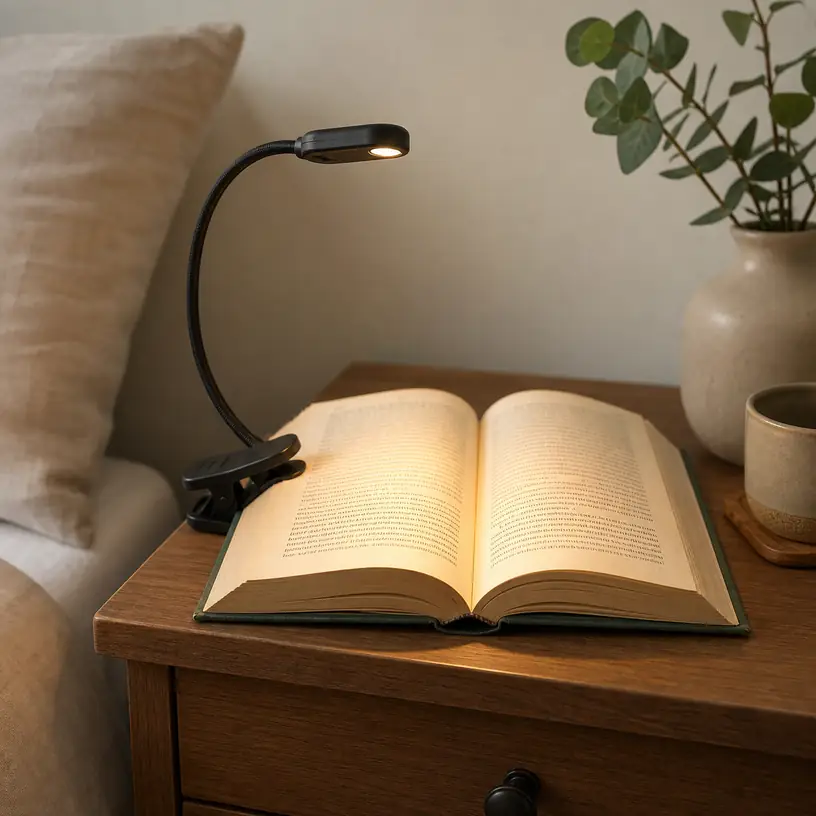
Illustrative image, not an official product photo.
Short answer
A useful clip-on book light should illuminate the page you are reading without turning the rest of the room into a spotlight. Start with beam shape and low-level brightness rather than the highest advertised output. Then consider how securely the clamp fits your usual books, whether the neck stays in position, how the controls behave in the dark, and whether charging or replaceable batteries better suit your routine. For travel or a shared bedroom, compact folded size, weight, indicator-light behavior, and the ability to reduce glare matter as much as raw brightness.
Search reference
Clip-on book light options
Compare beam coverage, dimming steps, color settings, clamp dimensions, charging method, folded size, and the location of the controls before choosing.
View matching optionsRead the page, not the whole room
The central job of a book light is narrower than that of a bedside lamp. It needs to cover the active page, or a two-page spread if you prefer, while keeping spill light under control. A broad beam can reduce the need to reposition the lamp, but it may also reach a sleeping partner or reflect from glossy paper. A tightly focused beam is more discreet yet can create a bright center and dim edges.
Product photos rarely show beam boundaries under identical conditions, so treat them as orientation rather than a direct comparison. Look for descriptions of adjustable brightness and color temperature, but also check how many button presses are required to reach a comfortable low setting. A light that remembers the previous setting can be convenient at bedtime; one that always starts at maximum may be disruptive in a dark room. Verify any memory function in the current product details rather than assuming it is included.
Paper type changes the experience. Matte paperback pages tolerate a stronger direct beam, while glossy magazines, illustrated books, or an e-reader screen can produce distracting reflections. A flexible neck or pivoting head helps move the reflection away from your eyes without moving the entire clamp.
Who this is for
- Readers who want focused light after the main room lights are off.
- Travelers who read in hotels, hostels, trains, or other spaces with inconsistent lighting.
- Students and musicians who need a small light for notes, sheet music, or a compact stand.
- Households where a full bedside lamp would disturb someone nearby.
- Readers who move between a bed, chair, and desk and prefer one portable light.
A clip-on model is particularly practical when there is no nearby table or outlet. It can also be easier to aim than a fixed wall light, provided the clamp has a stable place to attach.
Who should skip it
- Readers who need even illumination across an oversized art book or a large desk surface may be happier with a proper task lamp.
- Anyone who dislikes extra weight on a paperback cover should consider a neck light or a freestanding bedside lamp.
- A person who reads only on a front-lit e-reader may not need another light unless the device illumination is uncomfortable.
- Children who may bend, chew, or mishandle a small rechargeable device need an age-appropriate option and adult supervision; confirm the maker’s guidance.
- If the only attachment point is a thick headboard, shelf, or music stand, a small book clamp may not open far enough.
What to verify before buying
- Low-light control: Check the number of brightness levels and whether the lowest setting is genuinely intended for dark-room reading.
- Beam coverage: Look for a head shape and adjustment range that can cover your typical paperback, hardcover, or open spread.
- Color settings: Warm light often feels less conspicuous at bedtime, while a neutral setting may make small print easier to distinguish. Confirm the available modes.
- Clamp opening: Compare the stated maximum opening with the cover, headboard, shelf, or stand you plan to use.
- Contact surfaces: Padding can reduce slipping and marks, but its placement and durability vary.
- Neck stability: A flexible arm should hold its angle after repeated repositioning without slowly drooping toward the page.
- Power arrangement: Confirm battery type, approximate runtime conditions, charging connector, included cable, and whether the light can operate while charging.
- Controls: Buttons should be reachable without forcing the clamp or directing the lamp into your eyes.
- Status indicators: A bright charging or power LED can be noticeable in a dark bedroom; check its location and behavior.
- Folded dimensions: For travel, compare the packed shape rather than relying on the word “portable.”
Match the clamp to the way you read
Clipping directly to a book keeps the lamp and page together when you shift position, but clamp pressure and lamp weight become important. A rigid hardcover usually offers a more stable anchor than a thin paperback cover. On a paperback, clipping several pages along with the cover can improve stability, although you will need to move the clamp as you progress. Avoid forcing a clamp onto a decorative or fragile binding.
Clipping to a headboard or shelf removes weight from the book. That works only if the jaws open wide enough and the flexible arm can reach the reading area. Measure the attachment thickness and distance to the page. A clamp described for books may be too small for furniture, while a heavy-duty clamp may be unnecessarily bulky on a novel.
Also note where the hinge and buttons sit. A deep clamp can cover text near the top of a small page. Controls placed on the lamp head are easy to see but can change the aim when pressed; controls near the clamp may be less disruptive once you learn their position.
Brightness steps and color temperature
More modes are not automatically better. A long sequence of brightness and color combinations can make a simple bedtime adjustment feel like navigating a menu. Think about the setting you will use most often and how quickly you can return to it.
A very low mode is valuable after your eyes have adapted to darkness. Medium output is often more useful than maximum output for ordinary print, especially when the lamp is close to the page. Higher output may help with small type, diagrams, or a lamp mounted farther away, but can increase glare and reduce runtime.
Color temperature is partly a comfort preference. Warm illumination creates less visual contrast with a dark room and can be considerate in shared spaces. Neutral or cooler illumination can make black text appear crisper to some readers. Claims about sleep or health should not drive the purchase without appropriate evidence; choose based on comfort, readability, and room impact rather than expecting a book light to provide a medical benefit.
Battery and charging choices
Rechargeable lights reduce the need to keep spare cells, but charging details deserve attention. USB-C is convenient only when the device supports the cables and power sources you actually carry; connector shape alone does not guarantee every charging behavior. Some compact lights use a built-in plug, which eliminates a cable but may block neighboring ports or place strain on the light while charging.
Replaceable-battery models can make sense for long trips away from power or for occasional emergency use. Account for the cost and availability of the specified cell size, and remove batteries before long storage if the manufacturer recommends it.
Runtime figures depend on brightness, color mode, battery condition, and test method. A single headline number may represent the lowest setting. Look for mode-specific estimates and regard them as planning guidance, not a promise. For an overnight trip, charge the lamp before leaving even if the stated runtime sounds ample.
Packing it for travel
The best travel design folds so the lamp head and neck do not catch on cables, clothing, or the lining of a bag. A hard-sided pocket or small pouch can protect the hinge and prevent accidental activation. If the power button is exposed, check whether the model has a lockout or requires a long press.
Weight matters in two ways: in your luggage and on the book. A slightly larger light may provide a steadier clamp and wider beam, while an ultralight model may be easier on thin covers. There is no universal winner; decide whether the light will spend more time clipped to a paperback or mounted to furniture.
If you travel internationally, the low-voltage charging input is generally more relevant than a plug adapter, but always check the supplied charging instructions and your power source. Do not assume a cable, wall adapter, or storage case is included unless the current listing says so.
Shared-room etiquette
Even a warm, dim light can be annoying if its beam points across the bed. Place the clamp on the side that lets the lamp head face inward toward the book, and angle it down enough that the light source is not directly visible to the other person. A head with a recessed light-emitting surface or a small shield may help, but the geometry of your reading position matters more than marketing language.
Test the setup before the other person is asleep. Sit in your normal position, turn off the room lights, and view the lamp from the neighboring pillow or bunk if possible. You may find that moving the clamp a few inches works better than lowering brightness. A silent physical button can also be preferable to touch controls that are easy to trigger accidentally.
Limitations
- A small lamp may leave the outer edges of a large book dim.
- Clamp pressure can wrinkle pages or mark delicate covers if the contact surfaces are unsuitable.
- Flexible necks and hinges can loosen over time, especially when used as carrying handles.
- Rechargeable battery capacity gradually declines with age and use.
- Runtime and perceived brightness vary substantially by selected mode and ambient light.
- Product images may make the beam look more even or warmer than it appears in your room.
- A clip-on light adds another object near the page and can interfere with frequent page turning.
Alternatives to compare
A neck reading light keeps weight off the book and can illuminate both pages, though it remains on your body and may feel awkward when reclining. A bedside task lamp offers broader, steadier light and is easier to use for writing, but needs surface space and may cast more light around the room. A wall-mounted reading lamp keeps the nightstand clear and can be positioned precisely, at the cost of installation and reduced portability. For an e-reader, the device’s built-in front light may already be sufficient and avoids carrying another charger.
Choose the format that fits the attachment point and reading posture you actually have, not the one shown in a staged photograph.
FAQ
Is warm or cool light better for bedtime reading?
Warm light is often less conspicuous in a dark shared room, while neutral or cooler light may make print look sharper to some readers. Comfort, page contrast, and spill control are the practical deciding factors. A model with multiple color settings lets you compare them in your own room.
Will a clip-on light damage a paperback?
It can leave an impression or bend a thin cover if the clamp is heavy, narrow, or strongly sprung. Look for padded contact points, clip over several pages when appropriate, and avoid fragile or collectible bindings. Do not force the clamp beyond its intended opening.
How much battery runtime do I need for a trip?
Estimate your nightly reading time, multiply it by the number of nights, and add a margin. Compare that total with runtime stated for the brightness mode you expect to use, not just the longest advertised figure. Bringing the correct charging cable is still sensible.
Can one book light cover both pages?
Some wider heads and well-positioned lamps can cover a typical two-page spread, but book size, neck length, and beam shape all affect the result. Large-format books may need repositioning or a broader task light.
Can I clip a book light to a headboard?
Only if the clamp opens far enough, grips the surface without damage, and the neck reaches the page while remaining stable. Measure the headboard thickness and inspect its finish before buying; a furniture-oriented clamp lamp may be more suitable.
Is a clip-on book light useful for an e-reader?
It can help if you use a device without a built-in front light, but a direct beam may reflect from the screen. Adjust the lamp angle so the reflection falls away from your eyes. If your e-reader already has comfortable, even illumination, an extra light may add little value.