Stove Gap Covers: Measure the Seam Before You Choose a Strip
Product links are for reference. Verify current details on the retailer page before buying.
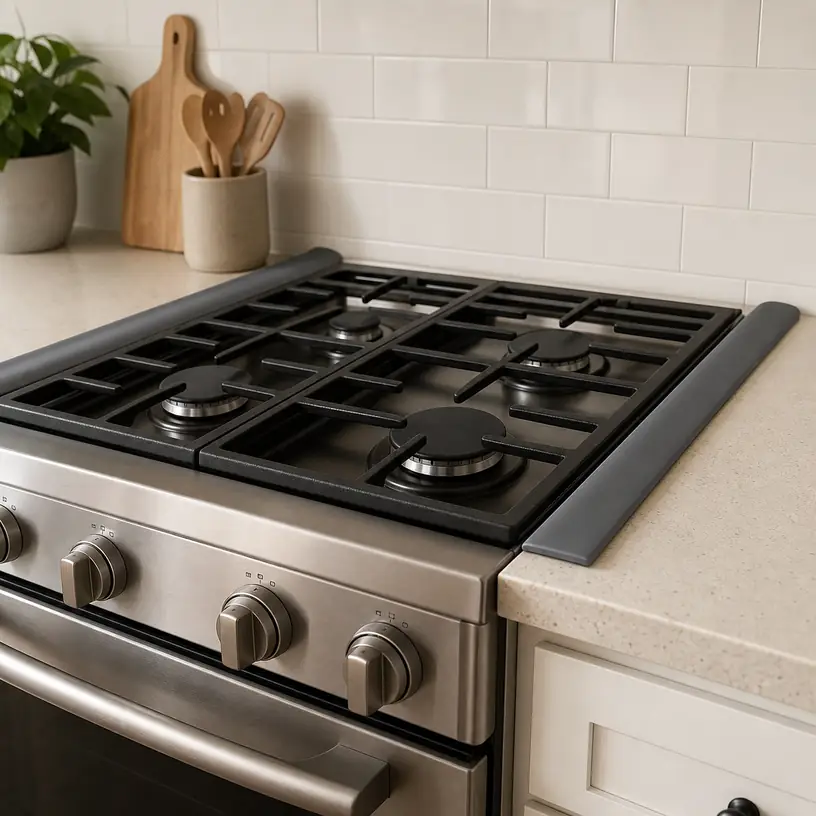
Illustrative image, not an official product photo.
Short answer
A stove gap cover should bridge the seam beside a range without interfering with controls, ventilation, appliance movement, or safe clearances. Measure the gap at the front, middle, and back on both sides; also note whether the counter and range top are level. Flexible T-shaped strips can adapt to modest variations when their center fin fits the seam, while flat strips need enough supported surface on each side. Before choosing either style, compare its full width, length, trim instructions, temperature limits, cleaning directions, and compatibility language with the range manual. A cover can catch crumbs at an awkward seam, but it cannot correct a poorly installed appliance or make an unsafe clearance acceptable.
Search reference
Stove gap cover options
Compare strip profiles, stated dimensions, trimming methods, material guidance, and cleaning instructions against the two seams in your kitchen.
View matching optionsMap the seam from front to back
The space beside a range rarely behaves like one tidy measurement. Cabinets may be slightly out of square, the appliance can sit closer to one counter than the other, and a raised edge or control panel may interrupt the back of the seam. Measuring only at the front can lead to a strip that pinches halfway along or leaves an opening where spills are most likely to disappear.
With the appliance cool and in its normal position, measure each seam at several points without moving the range merely to make the numbers look uniform. Record the narrowest and widest sections. Then measure the usable run from the front edge to the first obstruction at the rear. Left and right sides deserve separate notes; there is no guarantee they match.
Height is just as important as width. If the range top sits below the countertop, a very soft flat strip may sag toward the appliance. If it sits higher, a rigid cover may tilt or rock. Look at the cross-section shown in the listing and ask where it will actually rest. Product length alone says little about whether the profile can handle that height difference.
Who this is for
- Households that regularly find crumbs or light splashes in the narrow seams beside a freestanding or slide-in range.
- Renters who want a removable solution and are permitted to place one without adhesive or appliance modification.
- Cooks whose counters and range provide continuous, unobstructed support for the profile specified by the cover maker.
- People willing to remove the strips for cleaning rather than treating them as a permanent seal.
- Buyers who can check the range manual and current product instructions before placing an accessory close to a cooking appliance.
Who should skip it
- Skip a cover if the range manual prohibits accessories in that location or requires the seam to remain open for airflow, movement, or service access.
- Do not use a decorative strip to conceal an installation problem, unstable appliance, damaged counter edge, gas odor, electrical concern, or inadequate clearance.
- A poorly fitting cover is not useful when controls, burners, vents, doors, or cookware can contact it.
- Built-in cooktops and unusual commercial-style ranges may require a different solution specified by the appliance or counter manufacturer.
- Anyone unable to confirm the material’s permitted temperature and placement should leave the area clear until compatibility is established.
What to verify before buying
- Measure the gap width at multiple points on both sides and compare the complete range with the cover’s stated fit range.
- Check the counter-to-range height difference and identify which surfaces will support the strip.
- Compare usable seam length with the product’s actual length, then read whether and how it may be trimmed.
- Inspect the profile dimensions: top width, center-fin width and depth, edge thickness, and any end caps or raised lips.
- Confirm compatibility with the appliance type and follow the range maker’s clearance, ventilation, and accessory instructions.
- Review the material description, stated temperature limits, and restrictions around burners, hot cookware, flames, and oven vents.
- Check whether the strip relies on friction, adhesive, magnets, clips, or simple surface contact; verify that the attachment method suits both adjoining surfaces.
- Read cleaning directions, including whether the cover must cool before removal and whether hand washing or dishwasher cleaning is permitted.
- Confirm package quantity. A photo showing both sides of a range does not necessarily mean two strips are included.
- Look for color and finish descriptions under ordinary kitchen lighting rather than assuming a styled photo will match the appliance or counter.
Flat strips and T-shaped profiles solve different fit problems
A flat cover spans the seam from above. Its broad top can create a simple visual line, but it needs adequate contact on the range and counter to remain level. If the surfaces have a large height mismatch, the strip may lean, curl, or leave an edge that catches during wiping. Measure the available landing area as well as the open gap, especially near raised trim and rounded counter edges.
A T-shaped cover adds a center fin that drops into the seam. That fin can help locate the strip and reduce sideways movement, provided it is narrow enough to enter the tightest section and deep enough for the intended design. A fin that is too wide will bunch up; one that is too narrow may not stabilize the cover. Check whether the maker allows the fin to be trimmed, because cutting the wrong part can change how the strip sits.
Rigid metal-style bridges offer another look but tend to demand more consistent geometry. Curves, rolled edges, end pieces, and attachment hardware all affect fit. Magnets only help where the relevant appliance surface and cover design are magnetically compatible; a nearby stainless-looking panel should not be assumed to hold them. Adhesive may reduce movement, but it adds questions about heat exposure, residue, surface finish, removal, and rental rules.
Heat guidance matters more than a color match
A gap cover lives near an appliance, yet exact conditions vary by range design and burner use. Oven vents may direct warm air through the rear or side area, oversized cookware may extend beyond a burner, and a gas flame can behave differently from an electric cooking element. A generic material label does not prove suitability for every location on every range.
Start with the appliance manual. Identify vents, required openings, hot-surface warnings, cleaning-cycle instructions, and accessory restrictions. Then compare those requirements with the current cover instructions and stated temperature limits. Keep the strip away from any area the instructions exclude, and never let it overlap a burner, flame, heating element, control, or moving door.
Fit should be checked again during ordinary use without touching a hot strip. Curling, discoloration, odor, softening, or movement can indicate that the product is unsuitable for the conditions or placement. Turn off the appliance and follow the relevant safety directions if something appears wrong. Do not improvise with tape, caulk, or another material merely to hold a heat-exposed cover in place.
Trimming should preserve the intended profile
Many covers are sold in a standard length because appliance depths differ. A neat cut can keep a strip clear of a rear obstruction or align it with the counter front, but only when trimming is explicitly permitted. Read which end or section may be cut and what tool is recommended. A hollow profile, metal insert, magnet, cap, or adhesive channel can make a seemingly simple cut unsuitable.
Mark each side separately. Place the uncut, cool strip in position as the instructions allow, note the actual endpoint, and account for any required clearance. Removing a small amount at a time is safer than trying to restore material after an aggressive cut. Rounded front corners or manufacturer-supplied end pieces may affect which end should remain visible.
A cut edge should not expose sharp reinforcement, scrape the counter, or interfere with removal. If trimming creates an uneven profile that no longer lies as designed, choose a more suitable size rather than forcing it into the seam.
Cleaning works best when the cover stays removable
Gap covers intercept residue instead of eliminating it. Crumbs can collect along the edges and fine liquid can travel beneath a strip that is not a sealed barrier. Plan to lift and clean both the accessory and adjoining cool surfaces at an interval appropriate for the way the kitchen is used.
Follow the product directions for removal and washing. Flexible-looking material is not automatically dishwasher safe, and decorative coatings or attached magnets may require gentler care. Let the appliance and surrounding surfaces cool before handling the cover. Dry the seam and strip as directed before replacing it so trapped moisture does not remain hidden.
During cleaning, inspect the profile for cuts, hardening, warping, loose pieces, or residue that prevents it from sitting flat. Also confirm that the range has not shifted. If a cover suddenly fits differently, remeasure rather than stretching, wedging, or gluing it into position.
Limitations
- A cover reduces direct access to a seam but does not create a watertight or food-safe seal unless the exact product documentation explicitly says so.
- Irregular gaps, uneven counters, raised range edges, and rear obstructions can defeat an otherwise suitable profile.
- Flexible strips can curl, discolor, collect residue, or move when the fit and support are poor.
- Rigid strips are less forgiving of changing gap width and differences in surface height.
- Adhesive or magnetic features depend on compatible surfaces and may complicate cleaning or removal.
- Heat exposure varies with appliance design, cookware, ventilation, and cooking habits; a broad material claim cannot replace the stated limits.
- The strips must be removed periodically to clean underneath them.
- A gap cover cannot repair cabinetry, level a range, correct appliance clearances, or replace qualified service.
Alternatives to compare
- Leaving the seam uncovered and cleaning it with a narrow crevice tool after the appliance is cool.
- An appliance-manufacturer accessory specifically listed for the exact range model.
- A counter-mounted filler installed by a qualified professional when the cabinetry and appliance design permit it.
- Repositioning or leveling the range according to its installation instructions if the seam is uneven because the appliance has shifted.
- A removable crumb-catching tray beneath the side area when the appliance design allows access and the maker’s directions permit it.
- Cabinet or countertop correction during a planned kitchen renovation when the gap comes from a persistent installation mismatch.
FAQ
How wide a gap can a stove gap cover bridge?
There is no universal width because flat and T-shaped profiles use different dimensions. Measure the seam at the front, middle, and back on each side, then compare both its narrowest and widest points with the stated fit range. For a T-profile, also verify the center fin rather than looking only at the width visible on top.
Should a stove gap cover be level with the countertop?
It should sit in the position described by its maker without rocking, sagging, obstructing the range, or creating an awkward raised edge. A counter-to-range height difference changes how the cover is supported, so compare that difference with profile drawings and compatibility guidance before ordering.
Can stove gap covers be cut shorter?
Only trim a cover when the current instructions permit it. Confirm which end or section can be cut, the recommended tool, and whether the design contains magnets, reinforcement, adhesive, or end caps. Measure the left and right sides independently before cutting.
Are silicone stove gap covers safe near heat?
A silicone description by itself is not enough to establish safe placement. Check the exact product’s stated temperature limits and restrictions, then follow the range manual regarding vents, burners, flames, clearances, and accessories. Stop using a strip that changes shape or condition in a way the instructions identify as a problem.
Do gap covers stop every spill from reaching the floor?
No. They can intercept crumbs and some light splashes, but edges and an unsealed underside may still allow liquid or fine debris through. Remove the covers after the area cools and clean beneath them according to the product and appliance directions.