Salad Spinners: Choose a Bowl That Fits Your Washing Routine
Product links are for reference. Verify current details on the retailer page before buying.
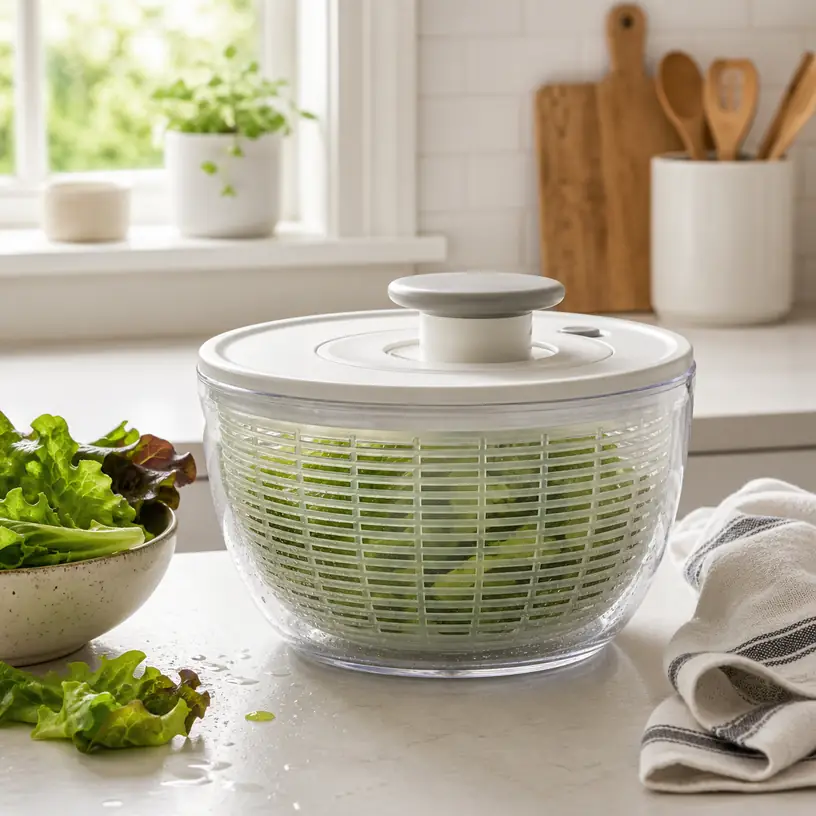
Illustrative image, not an official product photo.
Short answer
A useful salad spinner should hold the amount of greens you normally wash without crowding them, stay steady while the basket turns, and come apart without turning cleanup into another project. Capacity is only one part of the choice: compare the inner basket dimensions, crank or pump mechanism, lid controls, drainage method, and the cabinet space the assembled bowl consumes. A compact spinner can be enough for herbs and one-person salads, while a larger bowl better suits whole heads of lettuce or meal prep. The goal is not maximum speed. It is removing enough surface water for dressing to cling and for washed greens to be easier to store, without bruising delicate leaves or filling the sink with awkward parts.
Search reference
Salad spinner options
Compare basket capacity, spinning control, brake design, base stability, drainage, and cleaning instructions against the greens you prepare each week.
View matching optionsPicture the full wash-to-table routine
A spinner sits between several steps: separating leaves, rinsing away grit, draining the first rush of water, spinning, and then moving the greens to a bowl or storage container. Think through that sequence before choosing a design. If you rinse produce directly in the removable basket, its holes and handles should make it comfortable to lift from the sink. If you fill the outer bowl with water to loosen soil, you will need a controlled way to pour out a heavy bowl without losing leaves.
The amount you prepare also changes what “large enough” means. Loose herbs occupy little space but can be delicate. A head of romaine produces long pieces that may not settle into a shallow basket. Several servings of mixed greens need room to tumble; tightly packed leaves cannot move freely, even when the advertised bowl volume sounds generous. Compare usable basket dimensions rather than relying on the outside diameter alone, because the drive assembly and taper can reduce working space.
Finally, decide what happens after spinning. Some outer bowls are shaped to serve at the table, while others are primarily utility containers. That second use may save a dish, but only if the bowl is comfortable to hold, pours cleanly, and suits your table. It should be treated as a bonus rather than a reason to overlook an inconvenient mechanism.
Spin mechanisms feel different in a busy kitchen
Crank and side-handle designs
A crank turns the basket through repeated circular motion. It gives the user direct control over acceleration and can be easy to slow by simply stopping the handle, though the basket may continue coasting. Look at the crank’s folded and operating positions. A prominent handle can improve grip but make the lid difficult to stack or store.
Side-handle mechanisms use a back-and-forth or rotational action near the edge of the lid. They may keep the top lower than a tall center crank, but require enough clearance beside the bowl. Consider whether the supporting hand has a secure, dry place to hold the spinner while the other hand operates it.
Pump and pull-cord controls
A pump is usually pressed downward several times to build basket speed. This action can suit a spinner placed on a stable counter, and some pumps lock down for storage. Check whether the control remains tall when locked and whether the lock can be operated without forcing it. The pumping motion also transfers force into the base, making nonslip contact especially relevant.
Pull-cord models translate a straight pull into rotation. They can feel quick and keep one hand away from the lid center, but the cord path, retracting action, and handle storage deserve attention. Confirm the current cleaning instructions for the enclosed mechanism; a lid with an internal cord assembly may not be intended for soaking or dishwasher cleaning.
No mechanism guarantees better drying by itself. Basket load, how thoroughly water was drained first, leaf shape, and the length of the spin all affect the result. A separate brake button can stop the basket more predictably, but inspect where that control sits and whether it is easy to press without destabilizing the bowl.
Who this is for
- Households that regularly wash whole or loose leafy greens rather than relying only on ready-to-serve packages.
- Home cooks who want dressing to coat leaves instead of being diluted by rinse water.
- Gardeners and market shoppers dealing with herbs or greens that need a thorough rinse and drain.
- Meal preppers who wash several servings at once and want more control over surface moisture before storage.
- Cooks who would use the removable basket as a colander for produce beyond salad leaves, within the maker’s stated guidance.
Who should skip it
- Skip a dedicated spinner if greens are rare in your routine and a colander plus clean kitchen towels already handles the occasional batch.
- A full-size model is a poor fit for a kitchen without a realistic cabinet, shelf, or counter location for the assembled bowl and lid.
- Avoid assuming vigorous spinning is suitable for every delicate herb, berry, or prepared food; follow appropriate washing guidance and the product’s stated uses.
- A spinner does not replace proper produce handling, clean hands, a clean sink, or food-storage practices.
- If pumping, cranking, or pulling is uncomfortable, compare the operating movement carefully rather than choosing only by capacity.
What to verify before buying
- Usable basket size: Check inner diameter, depth, and any central spindle or raised base that takes space away from the greens.
- Typical batch fit: Match the basket to long lettuce leaves, loose greens, herbs, or smaller portions rather than aiming for the largest bowl available.
- Control style: Compare crank, pump, side-handle, or pull-cord motion and the hand position each requires.
- Braking: Determine whether there is a separate brake, how it is activated, and whether the basket stays contained as it slows.
- Base stability: Look for a broad base and the maker’s description of any nonslip ring or feet; these features still require a clean, suitable surface.
- Water removal: Check whether water is poured through the lid, drained after removing the basket, or released through another opening.
- Lid construction: Inspect seams around the drive mechanism and confirm whether the lid separates for cleaning.
- Care guidance: Verify which individual parts are currently described as dishwasher suitable and whether rack placement or hand washing is specified.
- Storage dimensions: Measure diameter and full height with the lid fitted, including handles or controls that do not fold down.
- Current contents and materials: Confirm every included part and the food-contact material wording on the current listing instead of judging from photos.
Capacity without wasted cabinet space
Bigger bowls give leaves room to move, but oversized equipment creates its own friction. A spinner that lives behind several appliances may not be used often enough to justify its footprint. Measure a likely storage spot before ordering, including door frames, shelf supports, and the clearance needed to lift the lid. Round bowls also leave unused corners in rectangular cabinets, so their diameter can matter more than volume.
Compact spinners are easier to store and may suit herbs, baby greens, or one or two portions. The tradeoff is batching: overfilling reduces movement, while splitting a head of lettuce into repeated loads adds time. If your routine alternates between small herb bundles and large salads, a medium basket may offer a more practical compromise than buying around the largest meal of the year.
Nesting can soften the storage cost. Some users keep the clean basket inside the outer bowl, but the lid still needs a home and all pieces should be dry before assembly. A flat or locking control may allow other lightweight items to sit nearby; do not assume the top is designed to support weight. Check the stated dimensions in both operating and storage positions.
Drainage, balance, and leaf handling
A spinner works by moving water away from the greens and through the basket openings. Drain free water before accelerating the basket; leaving the outer bowl full defeats the purpose and adds unnecessary mass. If a lid has a pour opening, consider how you will hold the bowl during draining and whether leaves remain securely contained. A transparent outer bowl can help you see collected water, but visibility does not confirm that the greens are fully dry.
An uneven load may make the spinner wobble. Distribute leaves around the basket and start at a controlled pace. Very long leaves can bunch on one side, while a few small herbs may lift or cling. Pausing to rearrange a load can be more effective than forcing the mechanism faster. Product instructions should take priority for maximum fill and operating technique.
Surface moisture is not the only consideration when greens are headed for storage. Damaged leaves, trapped soil, container choice, temperature, and time all matter. A spinner is a preparation tool, not a promise of a particular storage life. After use, empty collected water and clean food-contact surfaces so residue from one batch does not remain for the next.
Cleaning the mechanism matters
The basket and outer bowl are usually visually straightforward; the lid is where designs diverge. Gears, cords, springs, brake parts, and seams can retain water if the lid is submerged contrary to its care instructions. Read the current cleaning guidance for each component separately. A listing that describes the bowl as dishwasher suitable does not necessarily make the assembled lid suitable as well.
Removable lid plates may improve access, but only if they release and reinstall without excessive force. Look for instructions rather than prying at seams that merely appear detachable. After washing, allow enclosed areas and nested parts to dry as directed. A lid stored while damp can undermine the convenience of a tool intended to make produce preparation cleaner.
Basket holes also deserve a quick inspection after herbs or torn leaves. Fine stems can catch around the base, and residue may remain where the basket meets its hub. An uncomplicated basket with accessible surfaces may be more useful than an elaborate one if salad prep happens several times a week.
Limitations
- A salad spinner removes surface water but does not wash produce automatically or make food safe regardless of handling.
- Advertised bowl capacity may not represent the comfortable working load for bulky or long leaves.
- Fast rotation can bruise delicate ingredients, especially when the basket is crowded or unbalanced.
- Nonslip features reduce movement only under appropriate conditions; wet or uneven counters still require care.
- Enclosed lid mechanisms may demand different cleaning methods from the bowl and basket.
- Even a compact spinner occupies more storage space than a basic colander or towel method.
Alternatives to compare
- Drain greens in a colander, then spread or gently roll them in clean kitchen towels when storage space matters more than speed.
- Use a clean mesh produce bag with an appropriate manual drying method only where you can control splashing and follow safe handling practices.
- Choose a collapsible colander for rinsing and draining if removing every visible droplet is not central to the recipe.
- Wash smaller portions as needed rather than processing a full batch if refrigerator storage, not drying speed, is the main concern.
- Compare a compact herb spinner when most loads are small and a family-size bowl would stay largely empty.
FAQ
What size salad spinner should I get?
Choose around your common load, not the largest salad you might make once a year. Compare the inner basket diameter and depth with a typical head of lettuce or portion of loose greens, then confirm the assembled spinner fits your storage space. Leaves need room to move, so the useful load is smaller than the bowl’s full volume.
Does a salad spinner make lettuce completely dry?
It can remove a substantial amount of surface water, but results vary with the load, leaf shape, initial draining, and spin time. Water may remain in folds or near thick ribs. Inspect the greens and use a clean towel for any remaining moisture when the recipe requires it.
Is a pump salad spinner better than a crank model?
Neither mechanism is universally better. A pump uses repeated downward pressure and works best on a stable surface; a crank uses a circular hand motion and may provide more direct speed control. Compare hand comfort, lid height, braking, storage, and cleaning rather than choosing by mechanism name alone.
Can the outer bowl be used to serve salad?
Some outer bowls may be suitable for serving, but verify the product’s stated use and material guidance. Also consider grip, appearance, pour shape, and whether you need the bowl again for another batch. Wash and dry it as directed before bringing it to the table.
How should I clean a salad spinner lid?
Follow the instructions for that specific lid. The bowl and basket may have different care guidance from a lid containing gears, a pump, or a retracting cord. Do not assume an enclosed mechanism can be submerged or placed in a dishwasher, and let all parts dry before nesting them for storage.