Travel Jewelry Organizers: Keeping Chains, Studs, and Rings Separated
Product links are for reference. Verify current details on the retailer page before buying.
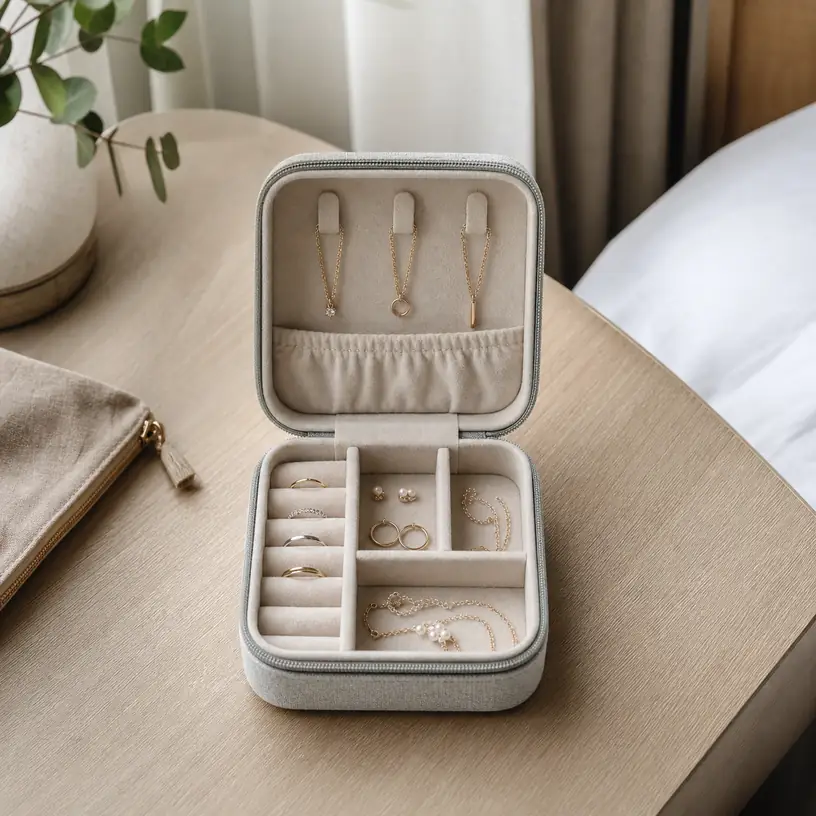
Illustrative image, not an official product photo.
Short answer
A useful travel jewelry organizer keeps delicate pieces from meeting one another in transit. Start with what you actually pack: necklace chains need individual anchor points and enclosed pockets, studs need holes that are easy to reach from both sides, rings need a padded bar or divided space, and rigid bangles need enough internal width. Then compare the organizer’s closed dimensions, depth, empty weight, zipper path, lining, and the way each section stays covered when the case is turned or compressed inside a bag. A tiny case can work for a weekend pair of earrings and two rings, while a longer trip or several necklaces may call for a flatter roll or a structured case with more separation.
Search reference
Travel jewelry organizer options
Compare the closed size with your packing space, then inspect necklace anchors, earring access, ring capacity, compartment depth, lining, and closure details.
View matching optionsLay out the pieces before choosing the case
The number of compartments tells only part of the story. A tray of small squares may suit rings and stud earrings but leave no safe route for a long pendant chain. A row of necklace hooks may look generous until wide pendants overlap below them. Before comparing organizers, place the jewelry intended for a typical trip on a soft, clear surface and group it by storage need rather than by appearance.
Count complete pairs of earrings, not individual pieces. Note the longest necklace from clasp to pendant, the widest rigid bracelet, the tallest ring setting, and any item with a sharp post or fragile projecting detail. Decide which pieces should never touch. These observations create a practical packing map and make product photos less persuasive than usable measurements and construction details.
Consider whether every piece needs to travel. A smaller, deliberately chosen set can be easier to secure, inventory, and coordinate than filling every slot. Photographing the planned selection for your own reference can also make repacking easier. For valuable or irreplaceable items, review travel and insurance considerations separately; an organizer provides separation, not security or loss protection.
Who this is for
- Travelers who bring several small jewelry pieces and want them separated from toiletries, cables, and loose items in a bag.
- People who find necklace chains tangled after using a shared pouch or zip-top bag.
- Wedding guests, event attendees, and business travelers carrying a few coordinated accessories for different outfits.
- Anyone who wants a repeatable way to count earrings, rings, and necklaces when packing and checking out of a room.
- Travelers choosing between a compact hard-sided case, a slim folding book, or a jewelry roll based on a specific packing list.
What to verify before buying
- Closed measurements and weight: Compare length, width, depth, and empty weight with the exact suitcase pocket, personal-item compartment, or hotel-safe space you expect to use.
- Necklace separation: Check the number and spacing of anchors, the position of any lower pocket or elastic, and whether pendants have room without stacking.
- Earring access: Confirm how studs and hooks attach, whether both sides of the panel are reachable, and where backs will sit when the organizer closes.
- Ring storage: Look at the bar diameter, usable length, attachment method, and clearance for raised settings rather than estimating capacity from a photo.
- Compartment depth: Make sure thicker pieces will not press against the lid, zipper, mirror, or neighboring jewelry.
- Interior surfaces: Review the current material description, seams, exposed hardware, and any rough hook-and-loop edges that could contact delicate finishes.
- Closure and containment: Determine whether internal sections stay covered when the case is held vertically, inverted, or placed beneath soft luggage.
- Removable parts: Check whether pouches, trays, or dividers remain secure during transit and whether unused fasteners can snag chains.
- Care guidance: Verify the listed cleaning method and allow the case to dry fully before jewelry is returned to it.
- Seller and return details: Confirm current specifications, included components, return terms, and seller information before ordering.
Match the format to the packing job
Structured cases protect the layout
A box-style case can preserve compartments and make small pieces easy to see on a dresser. Its shape is especially useful when rings or earrings have raised details that should not be flattened. The tradeoff is fixed volume: a case occupies roughly the same space whether it holds two pieces or every compartment is full. Rounded corners may pack more smoothly, but the outside measurements still need to fit the intended pocket.
Do not treat a firm shell as impact-proof. Check the stated construction and closure rather than assuming a case can protect jewelry from a hard drop or from heavy luggage placed on top. Pack it where crushing pressure is limited, and keep it under your control according to the needs and value of its contents.
Folding books favor a slim profile
Book-style organizers typically spread storage across panels and fold into a relatively flat package. They can separate studs, rings, and chains without the depth of a box. Look closely at the hinge area and the order in which sections fold. Jewelry near a crease may shift or press against an adjacent panel, especially when every position is occupied.
A flat organizer also needs enough closed depth for earring backs, pendants, and ring settings. If photos show only the empty case, seek listed interior dimensions and closure details. A zipper that closes easily when empty may become strained when hardware protrudes from both sides of a panel.
Rolls adapt to narrow luggage spaces
A jewelry roll wraps flexible layers around the contents and can fit along the edge of a packing cube or inside a narrow drawer. Separate zip pockets are useful for pieces that do not need rigid support, while tabs or loops may help route chains. Rolling too tightly, however, can place pressure on raised settings or bend pieces not intended to flex.
Check the roll’s dimensions both open and closed, how it is secured, and whether pocket zipper pulls or other hardware will sit against jewelry in the next layer. A soft roll is an organization tool, not a protective case for every item.
Give each jewelry type the right kind of space
Necklaces need separation along more than one point. An upper hook can hold the clasp end, but the lower portion of the chain and pendant also needs restraint. Look for enough distance between anchors and a lower pocket, elastic band, or individual covered section that prevents chains from drifting together. Very long chains may need to be gently routed according to their design rather than doubled sharply around a small tab.
Stud earrings require access to both the decorative front and the backing. A panel crowded against the case wall can make backs difficult to install or remove. Check whether long posts could contact the opposite surface when the case closes. Hook earrings may need a covered pocket or a panel designed for their shape so they cannot lift free during movement.
A ring bar should be evaluated with the actual ring profiles in mind. Low bands use space differently from wide rings or raised settings. Check how the bar opens and closes and whether removing one ring requires sliding off every piece before it. Individual compartments may offer quicker access, but loose rings can migrate if the lid does not sit close enough above the dividers.
Rigid bracelets, watches, brooches, and statement earrings often exceed the scale suggested by a compact case. Measure them. A large open compartment may be more appropriate than trying to force them into a specialized slot. Keep clasps, posts, and hard edges from bearing against softer pieces, and follow the jewelry maker’s care and storage guidance where available.
Pack it so the layout survives the trip
Load the organizer on a stable, well-lit surface. Fasten necklace clasps, secure earring backs, close internal pockets, and check that nothing crosses the outer zipper path. Gently move the closed organizer through the orientations it may encounter—upright, flat, and on its side—without shaking it aggressively. Reopen it to see whether small pieces escaped their sections or chains moved into contact.
Place the organizer where it will not be squeezed by shoes, bottles, or hard chargers. Liquids belong in appropriate closed containers and should remain separate; a zippered jewelry case should not be assumed to resist a toiletry spill. If the organizer goes into a personal item, make sure it does not sit where a laptop edge or overfilled outer pocket will press into it.
At the destination, use one consistent surface for opening and closing the case. Avoid sinks, drains, rumpled bedding, and dark carpet where a dropped backing can disappear. Return each piece to its assigned position after use rather than creating a loose pile beside the organizer. Before departure, compare the contents with your packing photo or written count and inspect drawers, the safe, and the immediate dressing area.
Who should skip it
- Use a small individual pouch or the original suitable case when you travel with only one durable item and do not need multiple compartments.
- Leave irreplaceable or very valuable jewelry at home when the trip, lodging, or transit plan cannot provide security appropriate to it.
- Choose a larger protective storage format for oversized, fragile, or sculptural pieces that would be compressed by a compact organizer.
- Skip panels with fixed holes or narrow loops when the jewelry shapes do not match those positions.
- A travel case is not a substitute for suitable long-term storage if the jewelry has specific humidity, tarnish-prevention, or material-care requirements.
Limitations
- Compartment counts do not reveal whether the spaces fit the height, width, and shape of particular jewelry.
- Soft rolls and folding organizers can transmit pressure from other packed items.
- A structured case still cannot guarantee protection against impact, crushing, theft, loss, moisture, or spills.
- Chains may tangle if anchors are too close, lower sections are not restrained, or the case is overfilled.
- Earring backs and small rings can migrate between dividers unless internal clearances keep sections contained.
- Mirrors, removable trays, magnetic details, and decorative hardware can consume usable space; verify how these features interact with the pieces being packed.
- Lining descriptions alone do not establish suitability for every metal, stone, coating, or finish.
- Search results and product specifications change, so current dimensions, materials, and included accessories need to be checked at the time of purchase.
Alternatives to compare
- Individual soft pouches for a very small selection, with each chain stored separately rather than combined in one bag.
- The original fitted box for a fragile or unusually shaped piece, if its size works with the travel plan.
- A compact divided pill-style case used only when its materials, compartment dimensions, and closure are appropriate for the jewelry; avoid assuming every container is suitable.
- A larger jewelry case kept at the destination when travel is frequent between the same two places.
- Bringing fewer pieces and choosing versatile accessories when minimizing luggage and tracking small valuables matter more than having many options.
FAQ
How do I keep necklaces from tangling in a travel jewelry organizer?
Choose separate anchors with enough spacing, fasten each clasp, and secure the lower chain and pendant in its own pocket or restraint. Do not layer several loose chains in one compartment, and reopen the case after a gentle orientation check to see whether the selected layout holds.
Is a hard jewelry case better than a jewelry roll for travel?
It depends on the contents and packing space. A structured case preserves compartment shape and may provide more clearance for raised pieces, while a roll can fit narrow spaces and adapt to a smaller load. Neither format should be assumed to resist crushing, moisture, or loss without confirming its construction and using an appropriate packing location.
What size travel jewelry organizer should I buy?
Build a typical trip selection first, measure the largest pieces, and choose the smallest organizer that gives them separate space without crowding. Check the case’s closed dimensions against the exact bag compartment where it will travel, including clearance for the zipper and surrounding items.
Can stud earrings stay on a panel while the case is closed?
Only if the panel provides access for the backs and enough closed clearance for the posts and fronts. Check the organizer’s design and dimensions carefully; long posts or raised earrings may press into the opposite surface or interfere with other stored pieces.
Does a travel jewelry organizer make valuables secure?
No. It helps arrange and separate jewelry, but it does not prevent theft, accidental loss, or damage in every situation. Decide what to bring based on the item’s value and replaceability, keep the case under appropriate control, and review lodging, transport, and insurance considerations separately.