Choosing a Dough Whisk for Bread, Batter, and Heavy Mixing
Product links are for reference. Verify current details on the retailer page before buying.
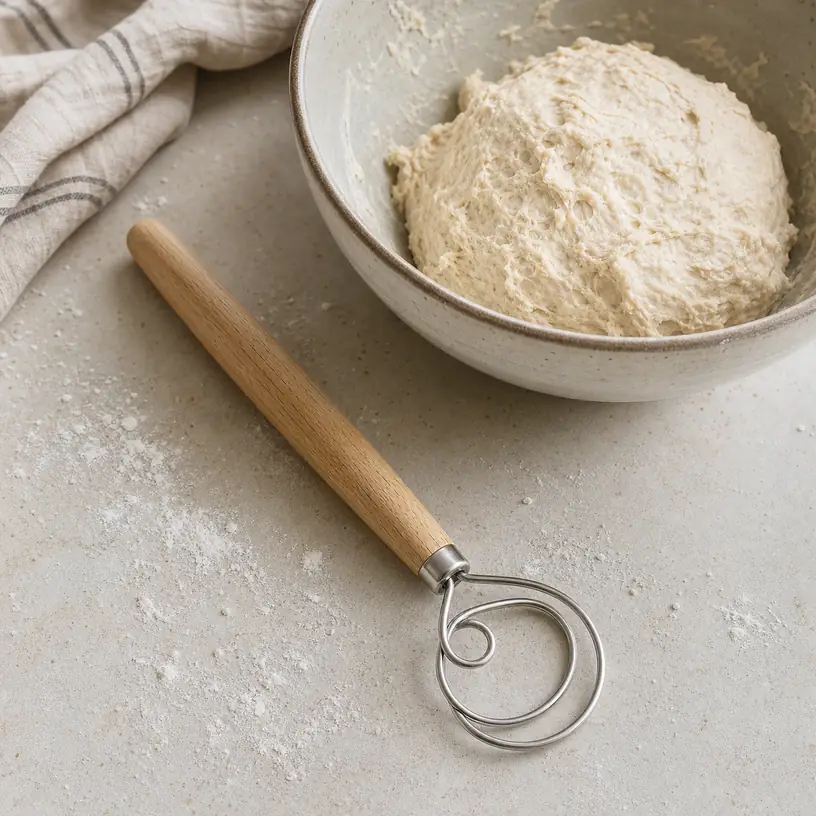
Illustrative image, not an official product photo.
Short answer
A dough whisk makes the most sense when ordinary balloon-whisk wires clog in a thick mixture but kneading has not yet begun. Look for a head that can move through your usual bowl without striking the sides, a handle long enough to provide leverage without becoming awkward, and smooth junctions that will not hold flour paste. The characteristic looped head can bring wet and dry ingredients together quickly for bread dough, muffins, pancakes, or other sturdy batters, yet it is not designed to aerate egg whites or finish gluten development. Base the choice on bowl size, batch volume, handle comfort, construction, and cleaning access—not on the number of loops alone.
Search reference
Dough whisk options for home baking
Compare head diameter, loop layout, handle length, attachment points, and care guidance against your mixing bowls and typical batch size.
View matching optionsWhere a dough whisk fits in the mixing sequence
Bread mixing has several stages, and this utensil is most useful near the beginning. Once liquid meets flour, a spoon may push a dense lump around the bowl while a fine balloon whisk fills with paste. A dough whisk uses a more open metal head to cut through dry pockets and pull ingredients toward the center. The goal is a roughly combined mass ready for resting, folding, or kneading by another method.
That role also explains its limits. Open loops do not create the fine aeration expected from a balloon whisk, and a handheld utensil cannot replace a stand mixer when a formula or baker calls for sustained mechanical kneading. It is better viewed as a bridge between measuring ingredients and working the developed dough.
Consider the mixture rather than the recipe label. A high-hydration bread dough, a stiff biscuit mixture, and pancake batter all resist the tool differently. If you mostly mix thin sauces, eggs, or whipped cream, a conventional whisk is more suitable. If your regular baking involves dense, sticky mixtures that only need to be combined evenly, the dough-whisk shape can be genuinely useful.
Who this is for
- Home bread bakers who mix dough by hand before folding, kneading, or resting it.
- Cooks whose balloon whisks repeatedly clog when flour first meets liquid.
- Small kitchens that need one uncomplicated manual mixing tool rather than another countertop appliance.
- Bakers preparing sturdy muffin, quick-bread, pancake, or biscuit mixtures where overmixing is a concern.
- People who prefer a broad handle and a pulling motion to gripping a thin spoon through a resistant batch.
Who should skip it
- Skip it if your main jobs are whipping cream, emulsifying a smooth sauce, or aerating eggs; a balloon whisk serves those tasks better.
- It adds little if a stand mixer already handles every bread batch from initial mixing through development.
- A large head can be frustrating in narrow measuring jugs or small bowls.
- Anyone who has difficulty with repeated wrist and forearm movement should compare a mixer or another method suited to their comfort.
- Do not expect the whisk to replace a dough hook, kneading, stretching and folding, or whatever development method the recipe requires.
Head size and loop geometry
The working head must be in proportion to the bowl. A broad head engages more mixture on each pass, which can help in a large batch, but it needs room to turn. In a small bowl it may knock the rim, leave ingredients in the corners, or send flour over the side. Compare the maximum head width and overall length with a utensil that already works well in your bowl.
Listings may show one loop, several concentric loops, coils, or related open-wire forms under the same general product name. More metal is not automatically more effective. What matters is whether flour and dough can pass through the open spaces while the head remains stable under resistance. Tight gaps may trap sticky dough; very open forms may miss small dry patches until the bowl is scraped.
Look at the head from the side as well as from above. A mostly flat profile reaches broad bowl bottoms differently from a deeper, three-dimensional form. Rounded bowls, straight-sided containers, and wide shallow mixing tubs each reward a different reach. Product dimensions and multiple viewing angles are more informative than a generic claim about mixing speed.
Handle leverage and control
Length changes both reach and force. A longer handle can keep fingers away from the dough and offer leverage in a deep bowl, but extra length magnifies wobble if the joint is weak. It also requires a larger drawer. A short handle feels direct in a compact bowl yet may place the hand close to wet ingredients.
Grip diameter deserves attention because thick mixtures ask for more force than a light batter. A broad, gently shaped handle can spread pressure across the palm; a very smooth cylindrical handle may rotate when hands are damp. Check side-view photos for abrupt ends or hardware that could press into the hand. Comfort claims are subjective, so measurements and handle shape should guide the comparison.
Wood, metal, and molded handles have different seams and care needs. A wood handle may need prompt hand washing and drying if the maker specifies it. An all-metal design can simplify the material transition but still needs a comfortable contour. Verify instructions for the complete tool rather than assuming the head material determines how the handle can be washed.
Construction details worth inspecting
Dense dough puts torque on the point where wire enters the handle. Search listings may not reveal long-term performance, but they can show how the parts meet. Look for a clearly described attachment method, smooth finished ends, and minimal recesses where hydrated flour can accumulate. Decorative collars can hide the junction, so confirm whether they create a cleanable seam.
Wire thickness affects stiffness, although exact measurements are not always provided. A head that flexes excessively may feel vague in a heavy batch, while a very rigid form transfers more resistance to the wrist. Material labels alone do not establish stiffness, corrosion behavior, or food-contact suitability. If those details are decisive, find explicit current specifications rather than inferring them from a polished surface.
After arrival, inspect the tool before using it. The loops should be secure and evenly finished, the head should not rotate independently of the handle, and no sharp wire tip or rough joint should be exposed. Those simple checks matter more than cosmetic finish.
What to verify before buying
- Maximum head width and depth relative to the bottom and sides of your usual bowl.
- Overall length, usable handle length, and the drawer or crock where the tool will live.
- Loop spacing and whether both sides of the head appear accessible for cleaning.
- How the metal head attaches to the handle, including seams, collars, welds, or fasteners.
- Handle shape, diameter, surface texture, and any hanging hole that affects the grip.
- Current material descriptions for every component rather than just the wire head.
- Hand-wash or dishwasher guidance for the fully assembled utensil.
- Whether the selected listing includes one whisk or a multipiece set.
- Return terms in case the head is too large for your bowls or the grip does not suit your hand.
Styled photographs often include bowls, proofing baskets, scrapers, or other baking accessories. Treat them as scene props unless the current package list specifically includes them.
A practical way to use it
Start with the mixing order given by the recipe; do not rearrange ingredients simply to suit the utensil. When dry and wet ingredients meet, use controlled strokes that pull through the center and sweep around the bowl. Rotate the bowl if that is safe and comfortable. Pause to scrape flour from corners with a flexible bowl scraper rather than forcing a large wire head into an angle it cannot reach.
As the mixture becomes cohesive, pay attention to resistance. The tool has likely finished its job when it is only dragging the dough as one mass rather than incorporating visible dry areas. Move to the next recipe step instead of continuing to churn a dough that needs resting, folding, or kneading.
For quick breads and muffins, stopping matters because unnecessary agitation can affect the result. A dough whisk may reduce clogged wires, but it does not prevent overmixing by itself. Follow the recipe’s visual cues and accept any appropriate small lumps rather than chasing an artificially smooth batter.
Cleanup before flour paste dries
Hydrated flour becomes stubborn around wire crossings and handle collars. Rinse or wash the utensil promptly according to its care instructions. Use a soft brush where the loops overlap if needed, and inspect both faces of the head. Avoid reaching between wires with fingers when a brush can do the job more safely.
A dishwasher claim should cover the handle as well as the metal loops. If the tool includes wood or bonded components, heat and prolonged moisture may have specific restrictions. Dry the joint thoroughly before putting the whisk in a drawer, particularly when the construction includes a collar or recessed opening.
Storage should not bend the loops under heavier utensils. A hanging hole can keep the head visible, while a roomy crock may suit a long handle. If it lies in a drawer, allow enough width that the head does not catch whenever another tool is removed.
Limitations
- A dough whisk combines ingredients but does not aerate like a balloon whisk.
- It cannot perform sustained kneading or guarantee proper gluten development.
- The open head still traps some sticky mixtures, especially around wire intersections.
- A head suited to a large bread bowl may be clumsy in a small batter bowl.
- Manual mixing still requires repeated hand, wrist, and forearm movement.
- Material names and loop counts do not by themselves establish strength, comfort, corrosion resistance, or cleaning ease.
Alternatives to compare
Sturdy mixing spoon: Familiar, easy to scrape against a bowl, and useful beyond baking, though a dense dough can gather into a heavy lump around it.
Flexible bowl scraper: Excellent for collecting dry pockets and turning sticky dough inside a curved bowl. It offers less reach and leverage for the first vigorous mixing strokes.
Balloon whisk: Better for thin batters, sauces, eggs, and aeration. Its fine wires tend to retain thick flour paste.
Stand mixer with dough hook: Useful for larger or repeated batches and recipes that call for mechanical development. It requires more space, setup, and cleanup.
Hands and stretch-and-fold methods: Direct feedback helps a baker feel hydration and development, but the suitable technique depends on the dough and recipe. A dough whisk can still handle the initial messy stage before hands take over.
FAQ
Is a dough whisk the same as a Danish dough whisk?
The names are often used for the same family of open-loop mixing tools, but actual head shapes and dimensions vary. Compare the pictured geometry, measurements, construction, and intended uses rather than assuming every product carrying either name is identical.
Can a dough whisk knead bread dough?
It can bring ingredients together and work through the early shaggy stage. It does not replace kneading, stretching and folding, a dough hook, or another development method when the recipe calls for one. Stop using the whisk when it is merely pulling a cohesive mass around the bowl.
What bowl size works with a dough whisk?
There is no single correct bowl size. The head needs enough room to turn and sweep without repeatedly striking the rim, while still reaching the bottom. Compare the head width and overall length with the internal dimensions of the bowls used for your normal batch.
Does a dough whisk work for pancake or muffin batter?
It can work well for sturdy batters because the open head combines wet and dry ingredients without filling with paste as readily as fine wires. Use the mixing cues in the recipe, since the utensil does not eliminate the risk of overmixing.
Are wooden-handle dough whisks dishwasher safe?
Do not assume they are. Care guidance varies with the wood, finish, attachment, and other construction details. Follow the instructions for the complete utensil; when hand washing is required, clean promptly and dry the handle and joint thoroughly.