Choosing a Magnetic Screen Door for Busy Patios and Pet-Friendly Homes
Product links are for reference. Verify current details on the retailer page before buying.
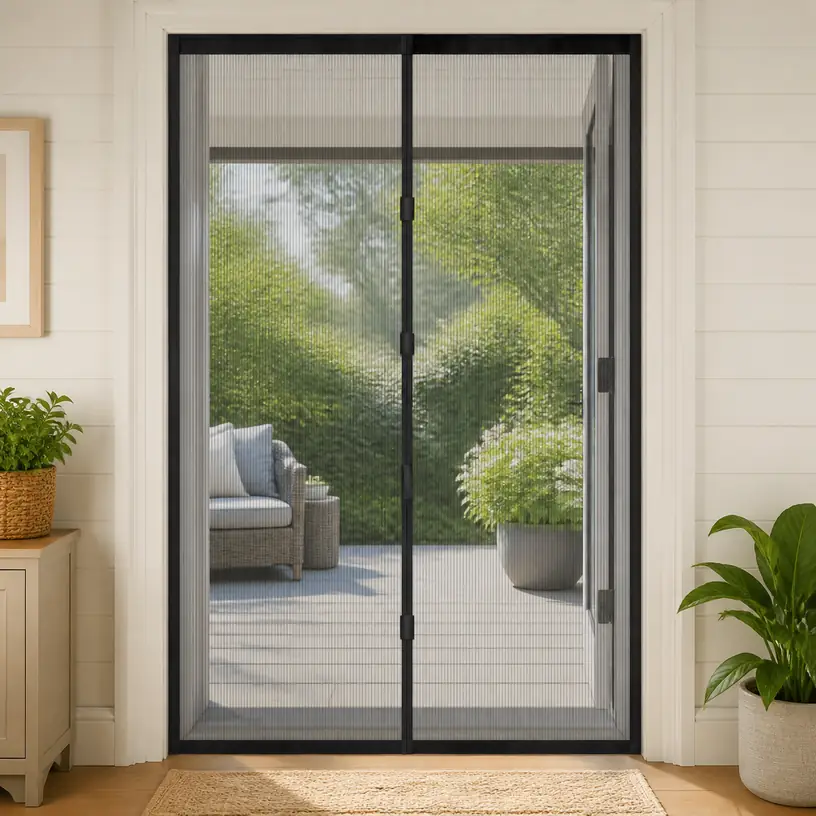
Illustrative image, not an official product photo.
Short answer
A magnetic screen door can make sense for a frequently used patio or back doorway when you want airflow while keeping the opening covered. Fit is the deciding factor: measure the inside of the frame, note where the mounting strips can attach, and compare those numbers with the finished dimensions rather than relying on a broad door-size label. For a household with children, pets, or armfuls of groceries moving through, also look closely at how the center seam opens, realigns, and closes near the floor.
Search reference
Compare magnetic screen door configurations
Use the current results to compare finished dimensions, mesh construction, center-closure layouts, mounting kits, and installation requirements for your doorway.
View matching optionsMeasure the opening, not the hinged door
A magnetic screen normally hangs around a doorway rather than replacing the hinged door itself. Measure the usable frame area from the points where the screen will actually attach. Record both width and height in more than one place, since trim, thresholds, and older frames may not be perfectly square. Then check whether the listed dimensions refer to the full screen, the opening it is intended to cover, or a nominal door size.
The center seam should fall where people can pass through without fighting the existing handle or latch. A screen that is stretched too tightly may not let the magnets meet naturally; one with too much extra material can drag at the threshold or bunch along the sides. If there is a sliding door, storm door, security door, or outward-swinging door in the same opening, map its movement before choosing a mounting position.
What this product type is
A magnetic screen door is a flexible mesh panel with a split down the middle. Magnets or weighted closures along that split are intended to separate as someone walks through and come back together afterward. Most versions use hook-and-loop strips, adhesive-backed fasteners, or a combination of temporary strips and reinforcing tacks around the frame.
It is a seasonal convenience product, not a structural replacement for a framed screen door. It will not lock an entrance, weather-seal a doorway, or provide the rigid barrier of a conventional screen. The useful comparison is therefore not just “does it fit,” but “does its mounting method and closing behavior fit this household’s traffic pattern?”
Who this is for
- Households that open a patio, porch, balcony, garage, or back door repeatedly in mild weather.
- People who often carry trays, laundry, garden supplies, or groceries through a doorway and value hands-free passage.
- Pet owners comparing a flexible passage with a permanently installed pet door.
- Renters who have permission to use removable fasteners and can test the frame finish first.
- Homes needing a screen for part of the year, with a dry place available for off-season storage.
Who should skip it
- Skip this format when the doorway needs security, a child barrier, or dependable pet containment.
- Choose a framed solution if strong wind regularly reaches the opening or the screen must stay taut at all times.
- Avoid adhesive mounting on crumbling paint, dusty masonry, damp wood, delicate finishes, or any surface the fastener instructions exclude.
- Look for another approach when an existing door swings through the only practical mounting plane.
- Do not assume a flexible screen will stop a determined pet from pushing around the edge or through the seam.
What to verify before buying
- Finished panel width and height, recommended opening range, and whether the screen can be trimmed.
- Required flat mounting space along the top and both sides of the frame.
- Mesh material wording, edge reinforcement, seam construction, and care instructions.
- Number and placement of magnetic or weighted closures, especially near the top and bottom of the seam.
- Included fasteners and whether optional tacks are suitable for your frame material.
- Threshold clearance so the lower edge will not drag, snag, or prevent the seam from settling.
- Current removal guidance, replacement-fastener availability, and storage instructions.
Traffic, pets, and closure behavior
For a busy doorway, closure layout matters more than a long accessories list. Compare product diagrams to see whether magnets run continuously, alternate with gaps, or are concentrated at specific points. More closure points do not automatically guarantee better performance: the panel still needs to hang evenly, and its bottom edge needs enough weight and clearance to settle after someone passes.
Pets introduce a different set of tradeoffs. A dog may learn to push through the seam quickly, while a cautious or small animal may need gradual introduction. Claws can catch loose mesh, and an excited pet can pull at a poorly secured edge. Treat “pet friendly” as a use-case description rather than a promise of durability or containment, and review the current construction and installation details accordingly.
Mesh descriptions can be difficult to compare across listings. Instead of assuming that a named fabric tells the whole story, look for clear information about weave, visibility, airflow, reinforced borders, and cleaning. Finer-looking mesh may improve the visual barrier while also collecting more dust or pollen; heavier-looking mesh may hang differently and reduce the view. The right balance depends on the doorway and how often it will be used.
Installation details that affect the result
Clean and dry the mounting surface according to the fastener instructions, then lay the screen flat and identify the top center before attaching it. Starting from the middle can help keep the center split aligned. It is usually better to test the hang and closure before pressing every adhesive section firmly or adding any optional tacks.
Check the seam from both sides. The panels should meet without needing to be pulled together, and the bottom should clear the threshold while remaining low enough to cover the opening. Open the main door fully, walk through several times, and watch for contact with handles, mats, trim corners, and door closers. A small alignment problem during a slow test can become much more annoying during normal household traffic.
Limitations
- Magnetic screens are not locks, weather doors, safety gates, or reliable animal-containment systems.
- Closure can be affected by uneven installation, wind, a sloped threshold, wrinkles, or contact with the main door.
- Adhesive performance varies with surface condition, temperature, humidity, preparation, and removal technique.
- Flexible mesh and edge binding can wear where pets, shoes, packages, or hardware repeatedly rub them.
- Dimensions, included fasteners, and installation instructions differ across current listings and must be checked individually.
Alternatives to compare
- A hinged framed screen door for a more rigid, permanent entrance.
- A retractable screen when keeping the opening visually clear is a priority.
- A sliding screen panel for a compatible patio-door track.
- A tension-mounted or track-based screen when adhesive is unsuitable for the frame.
- A professionally fitted screen for unusually wide, arched, uneven, or heavily used openings.
FAQ
How should I measure for a magnetic screen door?
Measure the frame area where the screen will attach, not only the hinged door slab. Take width and height measurements at multiple points, note the available flat trim, and compare them with the listing’s finished panel dimensions and recommended opening range.
Can a magnetic screen door work with an outward-swinging door?
It may, but only if the screen can mount on a separate plane without blocking the door’s swing, handle, closer, or latch. Sketch the direction of movement and verify the proposed installation position before buying.
Will a magnetic screen door keep pets inside?
It should not be treated as dependable pet containment. Many pets can push through the center seam or around a flexible edge. Use a secure door, gate, or other appropriate barrier whenever containment matters.
Are adhesive strips safe for a rental doorway?
That depends on the fastener, paint, frame material, surface condition, and lease rules. Get permission when needed, follow removal instructions, and test an inconspicuous area rather than assuming “removable” means damage-free on every finish.
What causes the center seam to stay open?
Common fit-related causes include an off-center installation, a panel stretched too tightly, excess material dragging at the bottom, wrinkles near the top, or interference from the threshold or main door. Wind and wear can also affect closure.