Reusable Silicone Stretch Lids: Matching Sizes to Bowls and Produce
Product links are for reference. Verify current details on the retailer page before buying.
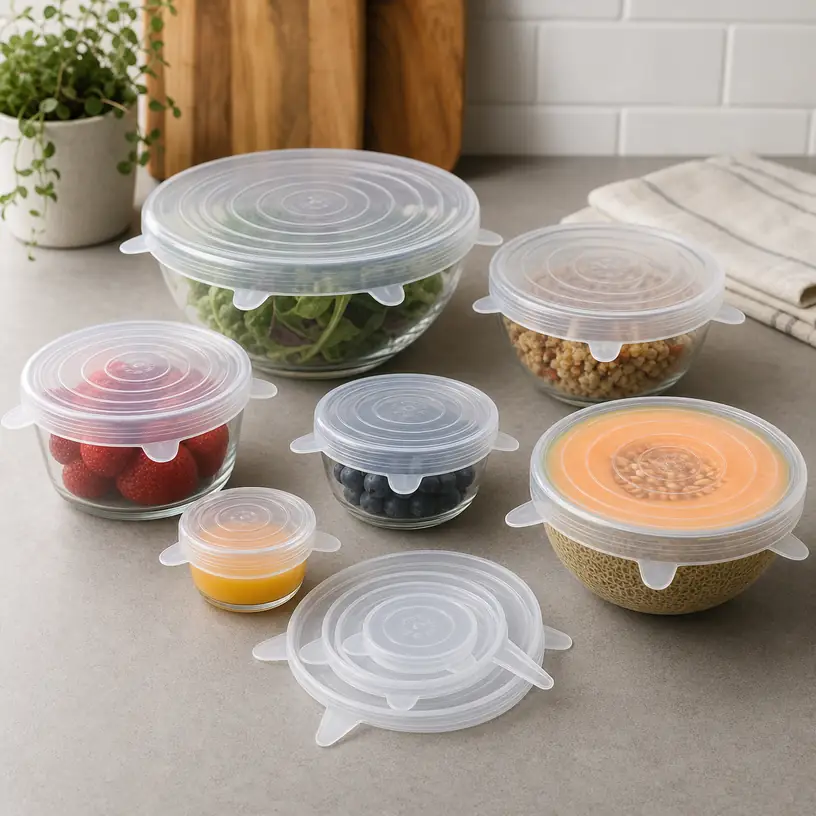
Illustrative image, not an official product photo.
Short answer
Reusable silicone stretch lids make the most sense when several lid sizes match containers you already reach for: a mixing bowl, an open can, half a melon, or a small leftover dish. Measure the outside diameter of those items instead of choosing by the number of pieces alone. Then compare the stated size range, compatible rim shapes, tab design, temperature guidance, and cleaning instructions. A lid still needs a clean, dry edge and an appropriate fit to stay in place.
Search reference
Reusable silicone stretch lid sets
Compare current size ranges, lid shapes, pull tabs, care directions, and stated container compatibility with the bowls and produce you plan to cover.
View matching optionsStart with six measurements, not a set count
A six-piece set sounds complete, but adjacent lid sizes may cover nearly the same group of containers while missing the large bowl that prompted the purchase. Make a short list of the items that regularly lose their original lids, and measure the widest part of each rim. For cut produce, measure the diameter near the cut face rather than the whole fruit.
Compare those measurements with the maker’s stated unstretched and supported ranges. Stretch is useful for creating tension, but it should not be treated as unlimited extra size. A lid pulled to its maximum may be difficult to position, more likely to slip during handling, and less convenient for everyday reuse. If two frequently used bowls fall between sizes, a mixed set with closer increments may be more practical than a bundle centered on very small containers.
Who this is for
- Households that often store leftovers in bowls without matching rigid lids.
- Small kitchens where a nested set of flexible covers takes less drawer space than many container lids.
- People who want temporary covers for cut onions, citrus, melons, or open cans when the size and shape are suitable.
- Shared kitchens where quick visual size selection matters more than a perfectly matched container system.
- Buyers willing to wash and dry flexible lids between uses and keep container rims clean before applying them.
Who should skip it
- Choose locking food-storage containers when spill resistance during commuting or bag transport is the priority.
- Keep purpose-made lids for containers that already have reliable fitted covers.
- Skip stretch lids if most cookware has pronounced handles, pouring spouts, or irregular rims that interrupt contact.
- Use another storage method when the food, temperature, or cleaning routine falls outside the current product’s stated guidance.
What to verify before buying
- Measure the outside diameter and note whether each target rim is round, square, rectangular, lipped, or irregular.
- Confirm the dimensions for every lid rather than relying on labels such as small, medium, or large.
- Check the stated material, food-contact information, temperature limits, and refrigerator, freezer, microwave, and dishwasher guidance.
- Look at the number and position of pull tabs, especially if wet or slippery lids are difficult for you to grip.
- Confirm whether the lids are intended for cans and cut produce as well as bowls and containers.
- Review care directions for oily foods, staining ingredients, odor removal, and full drying before nesting.
- Check whether the set includes a storage holder or whether the lids can be stacked without sticking together.
Rim shape decides whether stretch becomes grip
Flexible material cannot compensate for every container shape. A smooth, even rim gives the lid a continuous surface to wrap around, while a spout, side handle, thick rolled lip, or sharp corner can create a gap. Square and rectangular dishes also ask the material to travel farther around corners than around a circle with a similar width.
Container condition matters too. Moisture, oil, crumbs, or condensation on the contact area can reduce grip. Wipe the rim and your hands dry before stretching the lid evenly from opposite sides. If the lid repeatedly rides upward or distorts the container, move to the next size rather than forcing more tension. Very lightweight cups and bowls may flex or tip while a tight lid is being applied.
Tabs, texture, and a repeatable routine
Small tabs can help center a lid, pull it over a rim, and lift an edge later. Their usefulness depends on placement and thickness: a tiny tab may be hard to hold with wet hands, while several prominent tabs take slightly more room when lids are nested. A textured outer surface can also improve handling, but grooves may need extra attention during washing.
For an easier routine, assign the sizes to familiar objects before storing the set. For example, keep the lid that fits the everyday mixing bowl on top of the stack, and avoid tightly nesting damp pieces. Some sets use colors or molded size markings; verify whether those cues are visible enough to be useful once the lids are in a drawer.
Storage expectations and food safety habits
A stretch lid is a cover, not a promise that a bowl can be turned upside down or carried loose in a backpack. Keep covered containers upright unless the maker explicitly describes and demonstrates a different use. For soups, dressings, and other spill-prone foods, a rigid container with a locking lid is generally the more predictable transport option.
Follow ordinary food-storage practices regardless of the cover style. Refrigerate perishable leftovers promptly, use containers appropriate for the food, and discard food according to relevant safety guidance. Check the current instructions before exposing a lid to heat, freezing temperatures, sharp edges, or direct contact with a heating element. Replace a lid if it tears, remains tacky after cleaning, or can no longer hold its intended shape.
Limitations
- Real-world fit depends on rim geometry and surface condition, not diameter alone.
- A size range may describe possible stretch rather than the easiest everyday fit.
- Flexible covers can slip on wet, oily, dusty, or uneven edges.
- Strong-smelling or deeply colored foods may require more careful cleaning according to the maker’s directions.
- Stretch lids do not automatically make a container leakproof, stackable, or safe for travel.
- Pulling a small lid over a large rim can make application and removal unnecessarily difficult.
Alternatives to compare
- Rigid snap-on or locking containers for lunches and liquid leftovers.
- Elastic fabric bowl covers for low-tension countertop or refrigerator covering where appropriate.
- Flat silicone covers that rest on smooth bowl rims without wrapping around the sides.
- Reusable storage bags for portions that do not need to retain a bowl’s shape.
- Replacement lids from the container maker when only one frequently used piece is missing.
FAQ
How do I choose the right stretch-lid size?
Measure the outside diameter of the container rim and compare it with the individual lid dimensions and supported fit range. Select a lid that needs modest, even tension rather than the smallest one that can be forced over the edge.
Do silicone stretch lids fit square containers?
Some are described for multiple shapes, but corners, rolled rims, and side features can interrupt the seal. Check the current compatibility guidance and dimensions; a round-lid set should not be assumed to fit every square or rectangular dish.
Why does a stretch lid keep slipping off?
The lid may be too small or too large, or the rim may be damp, oily, uneven, or interrupted by a handle or spout. Clean and dry the contact area, center the lid, and try the next appropriate size without overstretching it.
Can a covered bowl be stored upside down?
Do not assume so. Stretch lids vary in fit and are not automatically leakproof. Keep the container upright unless the maker explicitly states that the specific lid and container combination supports another orientation.
How should reusable stretch lids be stored?
Wash and dry them according to the current care instructions, then stack or hang them without trapping moisture. A loose nested stack or simple holder can make sizes easier to separate than a tightly compressed bundle.