Choosing an Oven Thermometer You Can Read Through the Door
Product links are for reference. Verify current details on the retailer page before buying.
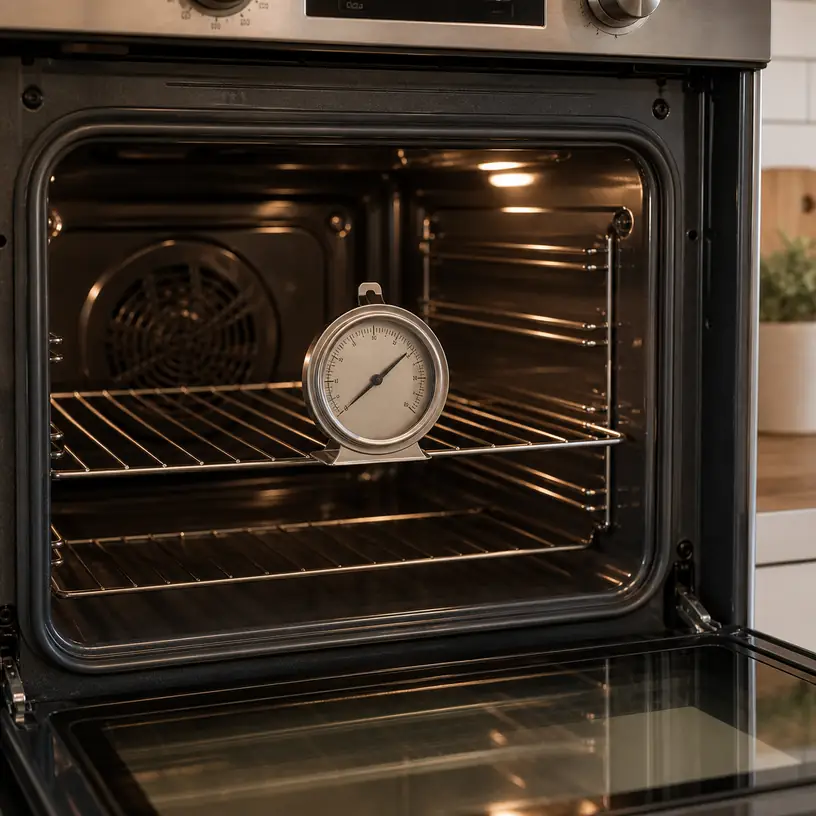
Illustrative image, not an official product photo.
Short answer
An oven thermometer is only useful if its scale is legible in the place where it will sit. Before comparing decorative dial styles, look at the temperature range, spacing between scale marks, pointer contrast, viewing angle, and whether the unit can stand securely or hang from your oven rack. The specified heat limit must cover your cooking routine, and the body should fit without touching an element, fan cover, wall, pan, or food. Treat its reading as a reference for understanding your oven, not as a substitute for following appliance instructions or checking food with the appropriate food thermometer.
Search reference
Oven thermometer options
Compare dial layouts, stated temperature ranges, mounting methods, dimensions, and use-and-care guidance for the oven you own.
View matching optionsBegin with the view from outside the oven
Product photos make nearly every dial appear easy to read because they are close, level, and brightly lit. Your real viewing position may be several feet away, above the rack, and behind tinted or reflective glass. A large case does not guarantee a useful display: scale marks can still be crowded, numbers can be small, and a thin pointer can disappear against a busy background.
Think about when you intend to read it. If you want to glance through the closed door, favor a clean scale with strong pointer contrast and numbers visible at the temperatures you use most. Check whether the oven light and window offer a clear line of sight at the intended rack height. If the door must be opened for every reading, temperature can change while you inspect the dial, and the hot rack becomes harder to approach safely.
Scale resolution and range work together. A very broad range can support more cooking modes, but fitting that range onto one dial may place the markings closer together. Compare the actual labeled intervals rather than assuming a larger maximum temperature produces a more useful instrument. Make sure the manufacturer’s stated operating range covers your routine, including any low-temperature or high-heat setting you genuinely plan to monitor.
Who this is for
- Bakers who want another reference point when cakes, breads, or cookies consistently finish earlier or later than expected.
- Renters and homeowners learning how an unfamiliar conventional or countertop oven behaves at their usual settings.
- Cooks who need a persistent oven-air reading rather than the quick internal-food reading provided by an instant-read thermometer.
- Households comparing heat at practical rack positions while staying within the appliance and thermometer instructions.
- Anyone replacing a dial that is hard to see, unstable on the rack, or unsuitable for the temperatures they commonly use.
Who should skip it
- Skip a dial model if your oven window, lighting, or required placement makes the face impossible to read without unsafe reaching.
- Do not use an oven thermometer as a meat, candy, frying, refrigerator, grill, or surface thermometer unless its instructions explicitly permit that job.
- Choose an appropriate probe system if you need to monitor food internally or read a display outside the closed oven.
- Do not place any thermometer in a microwave or under a broiler unless the exact product and appliance instructions specifically allow it.
- Contact a qualified appliance professional rather than relying on an accessory if the oven shows signs of malfunction or cannot operate as its manual describes.
What to verify before buying
- Compare the stated operating range and any restrictions for broiling, self-cleaning cycles, grills, toaster ovens, convection ovens, or other cooking modes.
- Examine the number size, pointer contrast, labeled intervals, and scale units; confirm whether Fahrenheit, Celsius, or both are shown.
- Check full case dimensions, including the hook, base, and any projection behind the dial.
- Confirm whether it hangs, stands, clips, or supports multiple positions, then inspect how those positions interact with your rack wires.
- Read the placement directions and minimum-clearance guidance for walls, elements, fans, pans, and food.
- Look for instructions about initial setup, settling time, comparison checks, adjustment, and what to do if readings appear inconsistent.
- Review cleaning directions and whether the face, joints, or base can trap grease; do not assume it can be submerged or washed in a dishwasher.
- Verify the package quantity and contents rather than inferring that multiple thermometers or accessories shown in a photo are included.
Hooks, bases, and rack geometry
A standing base is convenient when the rack has a flat area that remains clear during cooking. It also consumes usable rack space and may shift when a heavy pan slides past. A hanging hook preserves the surface below, but its viewing angle depends on rack height, wire direction, and the shape of the hook. Some designs offer both positions; that flexibility helps only when each position is stable and clearly described.
Measure more than the round face. The hook may extend well above it, the foot can be wider than the case, and a rear projection may stop the thermometer from sitting where you expected. In a countertop oven, even a modest dial can compete with the pan for limited clearance. Sketching the thermometer’s complete dimensions on paper is an easy way to test the footprint before ordering.
Placement can affect what the dial reports because an oven is not necessarily uniform from front to back or top to bottom. Follow the product and appliance directions, and keep the thermometer from contacting heating components, oven walls, fan covers, cookware, or food. If you compare positions, change one location at a time and allow the oven and instrument to respond according to their instructions. A reading beside an empty rack is not automatically identical to conditions around a large pan during cooking.
Understand what the pointer can and cannot tell you
An oven’s heat source may switch on and off as it regulates temperature, so a dial can move rather than remain fixed at the number selected on the control. The thermometer itself also takes time to respond. A single glance during preheating does not explain the full heating pattern, and different instruments may not move at exactly the same pace.
For a useful comparison, keep the rack position, oven setting, thermometer position, and observation method consistent. Follow stated preheating and settling guidance, note readings over an appropriate period, and avoid repeatedly opening the door. The goal is to notice a repeatable pattern at the settings you use—not to chase every small pointer movement.
Accuracy claims also need context. Check whether the listing provides a tolerance, test point, or adjustment method, and follow the maker’s instructions if it describes a comparison check. Do not improvise a calibration procedure that exposes the thermometer to water, ice, direct flame, or other conditions outside its permitted use. If two thermometers disagree substantially, that difference does not identify the faulty item by itself.
Cleaning and long-term readability
Oven air can carry grease and cooking residue onto the face, pointer cover, hook, and base. A dial that begins with excellent contrast may become difficult to read if the cover clouds or the scale collects film. Review care instructions before purchase, especially if you roast splattering foods. Removable parts, immersion, abrasive cleaners, and dishwasher use should never be assumed.
Let the unit cool as directed before moving or cleaning it. Inspect the viewing cover, seams, hook, and base for damage or buildup, and stop using it if the instructions say its condition is unsafe or could affect operation. Store it where the pointer and mounting hardware will not be bent by heavier utensils. If it normally lives in the oven, remember to check compatibility before starting a high-heat, broil, or cleaning cycle.
Limitations
- A door window, oven light, rack position, and dial angle can make a readable product photo misleading in everyday use.
- Analog pointers take time to respond and may move as the oven cycles; one momentary reading has limited meaning.
- Placement near a wall, element, fan, pan, or open door can differ from conditions at another point in the oven.
- A wider temperature range may compress the scale and make small differences harder to distinguish.
- Grease, condensation, scratches, discoloration, or a bent hook can reduce readability or stability over time.
- An oven-air thermometer does not measure the internal temperature of food and cannot diagnose or repair an appliance.
Alternatives to compare
- A wired oven probe with an external display when you need to read oven-air temperature without looking through the door.
- An appliance-compatible smart probe system when remote alerts are important and the permitted temperature range suits the intended use.
- An instant-read food thermometer for checking internal food temperature at specific moments.
- A leave-in food thermometer designed for the particular food and cooking method you use.
- Professional appliance inspection when temperature behavior, controls, seals, elements, or safety features appear faulty.
FAQ
Where should an oven thermometer sit?
Use the location and mounting method specified by the thermometer maker while also following the oven manual. It should be stable, visible, and clear of heating elements, walls, fan covers, pans, and food. For comparisons, keep its position consistent rather than moving it every time you look.
Why does an oven thermometer reading move up and down?
Ovens commonly regulate heat by cycling their heat source, while analog thermometers take time to respond to changing air temperature. Watch for a repeatable pattern using the stated settling guidance instead of judging the oven from one glance during preheating.
Can I leave an oven thermometer inside all the time?
Only within the uses and temperature limits stated for that exact model. Check before broiling, running a self-cleaning cycle, or using another high-heat mode, and remove it whenever either the thermometer instructions or oven manual requires removal.
Is an oven thermometer the same as a meat thermometer?
No. An oven thermometer is intended to report the surrounding oven environment, while a meat or food thermometer is designed to check internal food temperature. Use an instrument whose instructions explicitly match the measurement and cooking method.
Is a Fahrenheit-and-Celsius dial easier to use?
It is convenient when recipes use both scales, but two scales can crowd the face. Compare the actual number size, intervals, pointer contrast, and your viewing distance; a single-scale dial may be clearer if you consistently use one unit.