Give Hot Cookware a Landing Zone: A Guide to Silicone Trivets
Product links are for reference. Verify current details on the retailer page before buying.
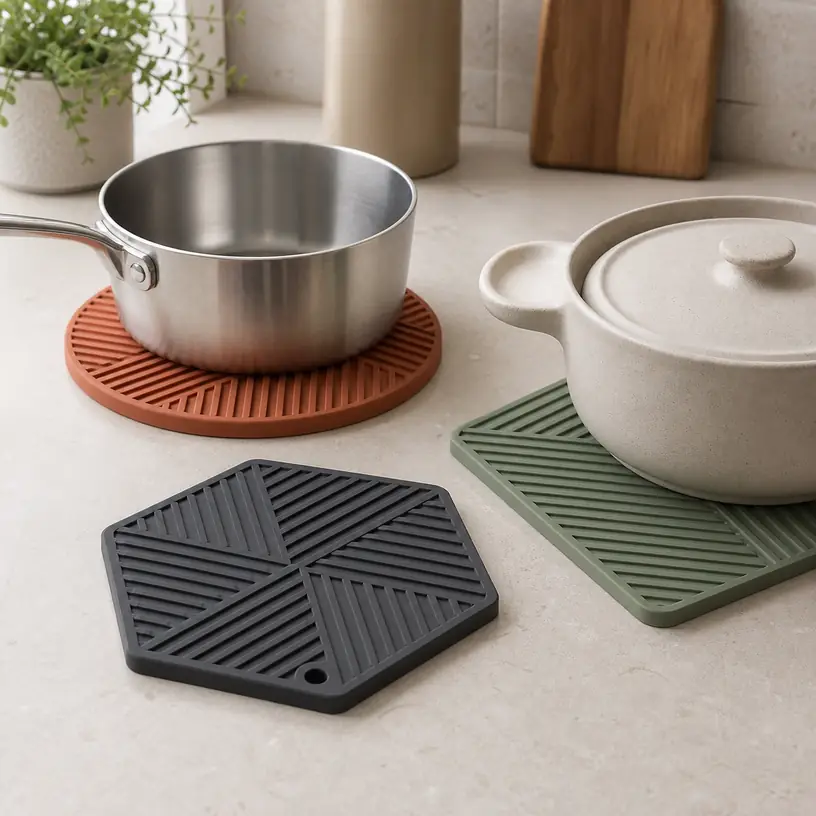
Illustrative image, not an official product photo.
Short answer
Start with the bottoms of the pots, skillets, and baking dishes that most often need a place to land. A silicone trivet should support that footprint without letting a heavy edge hang far beyond the pad, while leaving enough visible border to position the cookware without reaching underneath it. Compare the maker’s stated temperature and contact guidance with how the cookware will actually arrive—off a burner, from an oven, or from a serving table—and follow the countertop or tabletop maker’s care rules as well. Thickness alone does not establish protection: surface pattern, open holes, raised feet, flatness, and the stability of the entire cookware-and-trivet stack all matter. A pair of medium pads can be more adaptable than one small decorative shape, especially for roasting pans and long casseroles.
Search reference
Silicone trivets for pots and baking dishes
Compare usable dimensions, thickness, pattern, current temperature guidance, cleaning instructions, and set count for the cookware and surfaces in your kitchen.
View matching optionsMap the cookware that needs a landing place
A trivet is easy to buy by color and surprisingly easy to undersize. Before comparing shapes, turn over the cookware you use most and measure the portion that will actually touch the pad. The base of a saucepan may be much narrower than its rim, while a rectangular casserole or roasting pan may need support near both ends. Note whether the base is flat, footed, rounded, ridged, or fitted with a ring that concentrates weight on a narrow line.
Then identify where each hot item moves. A stockpot may go from cooktop to counter for draining. A Dutch oven may sit in the middle of the dining table. A sheet pan might only need a brief stop beside the oven. These routes create different requirements for space, grip, appearance, and duration of contact. Measuring the intended counter or table area also prevents a large pad from blocking a sink edge, drawer, place setting, or another active prep zone.
Draw the listed trivet dimensions on paper and place the relevant pot over the outline while everything is cool. This quick mock-up shows how much of the base would be supported and whether handles remain clear of walls and nearby objects. For long cookware, test two outlines placed apart. Two separate trivets can support both ends, but only when they sit level, cannot spread unexpectedly, and are positioned before the hot pan is lifted.
Who this is for
- Cooks who regularly move pots, kettles, skillets, or oven-safe dishes onto a counter or dining surface.
- Small kitchens that need a flexible pad that can hang, roll, or store in a shallow drawer when it is not in use.
- Households looking for several landing points for family-style serving dishes rather than one permanent countertop stand.
- People who want a washable barrier for cookware bases that may carry condensation, sauce drips, or light kitchen residue.
- Renters who can follow the surface owner’s guidance but do not want to install a fixed or built-in landing area.
Who should skip it
- Skip a small flexible trivet when large roasting pans need a rigid, continuous platform or support at widely separated points.
- Choose a purpose-designed insulated surface when the countertop, table finish, cookware maker, or appliance instructions require a specific protective system.
- Do not use an ordinary trivet as a burner cover, cooktop mat, oven liner, potholder, or direct-flame accessory unless the current product instructions explicitly permit that exact use.
- A stable metal, wood, cork, ceramic, or composite stand may suit someone who prefers a rigid piece that stays in one location.
- If a household member cannot reliably see or position a low-profile pad, a larger high-contrast landing zone may be easier to use safely.
Pattern is functional, not merely decorative
Silicone trivets appear as solid sheets, open honeycombs, woven-looking grids, concentric rings, flowers, and many other shapes. Those cutouts and ridges change how the cookware meets the pad. A mostly solid design provides broad coverage and can catch small drips, but its underside may trap moisture against the counter. An open grid allows visibility and some air movement, yet exposed gaps mean parts of the cookware footprint are not directly supported by silicone.
Raised ribs can reduce the contact area and create channels beneath a pan. They can also make a narrow cookware ring sit unevenly if the pattern does not meet it at enough points. Deep texture catches crumbs and oily residue more readily than a simple surface. Product photos taken straight on may hide these differences, so inspect side views and look for the actual height of ridges, feet, and edge borders.
Decorative extensions should not be counted as full support unless they share the load. A trivet listed as eight inches across may provide a smaller central area once holes and thin outer details are excluded. Compare the usable supporting zone, not just the maximum tip-to-tip measurement.
Thickness, flexibility, and a level stack
A thicker pad may create more separation between cookware and furniture, but thickness does not reveal the formulation, stated operating limit, or behavior under a heavy pot. It also raises the cookware farther from the surface. On a soft or uneven pad, a narrow pot can feel less settled than it does on a broad rigid stand.
Flexibility helps with drawer storage and cleanup. It may also let a pad conform to crumbs, grout lines, table seams, or an uneven surface rather than bridging them. Always clear and dry the landing area first. Place the trivet flat before moving the hot item, and never try to straighten a folded edge by reaching beneath loaded cookware.
Check whether the pattern lies flat after shipping and storage. A hanging loop or rolled form is useful only if the trivet returns to its intended shape. If several pads will be used together, their thickness should suit the planned arrangement. Supporting opposite ends of a long dish on pads of different heights can introduce a tilt that was not present on the counter.
What to verify before buying
- Usable support area: Compare the solid or load-bearing region with the actual base of each pot, pan, or serving dish.
- Overall thickness and profile: Look for side-view measurements, raised feet, borders, ribs, and any center that sits higher than the edge.
- Temperature and contact guidance: Confirm the current stated limits, allowed contact conditions, and prohibited uses; do not infer them from appearance or generic material wording.
- Intended placement: Check whether the item is described for counters and tables and whether there are separate restrictions for cooktops, ovens, grills, microwave appliances, or open flame.
- Surface compatibility: Follow the care instructions for stone, laminate, wood, veneer, glass, painted finishes, and other surfaces in the home.
- Cookware stability: Consider the base shape, filled weight, handle direction, and how the trivet pattern contacts the cookware.
- Food-contact status: If the pad will touch food directly or double as a jar opener or prep accessory, verify that the maker explicitly allows that use.
- Cleaning method: Check dishwasher placement or hand-washing instructions, drying requirements, and whether oils can collect inside deep openings.
- Set count and sizes: Confirm whether all pads share one size and thickness or whether the package mixes shapes intended for different jobs.
- Storage: Measure the drawer, hook, or cabinet location and determine whether folding, rolling, hanging, or stacking is permitted.
Props can make a listing look more complete than the package is. Pots, utensils, tableware, and storage hooks shown around the trivets should be treated as context unless the current included-pieces list says otherwise.
Treat temperature numbers as conditions, not a promise
A maximum temperature shown in a listing is not the temperature of the cookware in your kitchen, nor does it automatically describe every duration, pressure, surface, or mode of use. A pan base can have hot spots, and cookware coming from a burner is not identical to a serving bowl filled with warm food. Verify both sides of the situation: the trivet’s instructions and the cookware or appliance guidance.
The protected surface matters just as much. Some finishes can react to prolonged heat, trapped moisture, pressure, or residue even when a pad remains intact. Stone is not one uniform category; wood finishes differ; laminate and veneer instructions vary. The safest comparison uses explicit guidance for the actual counter or table rather than a broad claim that a trivet “protects all surfaces.”
Use the trivet only in the location and manner its instructions allow. A flexible silicone pad should not be assumed suitable inside an oven, across a hot cooktop, directly on a burner, under a countertop appliance, or around flame. Those environments introduce different heat sources and ventilation needs. A product that works as a serving trivet may still be inappropriate as an appliance mat.
Stability comes before multitasking
Some silicone trivets are also promoted as jar grippers, spoon rests, drying mats, or potholders. A second use can be convenient, but each job has different geometry and risks. A pad that grips a jar lid well in the hand may be too small under a wide Dutch oven. Deep openings that drain water can let sauce reach the table. A thin, flexible piece that bends around a handle may not provide the coverage or control expected from a purpose-made oven mitt.
Evaluate each claimed function separately and follow the relevant instructions. If handling hot cookware is the task, a mitt or potholder must fit the hand, provide the required coverage, and remain secure during lifting. Never assume that success as a stationary trivet establishes safe performance as hand protection.
Color can support a household routine. For example, one visible pad can stay near the oven while another remains on the dining table. This reduces last-second searching with a hot pan in hand. High contrast between pad and surface also makes the landing zone easier to see. Keep the route clear and position the pad before the cookware leaves its heat source.
Cleaning away oil, crumbs, and trapped moisture
Let cookware and the trivet cool according to their instructions before cleanup. Wash the pad using the specified method, paying attention to grid intersections, hanging holes, deep grooves, and textured undersides. Cooking oil can remain in recesses even when the top looks clean, and crumbs beneath the pad can affect stability or mark a delicate finish.
Dry both sides before stacking the trivet or returning it to a drawer. A solid pad left over a damp tabletop can hold moisture against the finish. If trivets nest or cling together, separate them so hidden surfaces can dry. Follow the maker’s guidance before using abrasive scrubbers, strong cleaners, or high-temperature dishwasher cycles.
Inspect the pad periodically in good light. A piece that remains curled, has torn around an open grid, has a damaged edge, or no longer lies as intended should not continue in service without checking the replacement guidance. Discoloration alone does not prove failure, and a normal-looking surface does not prove that it was used within its limits; history and condition both matter.
Limitations
- A trivet reduces direct contact but cannot guarantee that every countertop or table finish will tolerate a given pan, temperature, weight, and contact time.
- Search listings may emphasize overall diameter while the usable support area is reduced by holes, thin decorative edges, or raised patterns.
- Flexible pads can fold, curl, shift, or conform to debris and uneven joints beneath heavy cookware.
- Open patterns allow spills, condensation, and crumbs to reach the surface below.
- Silicone can retain oily residue or odors when intricate textures are not cleaned and dried thoroughly.
- One compact trivet may not support a roasting pan, sheet pan, or long casserole evenly.
- A stationary cookware rest is not automatically suitable as a potholder, oven liner, burner cover, appliance mat, or direct-food surface.
- Product temperature wording does not replace the care requirements of the cookware, appliance, countertop, or furniture manufacturer.
Alternatives to compare
A cork trivet is lightweight and naturally rigid compared with a thin silicone sheet, though it has its own cleaning, moisture, and heat guidance. A wooden trivet can create a stable serving platform and complement a dining table, but joints, finish, and washing requirements deserve attention. A metal stand offers a raised rigid structure; check its feet, spacing, stability, and potential to mark a surface. Ceramic or stone trivets provide weight and a solid top but can chip and may need a protective backing. A large purpose-made counter protector creates a broader landing zone for sheet pans and several dishes. For a particular appliance or delicate worktop, the maker’s specified protective accessory may be a better choice than a general household trivet.
FAQ
How large should a silicone trivet be for a pot?
Measure the part of the pot that will bear weight, then choose a usable supporting area that keeps the base stable and leaves a visible margin for placement. Do not rely only on the pot’s rim diameter or the trivet’s widest decorative points. Wide or rectangular cookware may need a larger pad or two equal-height supports positioned according to the cookware guidance.
Can two silicone trivets support one large casserole dish?
They can only be considered when both trivets lie flat, have compatible thickness, support stable parts of the dish, and are used within all current instructions. Position them before lifting the hot dish and make sure they cannot spread or create a tilt. A single broad, rigid landing surface may be simpler for a heavy or awkward casserole.
Can a silicone trivet go directly on a glass cooktop?
Do not assume it can. A trivet intended for a counter or table may not be approved for a cooktop, especially while the surface is warm or in operation. Follow the cooktop manufacturer’s rules and the trivet’s current placement restrictions; use a different landing area if either set of instructions is unclear.
Is a silicone trivet the same as a silicone potholder?
Not necessarily. A trivet is primarily a stationary rest, while hand protection requires suitable coverage, grip, flexibility, and handling instructions. Use a pad as a potholder only when the maker explicitly permits that use and its size and design suit the cookware being lifted.
Why do some silicone trivets have holes or raised ridges?
Openings and ridges change contact area, flexibility, airflow, drainage, and cleaning access. They may help a pad bend or keep part of a pan above the base, but they can also expose the surface to drips or contact a narrow cookware ring unevenly. Compare the actual pattern with the base of your cookware rather than choosing by appearance alone.