A Recipe Card Box for a Kitchen That Is Still Collecting Recipes
Product links are for reference. Verify current details on the retailer page before buying.
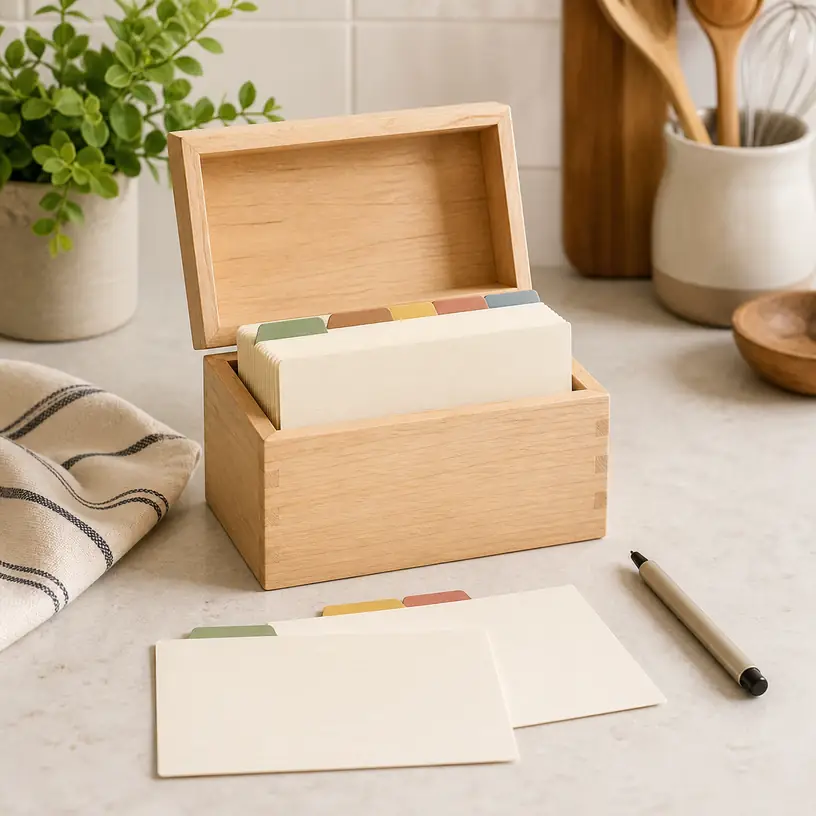
Illustrative image, not an official product photo.
Short answer
A useful recipe card box should fit the cards you already own, leave room for the collection to grow, and let you pull one recipe without unloading half the file. Measure the largest card, including any protective sleeve and raised tab, then compare that envelope with the box’s internal dimensions and lid clearance. Look beyond the number of cards a listing claims to hold: divider thickness, bent corners, handwritten inserts, and breathing room all reduce practical capacity. Stable footing, labels you can read while standing, and a lid that stays out of the way can make the box easier to use at the counter. If most recipes live on a phone or arrive as full sheets, a card box may add a transcription project rather than solve an organization problem.
Search reference
Recipe card boxes with dividers
Compare internal card clearance, divider positions, working space inside the file, lid behavior, and the material care instructions for a real kitchen.
View matching optionsBegin with the recipes, not the box
Pull together a representative sample before shopping: an old family card, a newer card, a clipped recipe you intend to rewrite, any laminated favorites, and the thickest sleeve you use. Measure width and height at the widest points. A nominal card format such as 3 by 5 inches or 4 by 6 inches is only a starting description; handwriting tabs, curled edges, dividers, and sleeves can make the working file taller, wider, and thicker.
Decide whether everything truly needs to share one box. A mixed archive may include cards in two orientations, folded notes, printouts, photographs, and booklets. Choosing an oversized container for the largest odd item can leave ordinary cards leaning and sliding. It may be simpler to keep standardized working cards in the box and store source clippings or full-page originals in a separate folder.
Count the cards loosely rather than compressing them into a tight stack. Add the dividers you expect to use and leave enough free space to flip through sections with two fingers. A box filled edge to edge on the first day will be frustrating as soon as another recipe arrives. On the other hand, a mostly empty deep box lets cards fall forward unless it includes a follower block, adjustable support, or another suitable way to keep a small collection upright.
Who this is for
- Home cooks who use handwritten or printed index cards more often than a screen at the counter.
- Families consolidating a manageable set of inherited recipes while preserving the wording and notes on the original cards.
- People who want a small, portable file that can move from a shelf to a prep area and return after the meal.
- Recipe collectors willing to use consistent card sizes, category labels, and a simple filing routine.
- Gift makers assembling a starter collection with blank cards and enough open capacity for the recipient’s additions.
Who should skip it
- Cooks whose collection is mainly letter-size printouts, cookbook pages, saved web links, or notes in several unrelated formats.
- Anyone who wants automatic search, scaling, sharing, meal planning, or backup; a paper box does not provide digital tools.
- Very large archives that need multiple indexing levels, duplicate detection, or storage conditions beyond a kitchen shelf.
- Households without a reasonably dry, clean place away from splashes, cooking vapor, direct heat, and strong sunlight.
- Buyers who enjoy collecting recipes but are unlikely to rewrite, print, label, or return cards after use.
What to verify before buying
- Internal dimensions: Compare usable width, depth, and height with the largest card, sleeve, and divider tab—not just the box’s exterior measurements.
- Card orientation: Check whether cards stand in landscape or portrait orientation and whether your recipes are readable that way.
- Divider fit: Confirm the number, material, writing area, tab position, and compatibility of included dividers with replacement cards.
- Lid clearance: Make sure raised tabs and sleeves will not bend when the lid closes, and check how far the lid opens at the counter.
- Working capacity: Treat stated card count as an estimate until card thickness, dividers, sleeves, and browsing space are considered.
- Interior finish: Look for smooth card-contact surfaces, covered hardware, and corners that will not catch paper during filing.
- Counter stability: Compare the base footprint, empty weight, feet, and how the box is meant to stay steady while cards are flipped.
- Material care: Read the cleaning and moisture guidance for the complete box, including finishes, hinges, labels, windows, and adhesives.
- Included cards: Verify their actual dimensions, quantity, printing layout, paper specification, and whether matching refills can be sourced.
- Closure and hardware: Check how the lid or latch operates, whether fingers can stay clear of hinges, and whether spare hardware is available if relevant.
Dividers should follow the way dinner is planned
A preprinted divider set can look complete while using categories that do not match the household. One cook may search by meal—breakfast, lunch, dinner, dessert—while another thinks in techniques, main ingredients, family branches, seasons, or frequency. Before accepting the included labels, write ten recipes on slips of paper and decide where each would go. If several could reasonably belong in three places, the system needs a cross-reference or simpler categories.
Broad sections are easier to maintain than a forest of narrow tabs. Five to ten starting categories leave room to browse and can be subdivided later. Blank or erasable labels allow the file to evolve, but verify which pens or label materials are suitable and whether rewriting damages the divider. Alternating tab positions may make labels visible, provided the lid has clearance above the tallest row.
An alphabetical system works when recipe names are stable and memorable. It is less helpful when the same dish is known by a relative’s name, an ingredient, and a holiday nickname. A small index card at the front can map alternate names to the filing location. Numbering cards and maintaining a separate index adds control for a larger collection, but it also adds work every time a card is removed or added.
Avoid creating categories for imagined future recipes. Empty sections take space and make the file feel unfinished. Begin with the cards in hand, use temporary labels for a few weeks, and formalize the dividers after real cooking has shown where people look first.
The lid has a job during cooking
A box protects cards in storage, but its behavior while open deserves equal attention. A fully removable lid creates an extra object on a crowded counter. A hinged lid remains attached, though it needs overhead and rear clearance and should not pull a light box backward. Some designs describe a groove or clip for displaying a card; verify the card sizes, viewing angle, and whether the box remains stable when that feature is used.
Do not place the box where a propped card can fall toward a burner, sink, moving appliance, or wet prep area. A separate washable recipe stand may be safer and easier to position than using the storage box as a display. If a sleeve is used during cooking, confirm that it fits the stand and clean it according to its own instructions before returning it to the file.
Closures range from simple lift-off lids to hinges, magnets, clasps, or sliding panels. A tight closure may help keep shelf dust out, but it should not crush tabs or require two hands to fight with a loaded box. A carry handle can be useful for moving the archive, yet it does not establish how much weight the lid, handle, or fasteners can support. Carry the base unless the maker gives clear guidance for another method.
Paper needs protection without becoming inaccessible
Kitchens combine moisture, oils, crumbs, temperature changes, and frequent handling. No ordinary recipe box should be assumed to be waterproof or food-safe simply because it is sold for kitchen use. Keep it away from sink spray, kettles, ovens, dishwashers, and the path of raw ingredients. Wipe hands before browsing and return the box to a dry shelf after cooking.
Wood can bring warmth to an open shelf, but species, construction, finish, and cleaning limits vary. Metal may offer a different feel and thinner walls, yet edges, coatings, seams, and corrosion guidance still need checking. Plastic can be light and easy to see through, while hinges, latches, scratching, and heat sensitivity remain model-specific. Choose from documented dimensions and care instructions rather than assuming one material label guarantees durability.
Sleeves add a replaceable barrier for frequently used cards, but they also increase thickness and may create glare. Verify sleeve dimensions and opening direction so the card cannot slide out when placed on a stand. If an old handwritten card is fragile, repeated removal may be unwise even with a sleeve. A high-quality scan and a working copy can preserve the original while allowing the recipe to remain in regular rotation.
A box protects against ordinary handling; it is not an archival conservation system. Irreplaceable family cards may deserve scanning, backup copies in more than one location, and advice suited to the paper and ink. Do not apply tape, laminate, cleaners, or coatings to an original until their long-term effects are understood.
Capacity is about thumb room
Card-count claims are difficult to compare because paper weight, printing, coatings, sleeves, and dividers differ. Internal depth is a more useful starting point, but not every inch should become a solid block of paper. The user needs room to separate a section, read a title, pinch a card, and return it without scraping adjacent edges.
One practical check is to place the current collection, dividers, and sleeves into a temporary box or tray with similar internal dimensions. Add a small group of blank cards representing expected growth. If the file can be browsed without lifting out a chunk, the spacing is workable. Measure the occupied depth rather than relying on a visual guess.
A long box can hold more but may be awkward on a shallow shelf and heavy when full. Two smaller boxes can separate everyday recipes from an archive, different households, or sweet and savory cooking. The tradeoff is a second filing decision and a greater chance that a card returns to the wrong box. Labeling the exterior clearly matters when containers look alike.
Make the collection easy to hand forward
A recipe file is most valuable when another person can understand it. Put a dated note inside the lid or at the front explaining the categories, abbreviations, and ownership of fragile originals. Include source information where known, especially when a card has been adapted over time. Marking the date of a change helps preserve the history instead of silently replacing it.
Use one intake routine for new recipes. A loose clipping can go into a temporary inbox envelope rather than being wedged between finished cards. On a regular schedule, decide whether to discard it, digitize it, or copy it to the standard format. This keeps untested scraps from overwhelming the recipes people actually cook.
Photograph or scan both sides of handwritten cards, including stains and margin notes that carry context. Confirm that files are readable, named consistently, and backed up before treating the digitization as complete. The digital copy does not make the paper disposable; it simply reduces the risk that one kitchen accident erases the only version.
Limitations
- Internal dimensions and practical card capacity are not always stated clearly or measured the same way.
- Included cards and dividers may use a layout, paper thickness, tab sequence, or category scheme that is hard to match later.
- A decorative box does not provide waterproof, fireproof, pest-proof, or archival storage unless the current specifications explicitly establish a relevant level of protection.
- Hinges, clasps, magnets, display grooves, and handles add functions but also create points that may wear or interfere with cards.
- Small boxes fill quickly once sleeves, thick dividers, folded notes, and browsing space are included.
- Large boxes can be heavy, take up counter or shelf space, and allow a small collection to slump.
- Paper filing cannot search ingredients, recalculate portions, synchronize edits, or create an off-site backup by itself.
- No organizer can compensate for inconsistent labels or cards that are not returned after cooking.
Alternatives to compare
A three-ring recipe binder accommodates full sheets, sleeves, and printed pages, although it occupies more open counter space. An index-card file drawer provides growth and easier subdivision for a larger standardized collection. A photo storage case may separate cards into small removable groups, but internal fit, materials, and latch behavior need the same scrutiny. A document folder suits clippings and letter-size printouts better than small cards. A recipe app or ordinary note system adds search, sharing, backup, and scaling tools, while requiring a screen and a consistent import process. Many households will do well with a hybrid: preserve original cards in protected storage, keep working copies in the kitchen box, and maintain readable scans as a backup.
FAQ
What size recipe card box should I buy?
Measure the largest card you plan to file, including its sleeve and the tallest divider tab. Compare those measurements with the box’s internal width, depth, height, and closed-lid clearance. Leave enough depth for fingers to browse rather than sizing the box to a tightly compressed stack.
How much extra space should a recipe card box have?
There is no universal percentage because card and divider thickness varies. Add the dividers, sleeves, and a realistic batch of future cards, then preserve enough open space to separate sections and lift one card cleanly. If the collection is already near the box’s working limit, choose a larger file or divide the archive now.
Are 3-by-5 and 4-by-6 recipe cards interchangeable in one box?
Not automatically. A box sized for 4-by-6 cards may physically hold smaller cards, but they can lean, hide below tabs, or slide out of order. A box designed only for 3-by-5 cards will usually lack clearance for larger cards. Check orientation and internal measurements, and use an appropriate insert or separate section only if it supports the smaller cards without damaging them.
Should original family recipe cards stay in the kitchen box?
Frequently handled originals face spills, light, abrasion, and loss. Consider making clear scans and working copies, then storing fragile or irreplaceable originals under conditions appropriate to their paper and ink. If an original remains in the active box, use a suitable sleeve and keep the box away from food preparation hazards without applying unverified treatments to the card.
Is a wooden or metal recipe card box easier to maintain?
Material alone does not decide maintenance. Finish, seams, hinges, edge treatment, coatings, and the maker’s cleaning instructions all matter. Compare the complete product’s care guidance and keep any box in a dry location away from heat and splashes.