Move Large Houseplants Without the Floor Scrape: A Rolling Plant Caddy Guide
Product links are for reference. Verify current details on the retailer page before buying.
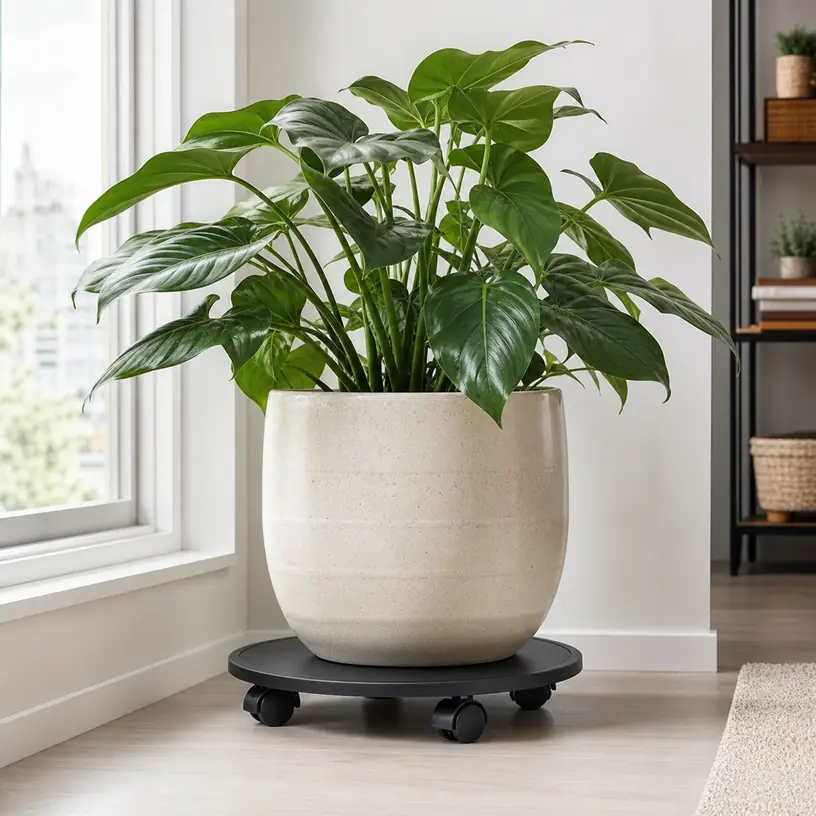
Illustrative image, not an official product photo.
Short answer
A rolling plant caddy can make a large planter easier to turn for more even light, move away from a cold window, or roll aside for cleaning. The useful match starts with two numbers: the pot’s actual bottom diameter and the combined weight of the pot, growing medium, plant, and water. Then consider wheel material, caster count and placement, brake access, deck shape, floor transitions, and whether drainage water could reach the caddy or floor. A caddy is a positioning aid on a smooth, level route—not a license to move an unstable, top-heavy planter across thresholds or stairs.
Search reference
Rolling plant caddies for heavy pots
Compare deck dimensions, documented load guidance, caster construction, locking arrangement, surface contact, and moisture-care instructions for your planter and room.
View matching optionsWhy the pot footprint matters more than the leaf spread
Measure the part that will rest on the deck. A planter may flare outward at the rim while standing on a much narrower foot, or it may have a broad base hidden by a matching saucer. Record the maximum contact diameter and note whether the bottom is flat, ring-shaped, footed, or irregular. The caddy should support the intended contact area without forcing the pot to perch on a raised lip, wheel housing, or decorative edge.
Also look at where the plant’s mass sits. A tall plant in a narrow pot has a higher center of gravity than a compact plant in a wide container. Even when both fit the same deck, the tall arrangement can be less forgiving during starts, stops, and direction changes. Leaves, trellises, and branches add clearance needs that the base measurement will not reveal, so map the entire route before rolling.
A saucer changes the fit. If the saucer travels with the plant, measure its bottom rather than the planter alone and check that it sits steadily on the deck. If the caddy includes a recessed tray or raised perimeter, verify the usable interior diameter—not just the product’s outside diameter.
Who this is for
- Houseplant owners who periodically rotate a large pot near a window while keeping it in one room.
- People who need to clear a smooth floor for sweeping or vacuuming without repeatedly lifting a heavy planter.
- Indoor gardeners moving a compatible pot a short distance for watering, pruning, or seasonal light changes.
- Renters who want a removable mobility option rather than a built-in platform.
- Sunroom, office, or conservatory setups with level routes and enough space to steer the whole plant.
- Buyers replacing an undersized stand whose pot overhangs the deck or whose wheels are difficult to control.
Who should skip it
- Skip a rolling platform when the route includes stairs, steep slopes, broken flooring, or a drop at the doorway.
- Do not use a caddy to compensate for a cracked pot, unstable saucer, loose trellis, or severely top-heavy planting.
- Choose another arrangement when children or pets could release the brakes, ride the platform, or push the plant into furniture.
- Avoid rolling a planter over delicate flooring unless the wheel and floor manufacturer guidance supports that contact and the route can be kept free of grit.
- Use appropriate handling help or equipment when the loaded planter is beyond what can be safely controlled by one person.
- Skip designs that would block drainage inspection or trap water against a floor that requires prompt drying.
What to verify before buying
- Loaded weight: Add the planter, saucer, plant, supports, growing medium, and water; compare that total with current documented load guidance and leave a sensible margin.
- Usable deck: Confirm the flat supporting diameter or dimensions, including any recessed area, rim, center opening, or wheel hardware.
- Caster arrangement: Check caster count, spacing, swivel behavior, attachment method, and whether wheels protrude beyond the deck where feet may catch them.
- Brake layout: Determine how many wheels lock, what the lock controls, and whether each lever remains reachable beneath the chosen pot.
- Floor contact: Review wheel material and maker guidance for hardwood, laminate, tile, vinyl, carpet, or other surfaces in the intended room.
- Threshold clearance: Measure door saddles, grout changes, rug edges, floor vents, and other transitions along the route.
- Moisture plan: Confirm whether the caddy is intended for damp environments and how drainage, spills, rust prevention, and cleaning should be handled.
- Pot stability: Check for non-slip texture, a retaining edge, or other features suited to the actual pot bottom without assuming they secure every planter.
- Overall height: Include the caddy in the plant’s final height so foliage still clears shelves, curtain rods, window hardware, and lights.
- Assembly: Verify whether casters arrive installed, what tools or fasteners are required, and whether periodic tightening or inspection is specified.
Estimate the real load before comparing capacities
The empty pot is only part of the load. Growing medium can account for substantial mass, and watering changes it. A decorative cover pot may hide a nursery pot and saucer, creating several separate pieces on the same deck. Stakes, moss poles, stones, and self-watering reservoirs also belong in the estimate.
If weighing the full planter is impractical, build the total from known component weights or use a suitable scale and safe method before shopping. Do not guess from pot diameter alone: two containers of the same size can have very different construction and contents. Product capacity wording should be checked on the current listing and instructions, including any conditions attached to the stated figure.
A published capacity does not guarantee stability. It may describe the platform under controlled conditions, while your planter’s height, base shape, and route introduce other variables. A reasonable weight margin can reduce strain on casters, but it cannot correct an off-center or poorly supported pot.
Casters determine how the platform behaves
A three-caster layout can sit without rocking on an even plane, while four or more casters may spread support differently. The better choice depends on deck stiffness, wheel placement, and how the pot’s weight reaches the platform. Count alone does not establish smooth rolling or stability.
Swiveling casters make tight direction changes possible, but every caster must align when the platform first moves. A sharp sideways pull can make an unaligned wheel scrub across the floor or jerk the pot. Start slowly, guide from low on the pot when appropriate, and avoid pulling on stems, branches, or a trellis.
Wheel diameter affects transitions. Small wheels keep the deck low but are more easily stopped by grout edges, cords, grit, and rug borders. Larger wheels may roll over small changes more readily while raising the plant and increasing the caddy’s visible footprint. No caster size makes an ordinary plant caddy suitable for stairs or uncontrolled drops.
Brakes should be reachable after the pot is loaded
A lock hidden under a wide saucer is difficult to use. Before committing to a size, compare the brake-lever positions with the pot footprint. If only some wheels lock, think about which side should face the open room and whether the caddy can be parked without reaching behind foliage or furniture.
Check what “locking” means for the current design. Some mechanisms restrain wheel rotation, some may also limit swivel, and others use a separate stop. Park on a level surface even when brakes are fitted, engage them according to the instructions, and treat them as one control measure rather than a substitute for a safe location.
Protecting the floor requires more than soft-looking wheels
Wheel material is only one part of floor care. Dirt, potting grit, and tiny stones can become trapped at the contact point and mark a surface as the wheel turns. Sweep the route and inspect the casters before moving the plant. If the manufacturer recommends a particular floor type or cleaning method, follow that guidance.
Watch for long-term contact as well as movement. A loaded caddy parked for months can leave pressure marks or react with some finishes, mats, or coatings. Moisture from overwatering can travel through drainage holes, run under a saucer, collect in recesses, and reach the floor without being obvious. Use a compatible drainage arrangement, check beneath it periodically, and dry spills promptly according to the flooring and planter-care instructions.
Rugs create a separate problem. A wheel that rolls freely on hard flooring may sink into a soft rug or stop at its bound edge. Do not build speed to force the planter over the transition. Reposition the rug, use an appropriate route, or keep the plant stationary rather than risking a sudden tip.
Plan a controlled route and parking spot
Clear cords, toys, leaves, floor vents, and lightweight furniture before the caddy moves. Open doors fully and measure the narrowest passage at pot height as well as deck height. A planter that clears a doorframe at the base can still catch wide foliage or a stake higher up.
Move slowly with the plant upright. If a threshold must be crossed, confirm that the caddy is intended for it and that the loaded arrangement can remain controlled; otherwise unload or use a safer handling method. Never pull the caddy toward a stair edge or leave it where normal household traffic can push it into a drop.
The final parking place should be level and allow access to the brakes, saucer, and floor beneath. Keep wheels out of walkways. Confirm that the extra platform height does not put leaves against hot or cold glass, block a vent, or bring the plant too close to lighting equipment.
Watering and maintenance change the ownership experience
A caddy may be described as wood, composite, plastic, or metal, but material names alone do not establish resistance to standing water, corrosion, swelling, staining, or outdoor weather. Read the current care instructions. If watering in place, use a compatible saucer or cachepot arrangement and inspect for overflow rather than assuming the platform contains it.
Remove accessible soil and debris from the caster housings. Check fasteners, wheel axles, deck surfaces, and brakes at intervals suggested by the maker, and stop using the caddy if parts loosen, crack, deform, or no longer roll predictably. Do not lubricate or treat components unless the instructions permit the product used around the plant and floor.
Outdoor use adds uneven paving, weather, drainage, temperature changes, and wind exposure. A caddy that suits an indoor tile floor is not automatically suitable for a patio. Confirm the intended environment explicitly before choosing it for outdoor planters.
Limitations
- A plant caddy reduces lifting for short repositioning but does not make an overloaded or top-heavy planter inherently safe.
- Small casters can stop abruptly at grit, seams, thresholds, cords, and rug edges.
- Wheel locks may be obstructed by a wide pot and may not restrain every kind of movement.
- Water and potting debris can collect beneath the planter or around caster hardware without being immediately visible.
- Wheel materials and parked loads can affect floors differently; generic “floor-safe” wording cannot replace current product and flooring guidance.
- Added deck height may change light, window, shelf, and tipping clearances.
- Decorative rims or recessed decks can reduce the usable footprint compared with the stated outside size.
- Ordinary rolling caddies are not intended as stair-moving equipment, lifting devices, seating, toys, or ride-on platforms.
Alternatives to compare
A stationary plant stand with a broad base adds height without inviting movement and may suit a plant that rarely changes position. A low protective tray or saucer addresses drainage and floor separation when mobility is unnecessary. Furniture sliders matched to the surface and load may help with an occasional straight repositioning, though they lack casters and brakes and require their own suitability checks. A lighter nursery pot inside a decorative cachepot can make plant care easier when the inner pot can be removed safely. For very large planters, professional moving help or equipment intended for the load and route is more appropriate than improvising with a small household caddy.
FAQ
How much weight should I include when sizing a rolling plant caddy?
Include the pot, inner pot if present, saucer, plant, growing medium, stakes or trellis, decorative stones, and water. Compare the realistic wet-condition total with the current manufacturer’s load guidance; do not estimate from pot diameter alone.
Should the caddy be larger than the bottom of the pot?
The usable supporting deck should accommodate the pot or saucer’s actual contact area without unstable overhang or interference from a rim. Measure the bottom, then check the caddy’s flat usable area rather than relying only on its outside diameter.
Are locking wheels enough to keep a large plant from moving?
They can help on a level surface when engaged as directed, but their behavior and number vary. Confirm what the locks restrain, keep the caddy away from slopes and traffic, and make sure the levers are accessible after loading.
Can a rolling plant caddy go from hard floor onto a rug?
A rug edge can stop or redirect small casters, especially under a heavy or tall planter. Avoid forcing the transition. Verify the wheel guidance and route, remove the obstacle when practical, or use another handling method.
How do I prevent water damage under the caddy?
Use a drainage setup compatible with the planter and caddy, avoid overfilling, inspect the saucer and platform after watering, and dry the floor promptly according to its care requirements. Do not assume that a raised or wheeled deck is waterproof.
Can an indoor plant caddy be used on a patio?
Only if current product documentation supports the outdoor environment and expected load. Weather, uneven paving, drainage, corrosion, temperature, and wind create conditions that an indoor-focused model may not be designed to handle.