A Folding Shopping Cart for Grocery Runs: Wheels, Frame, and Folded Size
Product links are for reference. Verify current details on the retailer page before buying.
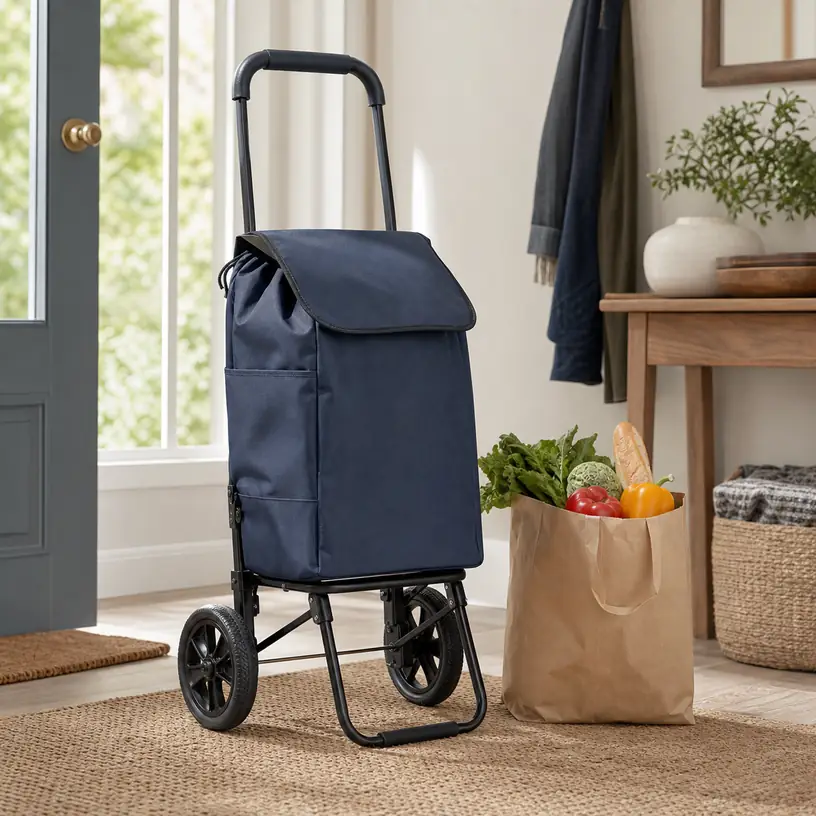
Illustrative image, not an official product photo.
Short answer
A folding shopping cart should be chosen around the route between the store and home, not around the largest bag in a listing photo. Count the curbs, thresholds, stairs, rough sidewalk sections, and tight turns you normally encounter. Then compare wheel diameter and layout, handle height, frame dimensions, stated load guidance, bag closure, and the cart’s size after folding. A cart that rolls smoothly when loaded and fits beside the door can be more useful than a higher-capacity design that is awkward to steer, lift, or store.
Search reference
Folding shopping carts for grocery trips
Compare wheel layout, handle dimensions, frame and bag construction, stated load guidance, folded size, and stair or curb suitability for your regular route.
View matching optionsWalk the route before comparing capacities
Folding grocery carts serve a different job from the small multi-tier utility carts used inside a kitchen, office, or craft room. A grocery cart has to follow a person over outdoor surfaces, hold a changing load, negotiate store entrances, and return to a practical storage spot. Those demands make the route a more useful starting point than color, pocket count, or a broad capacity claim.
Begin at the place where the cart will wait between trips. Measure the available floor or wall space and note whether a folded cart must stand on its own, hang from an appropriate hook, or slide into a closet. Follow the path out of the building. A narrow elevator, heavy entrance door, short flight of steps, uneven paving, or high curb can eliminate designs that would work on a smooth store floor.
Do the same at the destination. Some stores permit a personal trolley to be used while shopping, while others expect it to remain folded until checkout; current local practice should be confirmed directly. Think through where the folded cart will sit before it is loaded and whether its empty frame is manageable alongside a store basket or cart.
Estimate a normal trip rather than an exceptional stock-up run. Bottles, canned goods, produce, boxed food, and household supplies distribute weight differently. A very large bag can invite a load that is difficult to stop, turn, or lift over the final threshold. If grocery trips vary, plan around the heaviest load you can comfortably manage rather than the maximum volume the bag might hold.
Who this is for
- People who walk to a grocery store, farmers market, laundromat, library, or neighborhood shop and want the load to roll instead of hang from their hands.
- Apartment residents who have a defined elevator or ground-floor route and a compact place to keep a folded frame.
- Transit riders who can manage the cart at vehicle entrances and need groceries contained during the walk at either end of the trip.
- Households making smaller, more frequent grocery runs rather than transporting everything in a car trunk.
- Shoppers who can keep the cart within its stated use and load guidance and are comfortable slowing down for curbs, slopes, and crowded walkways.
What to verify before buying
- Complete open dimensions: Check width at the wheels, frame depth, bag height, and handle height rather than relying only on bag measurements.
- Folded shape: Compare folded thickness, wheel position, latches, and whether the cart is designed to stand, lie flat, or be stored another way.
- Wheel arrangement: Confirm wheel diameter, number of wheels, axle width, material wording, and any explicit guidance for stairs, curbs, or uneven surfaces.
- Handle position: Look for the height, grip width, padding or cover, and whether the handle is fixed, adjustable, or shaped for pushing as well as pulling.
- Stated load guidance: Distinguish the frame limit from any separate bag guidance, and check whether the listing specifies how weight should be distributed.
- Bag attachment: Determine whether the bag is removable, how it connects to the frame, and whether it can shift toward the wheels when partly loaded.
- Opening and closure: Check whether the top uses a drawcord, flap, zipper, hook-and-loop section, or remains open, and imagine accessing it at checkout.
- Base support: Review the platform or lower frame that supports the bag and whether small or soft items could sag into moving parts.
- Care details: Verify current material wording, cleaning instructions, drying guidance, and any claims involving moisture or weather exposure.
- Assembly and upkeep: Confirm what must be assembled, how wheel hardware is retained, and whether the listing discusses replacement parts or routine checks.
Wheels decide how the cart meets the street
Two-wheel carts are commonly pulled behind the user. Their simple footprint can be convenient for straight routes and compact storage, but pulling places the loaded cart at an angle. That angle changes how much weight is felt at the handle and how the bag settles against the frame. Check that the handle position and wheel clearance suit your stride so the cart does not repeatedly touch your heels.
Four-wheel formats may be designed to push, pull, or change orientation, depending on the frame. They can keep more of the load supported while standing, but the extra wheels add hardware and may increase the folded footprint. Small swivel wheels can turn neatly on smooth floors yet respond differently to sidewalk cracks and doorway transitions. Do not infer outdoor performance from wheel count alone.
Some carts use clusters of wheels described for stair movement. This layout may change how the cart contacts each step, but it does not remove the weight of the groceries or make every staircase suitable. Step height, landing space, cart width, wheel-cluster dimensions, and the user’s ability to control the load all matter. Verify the maker’s current instructions and consider whether carrying smaller grocery bags separately is safer for your actual stairs.
Larger wheels generally meet small surface changes at a different angle than tiny wheels, but diameter is only part of the system. Axle construction, tire material, alignment, frame stiffness, and the loaded center of gravity also affect how a cart tracks. Inspect wheel and hardware details in current listing images, and check the fasteners periodically according to the supplied instructions.
Fit the handle to the person doing the pulling
A poorly placed handle can make a manageable grocery load tiring. If it is too low, the user may lean or let the cart ride close to the heels. If it is too high or too far behind the frame, steering through a doorway can feel imprecise. Compare a stated handle height with a comfortable hand position while wearing the shoes normally used for errands. Adjustable handles add flexibility only when the adjustment range and locking method suit the user.
Grip shape matters during longer walks. A narrow rigid bar can concentrate pressure, while a wide grip may be difficult for smaller hands. Padding can feel comfortable when dry but may require more care after rain or spills. Check the current product details instead of assuming a fabric or foam-looking section is removable or weather-tolerant.
Also decide whether the cart will be pulled behind, pushed ahead, or used in either direction. Do not push a model merely because its handle looks suitable if the current instructions specify another method. When sharing the cart, make sure the least tall and tallest regular users can both control it without an awkward posture.
The bag should organize the load without hiding problems
A tall single compartment is flexible for cereal boxes, produce, and household packages, but heavy items can settle at the bottom and crush softer groceries. Pack dense, stable items low and keep delicate food in a separate layer or appropriate bag. Side pockets can hold a shopping list or small nonvaluable accessory, but they also add width and may catch on doorframes when full.
An inner liner or insulated-looking surface should not be treated as temperature control unless the current listing clearly describes the construction and intended use. Perishable food still needs an appropriate shopping and transport plan. Likewise, a covered opening can reduce casual exposure but does not automatically make the bag rainproof, spill-proof, or secure.
Removable bags can simplify cleaning and let the frame carry a suitably contained box or other load when the instructions permit. The connection points become important: check straps, hooks, loops, and lower support before each trip. A partly filled bag should remain clear of the wheels and axle. If the cart includes a rigid base insert, verify its orientation and care instructions rather than replacing it with an improvised panel that could interfere with folding.
Bring reusable produce bags or small totes when separation helps. The main cart bag does not need a dedicated pocket for every grocery category. A simple interior is often easier to unload and wipe, while smaller contained bags can be lifted out at the kitchen counter.
Folding is part of every trip
A folding frame earns its storage space only if the routine is manageable. Look at the complete sequence: empty the bag, release the correct latch, move the frame without placing fingers near a hinge, secure the folded shape, and put the cart away. Current instructions should control this process. A cart that collapses to a thin profile may still be tall, unstable when upright, or difficult to lift onto a shelf.
Measure the folded cart with the wheels and handle included. Wheels may prevent it from sliding into a gap that appears wide enough for the frame alone. A loose bag can add thickness or drag on the floor. If storage is behind a door, confirm the door can swing without contacting the cart.
Do not assume every frame can remain upright when folded. If it needs to lie flat, choose a clean, dry storage location where the wheel surfaces do not transfer outdoor debris to clothing or pantry goods. If it is intended to hang, use only a storage method suitable for the cart’s weight and structure; a convenient-looking handle is not necessarily a hanging point.
Who should skip it
- Skip a large trolley if the route includes stairs or vehicle transfers that make the loaded cart harder to control than two smaller hand-carried bags.
- Choose a backpack or balanced reusable bags when the grocery load is light and the walking surface is consistently unsuitable for small wheels.
- A delivery or pickup option may be more practical for occasional heavy orders, severe weather, or routes without accessible crossings.
- Avoid relying on a grocery cart for children, pets, seating, or any use not explicitly covered by its current instructions.
- If the main need is movable indoor storage, compare a room-to-room utility cart rather than an outdoor grocery trolley.
Limitations
- A high stated capacity does not mean that every user can safely steer, stop, or lift the fully loaded cart.
- Small wheels can catch at cracks, thresholds, gravel, thick mats, and other abrupt surface changes.
- Large or stair-oriented wheel systems can improve contact in some situations while adding width, weight, and storage bulk.
- Soft bags do not prevent crushing, leaks, or temperature change without an appropriate packing plan.
- Folding hinges, latches, axles, wheels, and bag attachments require inspection and care according to the supplied instructions.
- A cart can free the hands from grocery bags, but it remains an object that must be controlled around traffic, slopes, doors, and other pedestrians.
- Weather-related wording varies, and ordinary fabric should not be assumed to protect groceries from sustained rain.
- Store, transit, and building rules differ and may change; confirm the current requirements that apply to the route.
Alternatives to compare
- A grocery backpack for lighter loads on routes with stairs, while considering fit and comfortable carrying weight.
- Two balanced reusable bags for short trips where wheels would add more inconvenience than help.
- A collapsible wagon for suitable ground-level routes and larger loads, if its wider footprint and storage size are practical.
- A bicycle basket or cargo setup designed for the bicycle and load, with appropriate securement and riding practices.
- Grocery pickup or delivery for bulky stock-up trips, combined with smaller walking trips for fresh items.
- A compact hand truck with separately secured containers when the job extends beyond groceries and the equipment is intended for that load.
FAQ
Are two wheels or four wheels better for a folding grocery cart?
Neither layout suits every route. Two-wheel carts are often pulled at an angle and can fold compactly. Four-wheel carts may support more of the load while standing or moving, but wheel size, steering design, surface conditions, and folded dimensions still matter. Follow the current instructions for whether a specific cart should be pushed, pulled, or used in multiple orientations.
What wheel size should I look for on uneven sidewalks?
Start by observing the largest cracks, thresholds, and curb transitions on the normal route, then compare them with the wheel details and intended-surface guidance in current listings. Diameter is useful, but axle construction, tire material, wheel alignment, frame stiffness, and load placement also affect rolling behavior.
Can a folding shopping cart go up apartment stairs?
Only if the specific design, current instructions, staircase, load, and user make that practical. A multi-wheel stair layout does not eliminate the weight or the need to control the cart at every step and landing. For difficult stairs, smaller grocery bags, a lighter load, an elevator, or another transport method may be more manageable.
How should groceries be packed in a rolling cart?
Place compact, stable items low without exceeding the stated guidance, keep leak-prone goods in appropriate closed containers, and protect bread, eggs, produce, and other easily damaged items from heavier packages. Keep the bag clear of wheels and hinges, and make sure the top closes without forcing it.
Where can a folding grocery cart be stored in a small apartment?
Use the cart’s complete folded dimensions, including its wheels and loose bag, to check a closet, entryway recess, or other dry location. Confirm whether the folded cart is intended to stand, lie flat, or use an approved hanging method. Keep outdoor wheel surfaces away from clean textiles and food-storage areas.