Bed Risers for Extra Storage: Measure the Bed Before You Raise It
Product links are for reference. Verify current details on the retailer page before buying.
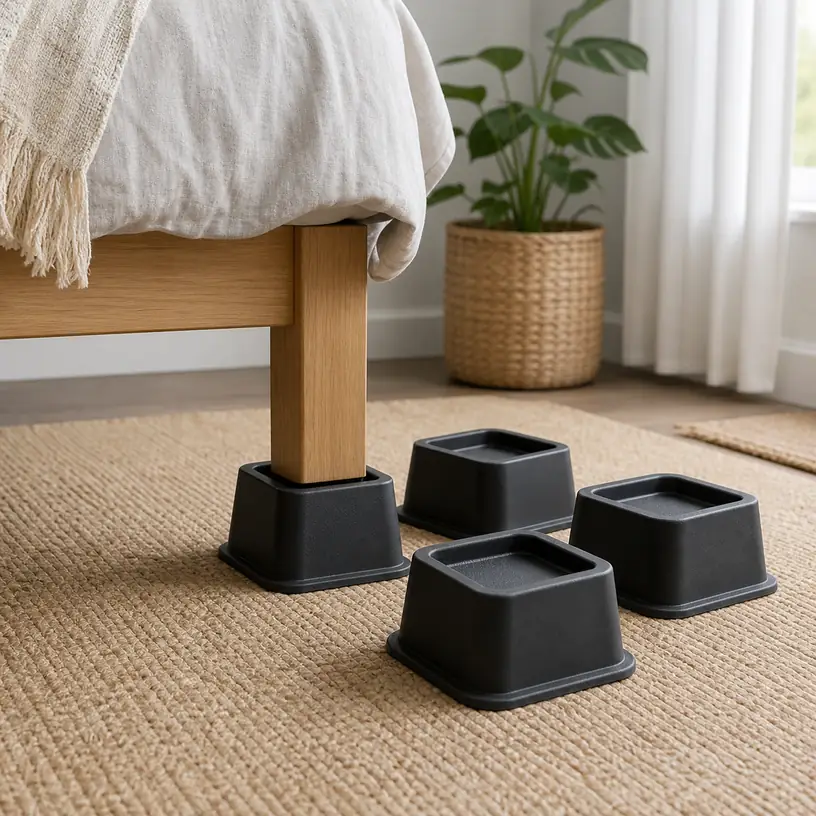
Illustrative image, not an official product photo.
Short answer
Start with the bed, not the storage bins. Count every point that actually touches the floor, measure the width and shape of each leg or foot, and note the present floor-to-frame clearance. Choose only enough lift to clear the containers you plan to use, then check the riser’s top recess, base footprint, stated load rating, floor guidance, and compatibility with the complete bed frame. Raising a bed also raises the mattress edge and changes how the frame handles movement, so the lowest suitable height is usually the more practical comparison point.
Search reference
Bed riser options
Compare lift height, recessed top dimensions, number of pieces, base width, load wording, and floor-contact design against your actual bed and storage plan.
View matching optionsMap the bed’s support points first
Four risers are enough only for a bed with four load-bearing feet. Many frames have a center rail with one or more legs, extra supports near the headboard, paired feet under a platform, or glides that are easy to miss beneath fabric. Putting risers under the visible corners while leaving a center support on the floor changes the frame geometry instead of raising it evenly.
Inspect the assembled bed from all sides and count every floor contact. If the frame instructions specify center legs, brackets, or required support locations, preserve that arrangement. A set advertised for a four-legged piece of furniture may not contain enough matching pieces for a six- or nine-point bed frame. Mixing heights or improvising a support from unrelated blocks is not a substitute for a complete compatible set.
Measure each contact point rather than assuming they are identical. A wooden bed may have square corner posts and a narrower center leg; a metal frame may end in wheels, broad glides, angled feet, or a combination of shapes. Record the widest dimension at the point that would sit inside the riser. Also note whether a caster can be removed only when the frame maker allows it, because a wheel sitting loosely in a shallow recess can behave differently from a flat leg.
Who this is for
- Renters and small-bedroom households trying to fit measured storage containers beneath an otherwise compatible freestanding bed.
- Buyers whose bed has clearly identifiable, accessible support feet that match a riser’s stated top shape and dimensions.
- People who need a modest increase in clearance and can still get into and out of the raised bed comfortably.
- Households willing to raise every required support point evenly and inspect the setup after installation.
- Organizers choosing bins after calculating usable clearance, rather than buying risers and hoping existing containers will fit.
Who should skip it
- Skip generic risers if the bed or frame instructions prohibit raising, require proprietary supports, or do not confirm compatibility.
- Do not assume they suit adjustable bases, bunk or loft beds, wall beds, waterbeds, trundle systems, hospital-style beds, or frames attached to another structure.
- Avoid a riser whose recessed top cannot fully and predictably receive the bed’s legs, feet, or permitted casters.
- A raised bed may be inconvenient when mattress height already makes sitting, transferring, or changing sheets difficult.
- If the floor is uneven, damaged, heavily cushioned, or unsuitable under the riser’s instructions, solve the surface issue rather than using the risers as levelers.
- A bed that is loose, bent, cracked, missing hardware, or unstable should be repaired or replaced before any change in height is considered.
What to verify before buying
- Support count: Count corner, center, and intermediate legs and make sure the set provides one identical-height riser for every required floor contact.
- Top fit: Compare the recess length, width or diameter, depth, edge shape, and any anti-slip insert with each bed foot.
- Lift versus total height: Distinguish added lift from the product’s full outside height, then calculate the new mattress-edge height.
- Load statement: Read how the current rating is defined and whether it applies per piece or per complete set; account for the bed, foundation, mattress, occupants, bedding, and anything else supported.
- Base footprint: Check that each riser can sit fully on the floor without touching a baseboard, wall, rug edge, cable, or neighboring furniture.
- Floor guidance: Confirm approved surfaces and whether a separate floor protector is allowed without changing stability.
- Frame compatibility: Review the bed maker’s instructions, especially for center supports, removable casters, adjustable components, and headboards.
- Stacking rules: Never assume risers can be stacked, nested, or combined to create another height unless the exact product instructions permit that configuration.
- Installation method: Determine how the bed will be lifted and positioned without placing hands or feet beneath it, and arrange enough capable help for the complete setup.
Choose clearance from a real container
The useful number is not simply “six-inch riser” or another headline dimension. Measure the current vertical gap at the lowest point a bin must pass under, which may be the side rail, center rail, slat hardware, or a hanging fabric edge. Add the advertised lift, not the riser’s total height, to estimate the new opening. Then leave handling clearance above the container so it can pass beneath the rail without scraping or requiring the bed to flex.
Container lids, wheels, handles, and bowed contents all affect the height needed in practice. A soft zippered bag may catch on hardware even when its nominal dimensions fit. A rigid bin needs enough room for fingers at the front and enough open floor area to turn as it slides out. Map where center legs divide the under-bed area as well; the total footprint under a queen or king bed is not one uninterrupted rectangle.
The raised mattress height deserves its own calculation. Measure from the floor to the top edge now, add the planned lift, and compare that result with the people who use the bed. More storage is a poor trade if feet no longer reach the floor while sitting at the edge or if regular access requires an improvised step. Thick mattresses, toppers, and foundations can make even a modest riser feel like a large change.
The top recess matters more than the color
Most rigid risers use a recessed cup, channel, or textured platform to locate a furniture foot. That area must be wide enough for the foot to sit as directed but not so mismatched that a narrow leg can slide across a broad, shallow surface. Compare the usable inside dimensions, not just the outside block size shown in a photograph.
Depth also changes fit. A deep cup may help surround a compatible straight leg, yet it can conflict with an angled leg, decorative flare, horizontal frame member, or caster bracket. A shallow top can be easier to place under a broad flat foot but may provide less surrounding edge. There is no universally better shape; the relevant choice is the one documented for the support geometry beneath your bed.
Some sets use separate inserts or removable pads. Confirm whether these pieces are required, how they are oriented, and whether replacements are available. Adhesive grip material and floor pads should not be added casually: extra layers can compress, shift, or change how the riser sits unless the product instructions specifically allow them.
Load wording needs context
Large capacity numbers can be difficult to compare because listings may describe one riser, an entire set, static load, or a test condition that does not match a moving bed. Read the complete current statement and supporting instructions. The relevant load is not just the sleeper’s body weight; it includes the frame, mattress system, occupants, bedding, and any supported accessories.
A load rating does not prove compatibility or stability. A riser can have a substantial stated capacity while its top is the wrong size for a particular leg or its base is poorly placed on the room’s floor. Likewise, a frame still has to follow its own load and support requirements. Treat capacity, fit, support count, and surface conditions as separate checks that all need acceptable answers.
Beds experience movement as people sit down, turn, or get up. Added height can increase leverage at joints and make existing looseness more noticeable. Check frame fasteners according to the bed instructions before installation, and stop if the raised arrangement rocks, shifts, creaks in a new way, or leaves any support unloaded.
Plan installation and future access
Installing risers is not a one-person balancing task for many beds. Remove loose items and under-bed storage, clear a working path, and follow both the bed and riser directions. The goal is to lift and place the frame without anyone reaching beneath an unsupported load. Large frames, heavy mattresses, attached headboards, and tight rooms may require disassembly or professional assistance rather than a quick corner-by-corner lift.
After every support is positioned, inspect from several angles. Each foot should sit in the intended area, every riser base should be flat on the floor, and center supports should carry load as designed. Check clearance around outlets, cords, nightstands, wall trim, and anything attached to the headboard. Raising the bed can change the alignment of bedside furniture and expose gaps that were not present before.
Recheck the setup after initial use and during routine room cleaning, following the maker’s inspection guidance. Look for movement, cracks, deformation, worn pads, loosened frame hardware, or damage to the flooring. Do not drag the bed while it is on risers unless the instructions explicitly describe a safe way to move it; unload and reposition the system as directed instead.
Limitations
- Risers create vertical clearance but do not remove center legs, low crossbars, or other obstructions beneath the frame.
- Outside block dimensions do not reveal whether the top recess fits a particular bed foot.
- A stated load rating cannot compensate for missing supports, an incompatible frame, or an unsuitable floor.
- More lift raises the mattress, increases the visual height of the bed, and may change access to nightstands or wall-mounted fixtures.
- Carpet, rugs, floor seams, and uneven boards can keep a wide base from contacting the floor as intended.
- Under-bed containers still need room to enter, turn, open, and clear dust or floor transitions.
- Generic risers are not automatically suitable for specialized, attached, stacked, folding, or powered bed systems.
Alternatives to compare
- Low-profile under-bed bags or shallow rolling bins that fit the bed’s current clearance.
- A bed frame designed with built-in drawers or documented storage clearance.
- Vacuum storage bags for appropriate soft goods when reduced volume matters more than quick access.
- Closet shelf, wardrobe, or over-door storage for items that should not be kept near the floor.
- A compatible replacement frame with a taller fixed clearance if the current feet cannot safely accept risers.
- Reducing the amount stored beneath the bed so frequently used items remain easy to reach and inspect.
FAQ
How many bed risers do I need?
You need one compatible riser for every support point the bed requires, not automatically four. Count corner feet, center legs, and any intermediate supports, then confirm that all can be raised evenly without changing the frame’s intended geometry.
How do I know whether a bed leg fits the riser?
Measure the leg or foot at the contact area and compare its shape with the riser’s usable recess length, width or diameter, and depth. Check for flared legs, caster brackets, angled members, or nearby hardware that could prevent the foot from seating as directed.
What height should I choose for under-bed bins?
Measure the present opening at its lowest obstruction, measure the bin including its lid, wheels, and handles, and add working clearance for sliding it in and out. Select the smallest compatible lift that creates that real opening, then calculate whether the new mattress height remains comfortable.
Can bed risers be stacked for more height?
Only when the instructions for that exact product explicitly allow a stated stacked configuration. Do not combine unrelated sets, invert blocks, or improvise extra layers to reach another height.
Do bed risers work on carpet?
Some may be intended for particular carpet types, while others may require a hard, level surface. Check the current floor guidance and base dimensions. The riser must remain flat and stable rather than rocking on padding, a rug edge, or a floor transition.
Can I use bed risers under a frame with wheels?
Do not assume so. Confirm both the frame maker’s guidance and the riser’s permitted foot or caster shapes. A wheel needs a specifically compatible recess or an approved conversion; removing casters or placing them in a generic cup without instructions can change fit and support height.