Choosing a Splatter Screen That Works With Your Frying Pans
Product links are for reference. Verify current details on the retailer page before buying.
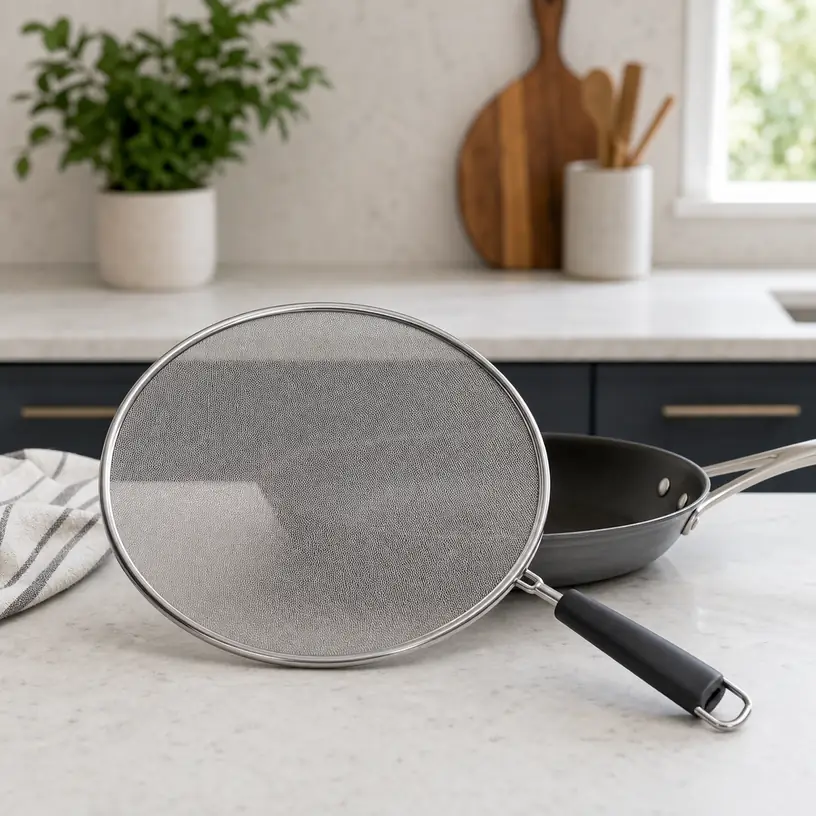
Illustrative image, not an official product photo.
Short answer
Start with the outside rim of the pan you use most, not its advertised cooking-surface size. A splatter screen should span that opening securely without leaving a broad gap, sliding into the food, or forcing its handle against another hot pan. Fine mesh can intercept droplets while letting steam escape, but it also collects residue and needs thorough cleaning. Compare the screen’s actual outside diameter, edge construction, handle length and angle, heat guidance, cleaning instructions, and the place where it will dry and be stored. If one screen is meant to cover several pans, check every rim individually rather than assuming a single nominal size will fit them all.
Search reference
Splatter screens for frying pans
Compare screen diameter, mesh construction, rim profile, handle position, care guidance, and storage features for the pans already in your kitchen.
View matching optionsFit begins at the top edge of the pan
Cookware size labels can be a rough starting point, but the dimension that matters here is the opening the screen must cover. Measure straight across the pan at its upper rim. Include pouring spouts, helper handles, or unusually flared sides in your inspection, because they can create gaps or keep a flat frame from resting evenly. Then compare that measurement with the screen’s stated outside diameter and usable mesh area.
A little overhang is often more practical than a screen that barely reaches the edge, provided the frame still rests stably and the maker describes it as suitable for the pan size. Excessive overhang has tradeoffs: it can crowd a neighboring burner, bump a saucepan, or place more hot metal beyond the pan. A screen that is too small may sit below the rim, contact food, or leave an open crescent where droplets escape.
Pan geometry also changes the fit. A high-sided sauté pan, low skillet, wok, and griddle do not present the same resting surface. Some screens have a flat outer ring; others use stepped rings intended to locate on more than one diameter. Those rings can improve positioning on compatible cookware, but only when the spacing agrees with the actual rim. Product photos are not a substitute for measurements.
Who this is for
- Cooks who pan-fry, sauté, or brown foods that regularly send small droplets beyond the cookware.
- Households trying to reduce routine cleanup on the range and nearby backsplash without sealing a pan under a solid lid.
- People who use one or two frequently reached-for skillets and can choose a screen around known rim dimensions.
- Small kitchens where a hanging loop or folding handle would give the tool a realistic storage location.
- Buyers replacing a warped, clogged, unstable, or difficult-to-clean screen.
Who should skip it
- Skip a separate screen if the cooking method specifically calls for a fitted solid lid and controlled moisture retention.
- A rigid wide screen is a poor choice when it would overhang the cooktop controls or interfere with cookware on adjacent burners.
- Do not use a generic screen as a substitute for specialized safety equipment, deep-frying guidance, or the appliance and cookware instructions.
- Avoid an option whose temperature limits, handle material, food-contact construction, or cleaning directions are unclear for your intended use.
- If hand strength or reach makes lifting a broad hot screen awkward, compare a stable lid or a different cooking setup instead of relying on a long handle alone.
What to verify before buying
- Outside diameter: Match the complete screen measurement to the pan opening and available space around the burner.
- Resting edge: Check whether the screen is flat, stepped, or shaped with feet, and whether it can sit evenly on your cookware rim.
- Mesh construction: Confirm the stated material, number of mesh layers, and how the mesh joins the outer frame.
- Handle position: Note its length, angle, grip material, and distance from the pan wall and neighboring burners.
- Heat guidance: Review current temperature and stovetop-use instructions rather than assuming every grip or trim piece tolerates the same heat.
- Steam behavior: Make sure the design is intended to vent steam; never assume it performs like a fitted lid.
- Cleaning method: Check for hand-wash or dishwasher directions and whether the rim, joints, or layered mesh have areas that trap residue.
- Storage footprint: Measure the full length with the handle extended and verify whether a folding handle or hanging loop locks securely.
- Included pieces: Determine whether the listing is for one screen, a multi-size set, or a screen bundled with unrelated utensils.
Mesh, perforations, and visibility
Traditional splatter screens often use woven metal mesh. The openings allow vapor to move upward while the strands interrupt many droplets. A finer weave may intercept smaller droplets, yet it presents more surface area for oil and food residue. Multiple mesh layers can add another barrier, but they can also make it harder to see the food and more important to clean and dry the screen carefully. Examine how the listing describes the construction instead of treating every mesh screen as equivalent.
Perforated metal guards use punched openings rather than woven wire. Their smooth sections may feel simpler to wipe, while the size and distribution of holes affect visibility and venting. Silicone elements sometimes appear around the edge or across parts of a guard. These features may change grip and cleanup, but their heat limits and care rules need specific confirmation.
Visibility is useful because a screen is normally lifted when food must be turned, stirred, or checked. No design stays perfectly clear once vapor and droplets reach it. If seeing browning is central to the recipe, plan for brief checks made with appropriate heat protection. Do not lean over the pan or place a face close to the screen to see through it.
The handle has to fit the whole cooktop
A long handle creates distance from the pan, but length by itself does not guarantee comfortable handling. Look at where the handle meets the frame and whether the grip rises above the pan’s own handle. Two handles occupying the same direction can be awkward to grasp separately. Rotating the screen can solve that conflict only if the cooktop leaves a safe, clear direction for its handle.
Grip materials deserve the same attention as the mesh. A dark or soft-looking section should not automatically be assumed cool to the touch. Read the heat and handling guidance, use suitable protection where directed, and keep every handle away from flames and other active heating zones. A loose joint can let the screen tilt as it is lifted, so inspect fasteners and follow the maker’s maintenance instructions.
Folding handles reduce drawer length and can make dishwasher placement easier when permitted. The hinge adds a moving part, however. Verify how it locks in the working position and avoid choosing one that must be held open by constant hand pressure. A short center knob has a smaller footprint but positions the hand over the hot pan; consider that movement before selecting by storage convenience.
Use and cleanup are connected
A splatter screen works best as one part of careful stovetop practice. Use cookware of suitable capacity, control heat according to the recipe, remove excess surface moisture from ingredients where appropriate, and avoid overcrowding. The screen can reduce escaping droplets, but it cannot contain every splash or correct an unsuitable pan-and-heat combination.
Lift the screen away from yourself so condensed moisture does not run toward your hand or back into hot fat unexpectedly. Have a heat-safe landing place ready before cooking. Setting an oily screen across a counter, sink edge, or another pan creates extra cleanup and can make the tool unstable. A dedicated rest or heat-safe plate needs enough area for the entire rim.
After cooking, allow the screen to reach a safe handling temperature and follow its cleaning instructions. Mesh often needs prompt attention because residue can dry between the wires. Clean both faces and inspect the rolled edge and handle joint. If dishwasher use is permitted, position the screen as directed so it does not block the spray or catch on a rack. Drying matters as much as washing, especially around layered mesh and enclosed rims.
Storage can decide whether it gets used
A typical screen is thin but broad, with a handle that makes it longer than the pan it covers. Before buying, try a cardboard circle and strip cut to the listed dimensions in the intended drawer or cabinet. This reveals whether the handle collides with the drawer front or whether the circular frame prevents other tools from lying flat.
Hanging can be efficient when there is a suitable hook away from heat, steam, and food-preparation traffic. Confirm that the loop is part of the load-bearing design and that the screen will not brush a wall while oily or damp. A folding model may fit vertically with baking sheets, but its hinge should not support the screen at an angle where it can roll out.
Sets with several diameters solve fit problems only when each size corresponds to cookware you actually own. Otherwise, the unused pieces consume space and complicate cleanup. One correctly sized, reachable screen can be more practical than a multi-piece set selected for coverage on paper.
Limitations
- A vented screen reduces many droplets but cannot create a sealed barrier or eliminate stovetop cleanup.
- Fine or layered mesh can retain grease and may require more detailed washing than a solid lid.
- A nominal pan size does not guarantee fit because rim diameter, flare, spouts, and handle placement vary.
- Steam, condensation, the metal frame, and some grip components can become hot during use.
- Wide screens and long handles may interfere with adjacent cookware, controls, walls, or compact cooktops.
- A screen does not replace recipe directions, temperature control, suitable cookware, or safe frying practices.
Alternatives to compare
- A fitted lid when retaining moisture is desirable and the recipe supports covered cooking.
- A partially vented cookware lid made for the pan, where its instructions allow the required steam release.
- A deeper sauté pan or skillet to add sidewall height for foods that can be cooked appropriately in it.
- An oven method when the recipe permits it and reducing open-pan stovetop activity is the main goal.
- A single-pan cooking schedule that leaves more clearance if crowding, rather than the screen itself, creates the handling problem.
FAQ
Should a splatter screen be larger than the frying pan?
It should cover the complete opening and rest securely on the rim, which may require a modest overhang. Too much overhang can crowd other burners or controls. Compare the screen’s full outside diameter with the measured top opening of the pan and follow the stated fit guidance.
Does a splatter screen work like a pan lid?
No. A mesh or perforated screen is intended to let much of the steam escape while intercepting many droplets. A solid fitted lid retains substantially more moisture. Choose according to the cooking method rather than treating the two tools as interchangeable.
Is a fine-mesh or perforated splatter guard easier to clean?
The answer depends on construction. Fine and layered mesh offers many small spaces where residue can collect, while perforated metal may have smoother open surfaces but still includes edges and joints. Review the care instructions and inspect how the screen, rim, and handle are assembled.
Can one splatter screen fit several pan sizes?
Sometimes, especially when the screen is large enough and has a stable resting profile for each rim. Measure every pan separately and check for spouts, sloped walls, and handle conflicts. A screen that merely spans a smaller pan is not useful if it slides or creates unsafe overhang.
Where should I put a hot splatter screen while stirring food?
Prepare a stable, heat-safe landing area large enough for the complete screen before cooking. Lift it away from yourself, account for condensation, and use the handling protection specified by the maker. Do not balance it on another pot, a narrow sink edge, or a surface that may be damaged by heat or oil.