A Wall-Mounted Key Holder That Works with Your Entryway Routine
Product links are for reference. Verify current details on the retailer page before buying.
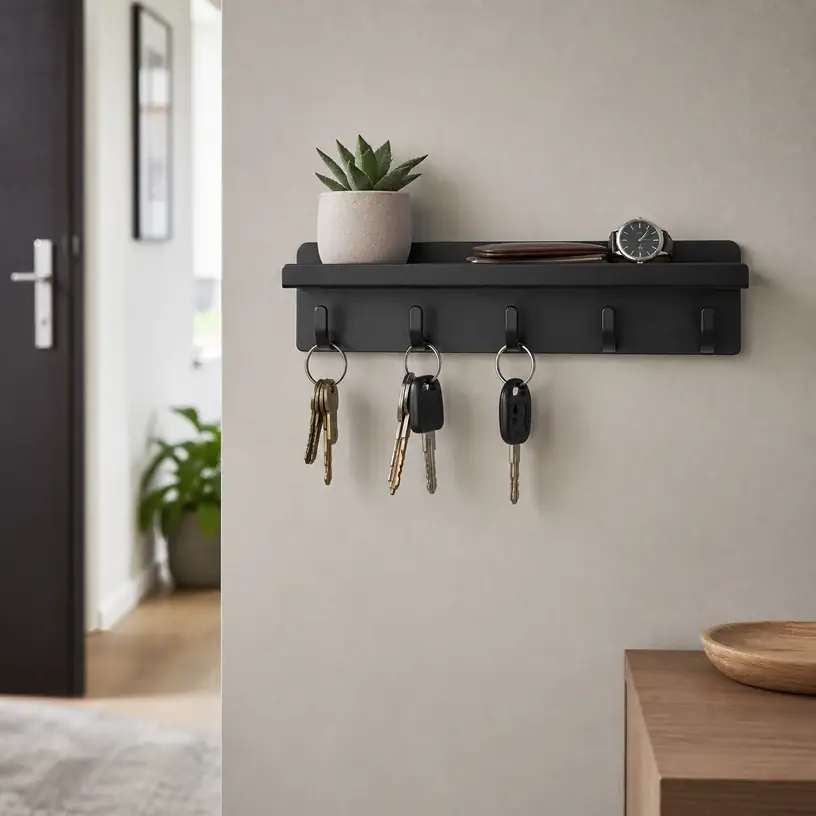
Illustrative image, not an official product photo.
Short answer
A useful wall-mounted key holder should make keys easier to drop off than to leave on a counter. Start by choosing a spot along the route through your main door, then count the everyday key rings that need separate hooks. Check hook spacing for bulky fobs, the mounting method for your wall, and whether a shelf or mail slot would solve a real entryway problem. A compact rack is often better than a feature-heavy organizer if the larger design crowds a light switch, door frame, or narrow hallway.
Search reference
Wall-mounted key holder options
Compare current hook layouts, mounting hardware, shelf dimensions, and organizer formats with the wall space beside your usual entrance.
View matching optionsPlan around the doorway, not the empty wall
The most important measurement is not the width of the key holder. It is the usable area where someone can reach it while arriving with a bag, closing the door, or turning on a nearby light. A rack that fits an open patch of wall may still be inconvenient if it sits behind the door, above shoulder height, or across the hall from the natural walking path.
Use removable tape to mark the proposed outline before ordering. Open the door fully, operate nearby switches, and make sure coats or tote bags will not snag on the hooks. In a shared entrance, place the rack where shorter household members can use it comfortably without creating a head-level obstacle for anyone else.
Placement also affects what belongs on the organizer. Keys used every day should have the easiest hooks. A shallow shelf can hold sunglasses or a small wallet, but it can also become a clutter ledge. Mail compartments are helpful only if paper really enters through that door and has another place to go after sorting.
Who this is for
- Households that repeatedly misplace keys on counters, desks, or in different bags.
- Renters or homeowners who want a small entryway landing zone without adding floor furniture.
- Families that need separate, visible spots for house, car, mailbox, or utility key rings.
- People combining keys with one or two lightweight departure items such as sunglasses or a dog leash.
- Small hallways where a narrow wall organizer is more practical than a console table.
Who should skip it
- Anyone who routinely keeps every key inside the same handbag, backpack, or closed drawer.
- Renters who cannot make wall holes and do not have a suitable surface for the listed adhesive method.
- Households needing secure or concealed key storage rather than an open rack near an entrance.
- Entryways where exposed hooks would project into a tight walking path.
- Buyers mainly trying to manage coats, heavy bags, or umbrellas, which usually need a different wall system.
What to verify before buying
- Measure the full width, height, shelf depth, and hook projection against the intended wall area.
- Count everyday key rings and allow extra side-to-side space for large car fobs and wrist straps.
- Confirm whether mounting hardware is included and which wall materials it is intended to fit.
- Check the stated installation process before assuming the rack can be mounted without drilling.
- Review any shelf lip, mail slot, tray, or cubby dimensions rather than judging capacity from photos.
- Look for care guidance appropriate to the listed wood, metal, plastic, or mixed-material finish.
- Consider whether keys will be visible from a window or open doorway and choose placement accordingly.
Hooks, spacing, and usable capacity
Hook count is only a rough capacity guide. Closely packed hooks may look efficient, yet wide key fobs can overlap and hide the rings behind them. If several drivers use the organizer, compare center-to-center hook spacing and hook depth. Open hooks are quick to use; more enclosed hook shapes may hold a ring more securely but can take an extra moment to load.
Think about weight item by item. A normal key ring and a lightweight leash are different from a loaded handbag or winter coat. Do not treat every hook as general-purpose storage unless the current instructions explicitly support that use and the rack is installed into an appropriate wall structure.
Labels can help a shared household, but permanent printed categories are less flexible when routines change. A simple row of visually distinct hooks or small removable labels may be easier to adapt after a move, a new vehicle, or a change in who uses the entry.
Shelf, mail slot, or hooks only?
A hooks-only rack has a clear job and a shallow profile. It suits narrow hallways and households that already have a tray or drawer for pocket items. It is also less likely to collect receipts, loose change, and unopened mail.
A top shelf makes sense when one or two small departure items need to stay with the keys. Check whether the shelf has enough depth and a raised edge; a narrow, flat ledge may not hold rounded sunglasses cases or a wallet securely. Avoid placing fragile objects on a rack beside a door that vibrates when it closes.
Mail pockets can support a deliberate sorting routine, especially in a small apartment without a console table. They are less useful when envelopes accumulate for weeks or when thick catalogs prevent easy access to the hooks below. If paper management is the main goal, compare a dedicated wall file with a separate compact key rail.
Mounting choices deserve a closer look
Screw-mounted key holders can provide a stable installation when the supplied or separately chosen hardware matches the wall. Drywall, wood, masonry, tile, and other surfaces do not all use the same fasteners. Product instructions should guide the installation, and heavier intended loads may require anchoring into suitable structure.
Adhesive mounting avoids holes but is not automatically compatible with every painted, textured, damp, or porous surface. Check surface preparation, curing time, removal guidance, and load limits in the current listing. An adhesive rack that releases can damage items below even when the keys themselves are light.
Some organizers use hidden keyhole slots or a separate mounting plate. These can create a tidy appearance, though screw spacing must be accurate. Before drilling, use the actual product or its verified template rather than relying only on approximate dimensions from a search image.
Materials and entryway upkeep
Metal racks can keep hook profiles relatively slim, while wood or wood-look organizers may blend with entryway furniture. Mixed-material versions often add a shelf, basket, or mail compartment. Material names alone do not establish finish quality or load capacity, so compare the current construction description and installation instructions.
Keys swing against the wall and the organizer during daily use. A back panel can reduce direct contact with paint, while a rack made only from a rail and hooks may leave the wall exposed. If scuffs are a concern, look at the distance between the hooks and mounting surface.
Entryways collect dust, damp outerwear, and residue from frequently handled objects. Choose a finish with care instructions that fit your routine. Deep decorative cutouts and wire baskets may take longer to dust than a plain rail and shallow shelf.
Limitations
- An open key rack makes keys visible, so placement should account for windows, visitors, and the view through the doorway.
- Extra shelves and mail slots can attract clutter rather than improve the departure routine.
- Included fasteners may not be suitable for every wall type or intended load.
- Adhesive performance depends on the surface, preparation, curing, environment, and stated limits.
- A key holder organizes items only when household members consistently return them to the assigned hooks.
- Search listings can change; verify dimensions, materials, included hardware, and installation guidance on the current page.
Alternatives to compare
- A small entryway tray when keys, earbuds, and wallets are usually emptied from pockets together.
- A closed drawer or cabinet when keys should stay out of sight.
- A magnetic key strip for compatible metal key rings and a very minimal setup.
- A wall-mounted mail organizer when incoming paper is the larger problem and keys are secondary.
- A freestanding console or narrow shoe cabinet when the entrance also needs substantial storage.
FAQ
How many hooks should a wall-mounted key holder have?
Count the key rings used regularly and give each one its own hook, then consider one or two spare positions. Hook spacing matters as much as the total because bulky car fobs can overlap when hooks are close together.
Where should I install a key holder near the front door?
Choose a reachable spot along the normal path into and out of the home. Check the door swing, light switches, coat movement, walking clearance, and visibility from outside before fixing the position.
Can an adhesive key holder work without drilling?
It can be an option only when the listed adhesive method suits the wall surface and intended load. Follow the current preparation and curing instructions, and do not assume textured or delicate paint is compatible.
Is a shelf useful on a key rack?
A shelf is useful when it has verified dimensions for a small wallet, sunglasses case, or another item that leaves with the keys. If it has no specific purpose, a shelf can simply become a place for clutter.
Should keys be stored beside the door?
Door-side storage is convenient, but an open rack should not expose keys to easy reach or a clear outside view. A less visible wall, closed cabinet, or drawer may be more appropriate for some entrances.