Give Household Paperwork a Home: Choosing an Accordion File Organizer
Product links are for reference. Verify current details on the retailer page before buying.
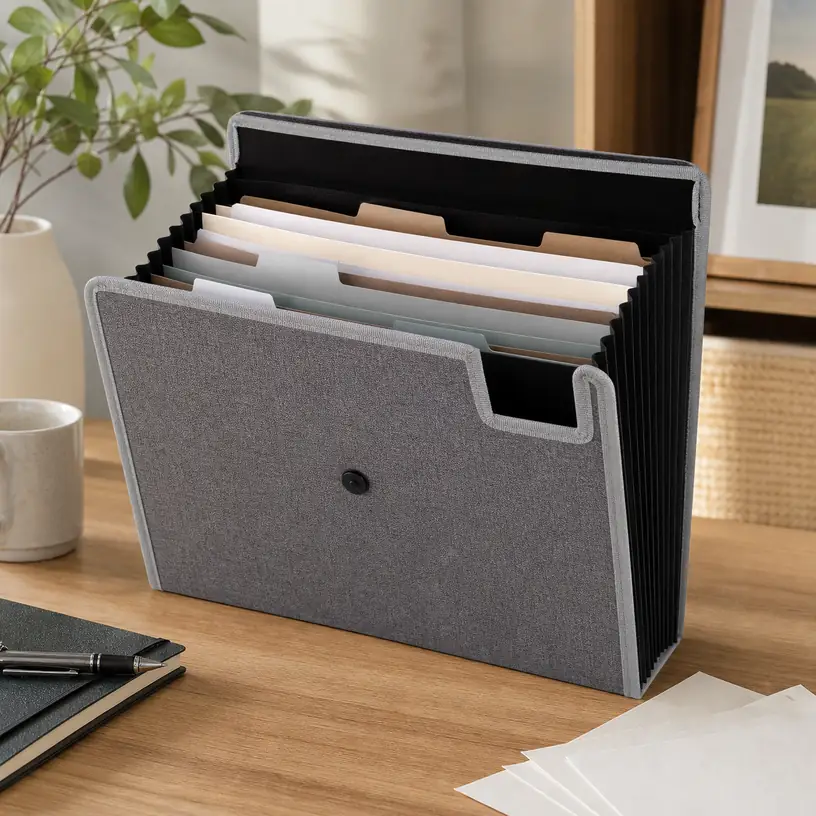
Illustrative image, not an official product photo.
Short answer
An accordion file organizer works well as a compact landing place for active household papers: bills awaiting action, school forms, warranties, tax documents for the current year, and records needed for an upcoming appointment. Choose it by counting the categories you actually use, not by chasing the greatest pocket count. Then check whether letter-size pages fit without curling, how clearly the tabs remain visible when the file expands, whether the closure reaches around a realistic load, and where the filled organizer will sit. A model that stands steadily and opens wide enough to file a page with one hand is usually more useful than an overfilled folder with many narrow sections. It can organize everyday records, but it is not automatically archival, fire-resistant, waterproof, or secure for irreplaceable originals.
Search reference
Accordion file organizers for household paperwork
Compare page format, usable pocket count, tab layout, expanded depth, closure range, carrying features, and the maker's material and care details.
View matching optionsBegin with the paper pile you already have
Put one ordinary month’s loose paperwork on a table before deciding how many sections to buy. Remove envelopes and duplicates that do not need filing, then group what remains by the next action. A practical set of groups might include “pay,” “reply,” “school,” “home,” “vehicle,” “health appointments,” and “file later.” Your categories will differ, but each one should describe a decision you can make quickly when a paper arrives.
This exercise separates active paperwork from long-term records. An accordion file is convenient when a document needs to move between a desk, kitchen table, appointment, or annual filing box. It becomes less convenient when every pocket is treated as permanent storage. Old statements and closed projects make the file heavy, hide current tasks, and stretch sections meant for a smaller working set.
Count the useful groups and leave a few spare pockets for seasonal categories. Do not assume every advertised section is a full pocket: some product descriptions count the front compartment, label area, or accessory space differently. Check a diagram or current specifications to understand what is actually divided inside.
Who this is for
- Households that need one visible place for papers awaiting payment, signatures, calls, or later filing.
- Renters and homeowners managing a modest group of property, utility, vehicle, and service documents.
- Families rotating school, activity, and appointment papers through short-term categories.
- People who occasionally carry a document set to a meeting and want the sections to remain together.
- Small home offices that lack room for a filing cabinet but can dedicate a shelf or drawer to an active file.
- Buyers replacing a loose stack, shopping bag, or single folder that makes individual papers difficult to retrieve.
Who should skip it
- Choose a locking or otherwise appropriate secure-storage solution when documents require access control.
- Use storage specifically documented for archival needs if long-term preservation of important originals is the priority.
- Skip a portable folder if the real workload consists of several full drawers of records; a filing cabinet or file box offers a different capacity.
- Avoid adding a paper organizer when scanning and a reliable digital records process already cover the entire workflow.
- Choose a rigid project case when bulky manuals, notebooks, media, or supplies must travel with the papers.
- Do not rely on an ordinary organizer for protection from fire, flooding, spills, or other hazards unless the current product documentation states and defines that capability.
What to verify before buying
- Document format: Confirm the interior pocket dimensions for unfolded US letter pages and any legal-size, A4, receipts, envelopes, or booklets you plan to store.
- Usable sections: Check the actual number of divided pockets and whether a front or rear compartment is included in the count.
- Pocket expansion: Compare the stated expansion with a realistic weekly or monthly load; narrow folds can become difficult to browse when packed tightly.
- Tab position: Look for tabs that remain visible across the full width and can accept labels large enough for your category names.
- Page containment: Check pocket-wall height and side construction so loose pages are less likely to slip under a divider or protrude when carried.
- Closure range: Determine whether an elastic, buckle, snap, zipper, flap, or tie can close at both light and expanded loads.
- Base behavior: If the file will stand on a shelf, verify whether its base is flat and stable at the expected fill level.
- Handle and carry orientation: Confirm where the handle attaches and whether pages stay upright when the organizer is lifted.
- Overall dimensions: Measure the file when expanded, not only when empty, against the target shelf, drawer, cubby, or bag.
- Material and care: Review the current construction and cleaning instructions without assuming that a plastic-looking surface is waterproof or suitable for harsh cleaners.
- Labels and extras: Verify whether inserts, blank labels, business-card slots, padlocks, or accessory pouches shown in images are included.
Pocket count should follow retrieval habits
More categories can make each destination precise, but they also slow down filing when the difference between two labels is unclear. “House,” “repairs,” “appliances,” and “warranties” may look orderly on tabs, yet a receipt for a repaired appliance could fit all four. Broader categories are often easier to use consistently. Add subdivisions only when a group becomes crowded or when you repeatedly look in the wrong place.
Arrange the tabs in the order papers move through the household. Action categories can go at the front, reference categories behind them, and “to file” at the back. Another workable sequence follows frequency: daily or weekly groups first, annual documents last. Alphabetical order helps only if every user remembers the same category names.
Tab visibility changes as the folder fills. Staggered tabs can display many labels at once, while straight tabs may offer more writing space. Translucent material can hint at a pocket’s contents but does not replace a clear label. If more than one person uses the organizer, write category names in ordinary household language rather than private abbreviations.
Fit is about the opening as well as the page
A listing may say that a folder holds letter-size paper while providing little information about usable opening width. A page should enter without bowing sharply at the corners, catching on a flap, or requiring neighboring sections to be pulled apart with both hands. Repeated friction can bend frequently handled forms and discourages quick filing.
Think about mixed shapes. Receipts can slide to the bottom and disappear behind full-size sheets. Envelopes add thickness. Stapled packets spread differently from single pages, and thin booklets can make a divider lean. Small items may need their own labeled envelope inside a pocket rather than another loose category. If you routinely store thick instruction manuals, measure the manuals and consider a project box instead of forcing them into pleated sections.
Legal-size papers generally do not fit a letter-size organizer without folding. A4 and letter dimensions also differ. Verify the exact internal dimensions when documents arrive from different systems. “Document size” in a title is not a substitute for the manufacturer’s current measurements.
Expansion changes the organizer’s footprint
Accordion sides allow the file to grow, but they do not create storage space around it. Measure the chosen shelf or drawer with the organizer expanded to a useful working depth. Leave enough room to open the top and spread adjacent pockets. A folder wedged tightly between books may be compact while stored but frustrating every time a document needs to be found.
An expanded file also behaves differently when lifted. Weight moves outward, handles take more load, and a loose closure may no longer reach its anchor. Check the maker’s carrying guidance and avoid loading beyond any stated limits. Before taking the organizer out of the house, close it, lift it over a table, and confirm that papers do not rise above the pocket walls or migrate between sections.
Freestanding designs are convenient on an open shelf, but stability depends on the base, material stiffness, and load distribution. A nearly empty accordion file can collapse inward; an unevenly filled one can lean. Store it where a fall will not scatter documents or block a walkway. If it belongs in a drawer, confirm the handle, flap, and tabs clear the drawer opening.
Match the closure to the routine
An elastic cord or band is quick and can accommodate some expansion, though its tension and attachment points matter over time. A buckle or snap offers a defined connection but may have a limited reach once pockets are full. A zipper contains the perimeter more completely, at the cost of requiring careful alignment around an uneven load. A flap with a tie can be simple, but long ties may be inconvenient during frequent access.
For a file that stays on one shelf, the closure may mainly keep dust and stray papers away. For a file carried to appointments, page containment is more important. Turn the closed organizer gently in the same orientation it will travel and see whether thin papers can escape near the sides. Do this with non-sensitive test pages first.
A closure is not the same as security. A zipper, snap, or small combination lock may discourage casual opening, but it does not necessarily make the file suitable for sensitive records. Choose where documents are stored and who can access them according to the records involved, not according to the appearance of the clasp.
Use a reset cycle so the file stays useful
Set a recurring time to empty the “action” and “file later” sections. Weekly may suit bills and school forms; monthly may be enough for a quieter household. Complete the task, move records to their proper longer-term location, shred or discard material according to your information-handling practices, and return the working pockets to a manageable thickness.
An annual reset is useful for categories tied to taxes, insurance, school years, or service contracts. Label the year where it genuinely helps, but avoid turning the active organizer into an indefinite archive. If you retain records, follow appropriate current guidance for the document type and your circumstances rather than assuming one universal retention period.
Keep a simple index near the front if categories are not obvious. An index is especially helpful when another household member may need to retrieve a document. Do not write sensitive identifying details on outward-facing tabs. A broad label such as “appointments” can be more discreet than a person’s condition, account number, or other private information.
Limitations
- Accordion pockets provide sorting, not guaranteed archival preservation, fire resistance, water protection, or theft prevention.
- The usable capacity can be much smaller than the apparent expanded width when packets, envelopes, and booklets are mixed together.
- Very narrow sections make individual pages harder to insert and browse.
- Tabs can become hidden, bent, or difficult to read when the organizer is compressed or overfilled.
- Flexible bodies may slump when nearly empty and lean when weight is distributed unevenly.
- A closure that works on an empty folder may strain or fail to align at a heavy load.
- Small receipts and cards can disappear below full-size documents unless placed in an inner envelope or dedicated pocket.
- Portable files can make sensitive records easy to carry away, so storage location and access still require judgment.
Alternatives to compare
A desktop vertical file keeps current action folders visible and easy to reach but is less contained for travel. A lidded file box with hanging folders provides greater capacity and clearer folder movement at the cost of a larger footprint. A small filing cabinet suits growing long-term records and can offer lock options specific to the model. Project cases hold thicker manuals, notebooks, or supplies without forcing them into narrow pleats. A binder with sheet protectors keeps a fixed sequence and allows page turning, though adding and reordering documents takes more effort. A digital scan-and-backup workflow reduces physical paper when electronic copies are appropriate, but it requires file naming, backups, access planning, and care with sensitive information.
FAQ
How many pockets should a household accordion file have?
Start with the categories in your current active paper pile, then add two or three spare sections for seasonal needs. Fewer well-defined categories are easier to maintain than many overlapping labels. Confirm how the manufacturer counts pockets before comparing models.
Will letter-size paper fit without folding?
It should only if the organizer’s usable internal width and height support US letter pages. Check current internal dimensions and pocket opening width rather than relying solely on the product name. Legal-size and A4 documents have different dimensions and need separate verification.
Can an accordion organizer hold receipts and small cards?
Yes, but small pieces can settle below larger pages and become difficult to see. Put them in a labeled envelope or inner pouch within the relevant section, and verify that any included small-item pocket closes securely.
Is a zippered accordion file waterproof?
A zipper alone does not establish water protection. Seams, outer material, zipper construction, openings, and the maker’s tested claims all matter. Unless current documentation clearly defines water resistance, keep the organizer away from spills, damp floors, and weather exposure.
Should I use an accordion file for original documents?
Use storage appropriate to each document’s importance, preservation needs, privacy, and replacement difficulty. An ordinary portable file is convenient for active copies, but it should not be assumed archival, fire-resistant, waterproof, or secure for irreplaceable originals.
How often should household paperwork be cleared out?
Use a cadence that matches the actions inside: weekly for time-sensitive forms and payments, monthly for routine transfers, and an annual reset for year-based categories. Follow suitable current retention guidance before discarding records; do not use one schedule for every document type.