Cordless Electric Screwdrivers for Furniture Assembly and Small Repairs
Product links are for reference. Verify current details on the retailer page before buying.
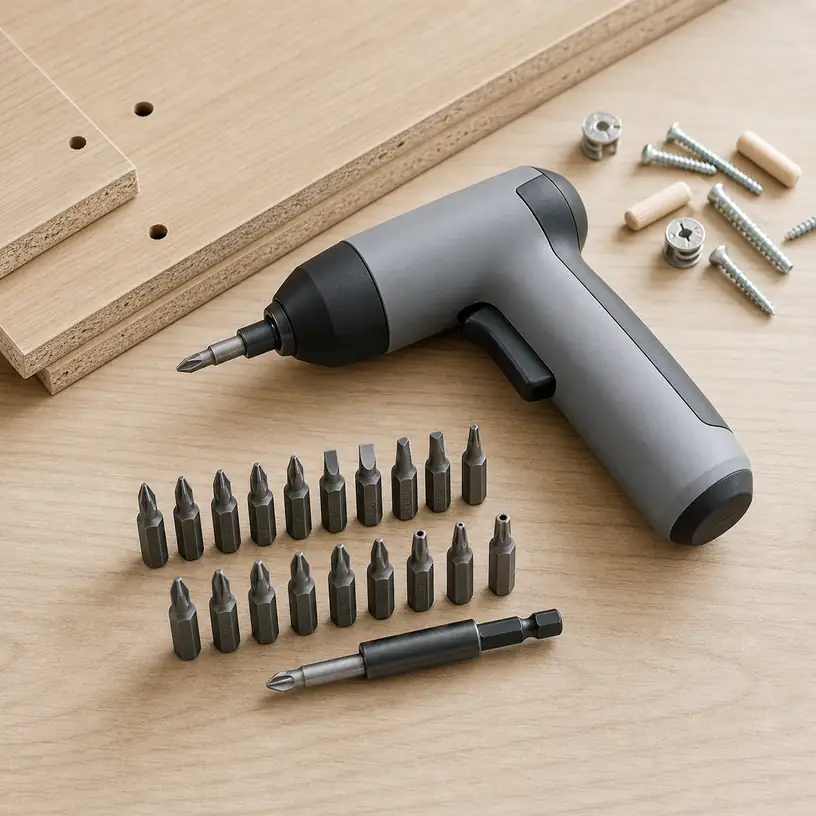
Illustrative image, not an official product photo.
Short answer
A cordless electric screwdriver is most useful for repeated, low-to-moderate fastening jobs: assembling flat-pack furniture, opening appliance panels, tightening cabinet hardware, and handling small household repairs. Choose one by the fasteners and spaces you actually encounter. Grip shape, bit access, low-speed control, adjustable torque, charging method, and the direction switch often matter more than a large accessory count. It is not a substitute for a drill when you regularly make holes or drive long screws into dense material.
Search reference
Cordless electric screwdriver options
Compare compact drivers by control layout, torque settings, bit standard, charging arrangement, and stated job limits.
View matching optionsWhere a power screwdriver earns its drawer space
Turning one or two accessible screws by hand is rarely difficult. The advantage appears when a project involves dozens of similar fasteners or awkward repetition. An electric screwdriver can reduce wrist motion while staying smaller and easier to position than a conventional drill/driver. That makes the category appealing for desks, shelving units, switch plates, battery compartments, cabinet pulls, and routine disassembly.
Compact size comes with limits. These tools usually prioritize control and portability over drilling ability and high fastening force. A screw that is corroded, cross-threaded, over-tightened, or buried in hard material may need a hand tool or a more capable driver. Matching the tool to the work prevents an underpowered purchase from becoming a frustrating substitute for the wrong category.
Who this is for
- Households that regularly assemble ready-to-build furniture or adjust cabinet hardware.
- Renters and homeowners who want a compact tool for light maintenance without storing a full-size drill.
- Hobbyists who remove many small screws from cases, fixtures, or simple projects.
- Buyers who want powered rotation but still value deliberate, low-speed fastening control.
- Shared tool kits where straightforward charging and clearly labeled controls are priorities.
Who should skip it
- A drill/driver is the more versatile choice if most jobs include drilling pilot holes or driving long construction screws.
- A manual ratcheting screwdriver may be better for occasional use, long storage intervals, or maximum tactile feedback.
- Precision electronics work can require a smaller driver, lower torque range, and specialized bits designed for tiny fasteners.
- Automotive, masonry, deck, and structural work generally call for task-appropriate tools rather than a compact household screwdriver.
What to verify before buying
Start with the bit holder. Confirm the shank size and retention method, then check whether the included bits match the screw heads in your furniture, fixtures, or devices. A high bit count is not useful if the common sizes are duplicated, poorly labeled, or difficult to replace. For recessed screws, compare bit length and holder diameter so the nose of the tool does not block access.
Next, examine control rather than relying on a single maximum-torque number. Check whether the driver has adjustable torque or a clutch, how slowly it can start, and whether it can stop before damaging a soft fastener or finished surface. Verify the direction switch position for both right- and left-handed use. If manual finishing is important, determine whether the tool permits safe hand-tightening when powered off and follow its instructions.
Read the current listing and manual for battery type, expected charging connection, included cable or charger, charge indicator behavior, and storage guidance. A familiar port is convenient only if the required power source and cable are clearly supported. Battery runtime claims depend on workload, torque, temperature, and usage pattern, so treat them as comparison context rather than a guaranteed number of projects.
Grip formats and access
Straight and pen-style bodies
A slim in-line body can reach narrow spaces and packs easily in a small tool pouch. It may also be easier to rotate by hand for final alignment. The tradeoff is less leverage when a fastener initially resists, and some users may find a narrow cylinder harder to stabilize. Compare body diameter, switch placement, and the distance from the nose to the grip area.
Pistol-grip bodies
A pistol shape provides a familiar trigger position and can make forward pressure easier on a vertical surface. It usually occupies more storage space and may not fit between a shelf and side panel. Check whether the handle angle feels suitable for both horizontal and vertical jobs rather than assuming the drill-like shape is universally better.
Pivoting handles
Some models change between straight and angled configurations. This can be useful when one furniture project presents several access directions, but the hinge introduces another moving part. Verify how the handle locks, whether controls remain reachable in both positions, and whether there is noticeable movement at the joint.
Torque, speed, and finishing control
More force is not automatically better. Flat-pack furniture often uses particleboard, plastic fittings, inserts, and small hardware that can be damaged by overdriving. Adjustable torque settings can help, but their markings are not standardized across every tool. Begin at a conservative setting, keep the bit aligned with the screw, and finish carefully according to the furniture or fixture instructions.
Speed also affects control. A lower or variable starting speed can help the bit seat in the screw head before full rotation. A fixed-speed model may still suit repetitive, accessible fasteners if its switch responds predictably. In either case, stop when resistance changes unexpectedly. Powered rotation should not be used to force a mismatched, tilted, or cross-threaded screw.
Bits, extensions, and small conveniences
A basic selection of Phillips, slotted, hex, and star-shaped bits can cover many household jobs, but the exact sizes matter. Inventory the fasteners you own before comparing sets. Standard replaceable bits offer more flexibility than a proprietary system, while a magnetic holder can assist placement without correcting poor alignment.
An extension may reach recessed hardware, though extra length can increase wobble. An offset or right-angle attachment can help near panels and corners, but it also changes the way force reaches the fastener. Verify that any attachment is intended for the selected tool and task.
A work light is useful only when it illuminates the screw instead of casting a shadow from the tool nose. Likewise, a battery gauge is more informative when it has several levels rather than a single warning light. These details are secondary to control, access, and bit fit, but they can distinguish otherwise similar options.
Charging and storage planning
Decide where the screwdriver will live and charge. A tool stored loose in a kitchen drawer can lose bits and activate accidentally if its switch is exposed. A compact case or organized pouch keeps the driver, charging cable, and most-used bits together. Check whether the tool has a trigger lock or another transport safeguard.
For longer storage, follow the manufacturer’s battery instructions and keep the tool away from heat, moisture, and conductive debris. Inspect the cable and charging port before use. If the battery is built in, consider the long-term tradeoff: the tool may be compact, but battery replacement might not be practical. A removable battery can extend service options, although it usually increases size and cost.
A sensible first-project check
Before starting a full assembly, test the selected bit and conservative torque setting on one accessible fastener. The bit should sit fully in the head without rocking. Keep the driver in line with the screw and apply only enough forward pressure to maintain engagement. If the fastener stalls, remove the tool and identify the cause instead of repeatedly activating it.
For furniture assembly, loosely start mating fasteners as directed before fully tightening the structure. This preserves alignment and reduces the temptation to use motor force to pull misaligned panels together. Use a manual screwdriver or specified hand tool for delicate final tightening when the instructions call for it.
Limitations
- A compact electric screwdriver may not have the chuck, speed range, or power needed for drilling holes.
- Maximum torque figures do not describe low-speed control, clutch behavior, or performance in every material.
- Battery runtime and charging time vary with workload, battery condition, temperature, and charging equipment.
- Built-in lights can miss deeply recessed screws or create shadows around bulky noses.
- Included bit kits may emphasize quantity rather than the exact profiles and sizes a household uses.
- Powered fastening can strip screw heads or damage material when the bit, alignment, or torque setting is wrong.
Alternatives to compare
- A ratcheting manual screwdriver for infrequent jobs and direct tightening feedback.
- A precision screwdriver set for electronics, eyewear, and very small fasteners.
- A 12-volt drill/driver when drilling and longer screws are routine parts of the same projects.
- A right-angle manual driver for occasional work in a very shallow clearance.
- A bit set with a comfortable hand driver if worn or mismatched bits are the main problem.
FAQ
Is a cordless electric screwdriver the same as a drill?
No. Both can rotate a bit, but a compact electric screwdriver is generally designed around light fastening, control, and portability. A drill/driver usually offers a chuck, broader speed range, and greater capability for drilling and demanding screws. Verify the stated functions and limits of the specific tool.
How much torque does a furniture-assembly screwdriver need?
There is no single useful number for every project because fastener size, material, inserts, and tool controls differ. For furniture, controllable low torque and a usable clutch can be more valuable than a high maximum figure. Follow the assembly instructions and avoid using motor force to correct misalignment.
Are more included screwdriver bits always better?
No. Check whether the kit contains the correct profiles, sizes, lengths, and shank standard for your jobs. A smaller, clearly labeled selection of replaceable bits may be more useful than a large assortment with duplicates or uncommon sizes.
Can an electric screwdriver remove a stuck screw?
It may remove a normally tightened screw, but a corroded, damaged, over-tightened, or thread-locked fastener can exceed the tool’s intended use. Stop if the bit slips or the tool stalls. A properly fitting hand tool or another task-appropriate method may provide better control.
Should I choose USB charging or a removable battery?
Choose around storage and frequency of use. A clearly specified USB charging arrangement can reduce cable clutter for occasional household work, while a removable battery may support longer sessions and future replacement. Confirm the exact port, power requirements, included charging equipment, and battery availability before buying.