Dish Drying Mats: Counter Space, Airflow, and Cleanup
Product links are for reference. Verify current details on the retailer page before buying.
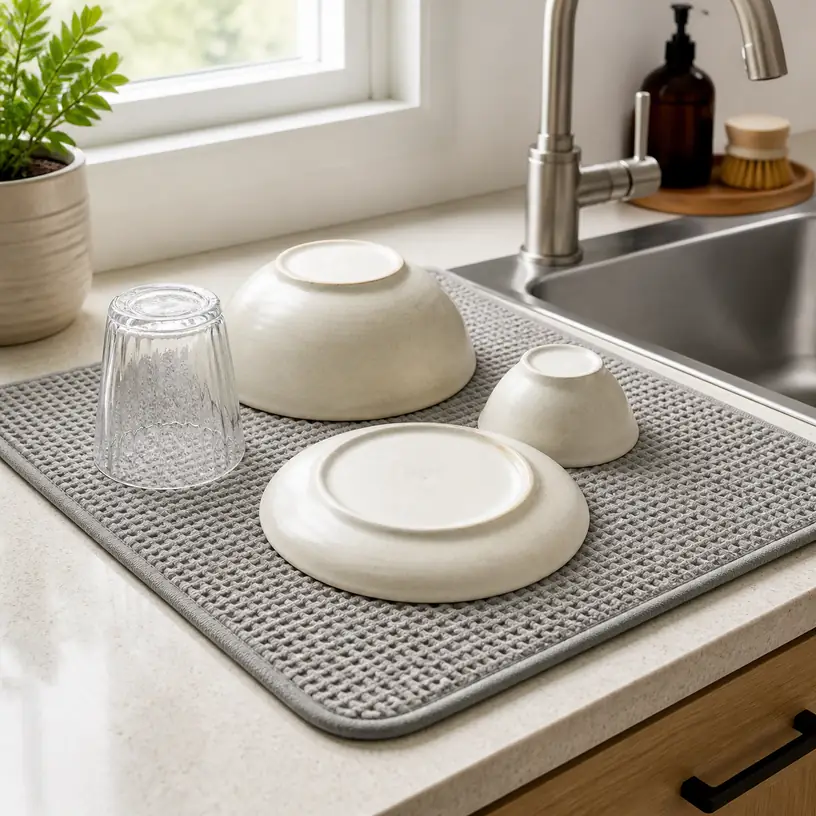
Illustrative image, not an official product photo.
Short answer
A dish drying mat makes the most sense when you hand-wash a modest batch, need the counter back afterward, and do not want a rigid rack occupying the same spot all day. Measure the open area beside the sink, including faucet reach and cabinet clearance, then decide where runoff should go. Absorbent mats hold moisture until they can dry; channeled or raised designs are intended to keep dishes above collected water; roll-up or foldable formats can be put away between uses. Whichever style you consider, leave room between items, check the care instructions, and plan a realistic place for the mat itself to dry.
Search reference
Dish drying mats for kitchen counters
Compare usable dimensions, surface design, care directions, storage method, and the way each mat handles water on your counter.
View matching optionsStart with the wettest part of your routine
The useful size of a drying mat is not simply the largest rectangle that fits beside the sink. Watch one ordinary wash-up first. Count the dinner plates, glasses, utensils, lids, and awkward pieces that usually need a landing place. A wide mat can hold more, but crowding dishes together reduces the open space around them. A compact mat may work better if you wash in two short batches and put dry items away promptly.
Also notice how much water reaches the counter. Some people shake or drain each item over the sink before setting it down; others transfer pieces directly from rinse water. Flatware, bottle lids, and containers with deep rims can carry surprising pockets of water. An absorbent surface and a draining surface manage that water differently, so the right choice depends on what you are willing to empty, hang, wipe, or launder after the dishes are put away.
Counter geometry matters just as much as dish count. A mat placed across a cabinet seam may prevent a drawer from opening. One pushed beneath an upper cabinet can leave little vertical room for tall bottles. If it sits close to a wood edge, backsplash joint, appliance cord, or wall outlet, splashes may reach places that are inconvenient to wipe. Sketching the usable rectangle with a tape measure is more reliable than estimating from a listing photo.
Who this is for
- Apartment and small-kitchen households that want a drying surface they can move after use.
- People who hand-wash a few glasses, knives, reusable bottles, or cookware pieces between dishwasher loads.
- Renters who prefer a counter solution that does not require mounting hardware or a permanent sink attachment.
- Households that already have a small rack but need temporary overflow space during meal preparation.
- Anyone willing to include the mat in a regular washing and drying routine instead of leaving it damp beneath dishes.
Who should skip it
- A full rack may be more practical when several place settings are hand-washed at once and plates need individual support.
- Skip a flat mat as the only solution if you regularly need to hold many plates, boards, or lids upright.
- An over-sink rack may suit a kitchen with almost no safe counter area, provided its dimensions match the sink.
- Avoid choosing a mat without first identifying somewhere to hang, stand, or lay it out after use.
- If standing water must drain directly into the sink, compare racks or mats with a clearly described drainage path rather than assuming every surface will shed water.
What to verify before buying
- Usable footprint: Compare the stated length and width with the clear counter area, not the counter’s total dimensions.
- Thickness and edge shape: Check whether a raised rim, stitched border, or sloped edge changes the usable surface or catches nearby drawers.
- Water strategy: Confirm whether the design absorbs moisture, holds it in channels, drains toward an edge, or uses an elevated surface.
- Care instructions: Verify whether the mat is intended for machine washing, hand washing, wiping, or another method, and follow any drying guidance.
- Material description: Read the current listing for the actual surface, core, backing, and any separate parts instead of inferring them from appearance.
- Heat guidance: Do not place hot cookware on a drying mat unless the maker explicitly describes suitable temperatures and uses.
- Folding or rolling: Determine how small it becomes and whether the design is meant to be folded, rolled, hung, or stored flat.
- Backing and counter contact: Check the stated backing design and any instructions for delicate, sealed, or porous counter surfaces.
- Included pieces: Confirm whether a utensil holder, rack insert, sling, or storage strap shown in photos is actually included.
- Clearance for dishes: Make sure tall bottles, stemware, cutting boards, and pan handles will not collide with cabinets or fall into a traffic path.
Absorbent, channeled, and raised surfaces solve different problems
Absorbent mats
An absorbent mat accepts drips across its surface and can provide a soft landing for cups and bowls. That simplicity is useful for mixed small items, especially when the mat doubles as temporary overflow beside a rack. Its limitation is equally straightforward: water remains in the mat until it evaporates or the mat is washed and dried. A thick, damp mat folded immediately into a cabinet has little opportunity to air out.
Compare the complete care routine rather than focusing only on an absorbency claim. Check whether the product has multiple layers, whether all layers share the same washing instructions, and whether the mat needs to be reshaped or laid flat after cleaning. The surface should be inspected between uses for trapped crumbs, cooking residue, or water that migrated beneath it.
Channeled or flexible draining mats
A molded mat may use ridges or channels to lift dishes above part of the wet surface. This can separate an upside-down glass rim from pooled droplets, but the water still needs a destination. Some layouts retain runoff for later emptying; others may direct it toward an edge when placed in the intended orientation. Verify the drainage description and measure whether any lip or spout can actually reach the sink from your chosen counter position.
Grooves create more surface detail to clean. Look at the spacing and depth of channels, particularly if you dry small bottle parts or flatware that could settle between ridges. A flexible design may roll for storage, while a firmer one may need to stand vertically. Neither behavior should be assumed from a styled photo.
Rigid or quick-drying slabs
Some drying surfaces are sold as firm slabs rather than fabric or flexible mats. Their weight, fragility, cleaning method, edge construction, and counter-contact instructions can differ substantially from soft formats. Check how the current listing says the surface handles water and stains, whether it requires any conditioning, and how it should be stored. A rigid slab may look tidy left on display, but it will not offer the same fold-away convenience as a textile mat.
The broad lesson is to choose a water-management method, not just a color. If you want to put the mat in a laundry cycle, prioritize clear textile care instructions. If you prefer to wipe a structured surface, inspect the channels and edges. If direct drainage is essential, confirm an uninterrupted route to the sink before ordering.
Give dishes enough room to dry
A mat supplies a boundary; it does not organize every item automatically. Place cups and bowls so air can reach their interiors, and avoid nesting wet pieces tightly together. Bottles with narrow openings may benefit from an appropriate stand or rack because a flat surface alone does not hold them at an angle. Large knives should be placed where their edges and handles do not create a reaching hazard, following suitable knife-care practices.
Plates are another dividing line between mats and racks. A plate laid flat consumes substantial space, while several plates leaning without supports can shift. If plates dominate the daily load, a small rack or removable plate holder on top of a mat may use the counter more effectively. Verify that any separate rack is stable on the chosen surface and that its feet do not damage the mat.
Do not treat visible dryness on the top side as proof that the counter underneath is dry. Lift the mat after use, wipe the worktop as appropriate for its material, and let both surfaces air out. This step is especially important when the mat sits in the same place every day or when water can collect along a raised counter seam.
Build cleanup into the choice
The mat becomes part of the dishwashing load, even though it is easy to overlook. An absorbent style may need laundering; a grooved mat may need scrubbing or rinsing; a rigid surface may have its own care restrictions. Check the instructions before using strong cleaners, high heat, a dishwasher, or a washing machine. A generic material label is not a substitute for the maker’s directions for the assembled product.
Think about timing as well. If the household needs the mat again for the next meal, a design that takes longer to dry may require a second mat or an alternate drying spot. Two smaller mats can sometimes be rotated more easily than one large mat, but they also create extra edges and storage pieces. A hanging loop can be useful only if there is a hook in a ventilated location where drips will not reach the floor or wall.
Storage should happen after the mat and counter are dry. Rolling may suit one design while creasing or compressing may be discouraged for another. Measure the cabinet shelf or drawer where the cleaned mat will live, and account for any rigid insert that cannot bend. If convenient storage is the main reason for choosing a mat over a rack, this measurement is part of the purchase decision rather than an afterthought.
A mat can complement a rack instead of replacing it
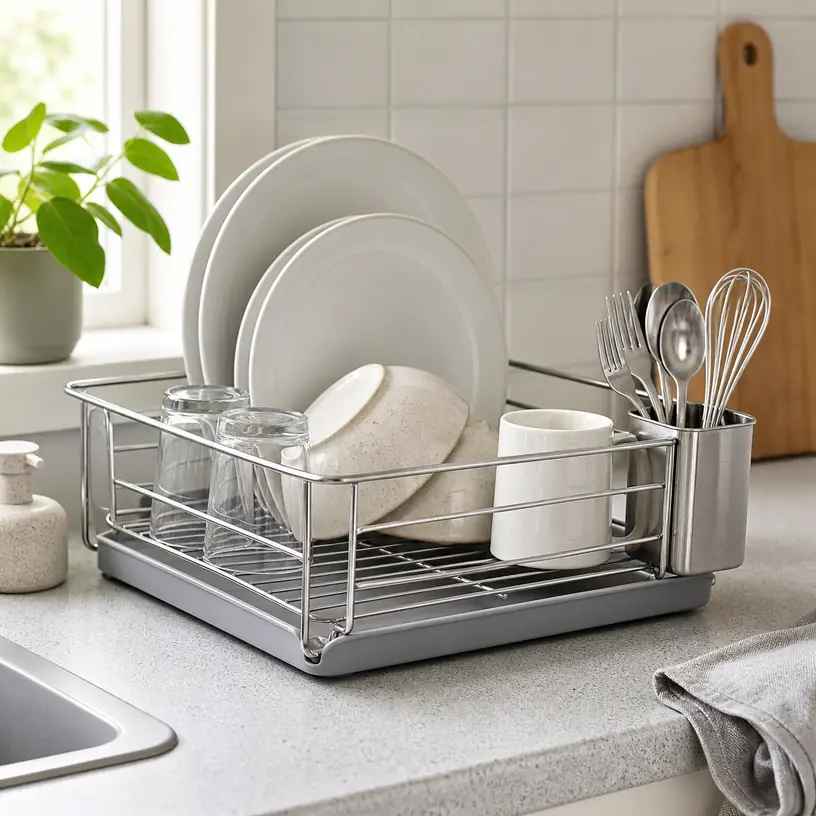
The choice does not have to be all mat or all rack. A compact rack can hold plates and bowls upright, while a mat beside it catches overflow or supports large cookware. A removable utensil cup can keep forks and spoons from occupying the mat’s center. For occasional baking sheets or pans, an expanded drying area may be more useful than buying a much larger permanent rack.
This mixed setup works best when each component has a defined role. Keep the rack’s drainage area aligned with the sink or tray, and do not assume a mat underneath can compensate for runoff that extends beyond its edges. Check whether rack feet remain secure on the mat and whether the combined height fits beneath cabinets. Afterward, separate the pieces so hidden contact areas can dry.
For a kitchen that changes roles through the day, modular pieces can restore prep space quickly. The benefit comes only if the rack, mat, and accessories each have a storage location. Otherwise, a supposedly flexible system can become a loose stack that stays on the counter.
Limitations
- A flat mat does not support plates or lids upright without a separate compatible holder.
- Absorbed water still has to leave the mat through proper drying and care.
- Channels and ridges can collect residue and require attention during cleaning.
- Water may reach the counter beneath or beyond a mat, especially when wet items overhang its edges.
- A large mat can interfere with drawers, appliances, food-prep space, or the natural route between sink and stove.
- Soft surfaces may not be appropriate for hot cookware, sharp edges, or every counter finish; follow current product and surface-care guidance.
- Foldable storage is not universal, particularly among rigid or layered designs.
Alternatives to compare
- A compact dish rack when plates and lids need supported slots and a defined drainage tray.
- An over-sink roll-up rack when counter space is limited and the sink dimensions allow a secure fit.
- A wall-mounted or over-sink drying system where installation and load guidance make it appropriate.
- A small rack placed over a separate washable mat for mixed loads and occasional overflow.
- Clean kitchen towels for rare, light-duty drying when they can be changed and laundered promptly.
FAQ
What size dish drying mat should I choose?
Measure the uninterrupted counter space beside the sink, then subtract room needed to open drawers, operate the faucet, and keep dishes away from edges. Match that usable area to an ordinary wash load rather than buying around the largest holiday meal. If plates are common, allow room for a separate holder or compare a rack instead.
Is an absorbent mat or a draining mat easier to maintain?
It depends on the cleanup you prefer. An absorbent mat may fit a laundry-based routine, while a channeled mat may be rinsed or wiped according to its instructions. Both need to dry fully, and both require the counter underneath to be checked and cleaned. Review the exact care guidance before choosing.
Can I put hot pots on a dish drying mat?
Do not assume a drying mat is a heat-resistant pad. Materials, backings, adhesives, and layered construction vary. Use it for hot cookware only when the current maker explicitly states the relevant temperature guidance and intended use; otherwise use an appropriate trivet or pot holder.
How do I keep water from collecting under a drying mat?
Drain items over the sink before placing them, keep wet pieces within the mat’s edges, and lift the mat after the load is put away. Wipe the counter according to its surface-care instructions and let both sides of the mat dry. If runoff is heavy, compare a design with a clearly described tray or sink-directed drain.
Can a dish drying mat replace a rack?
It can replace a rack for small, stable items when flat counter space is more useful than plate slots. It is less effective for holding many plates, lids, boards, or narrow bottles at useful angles. A compact rack on or beside a mat may be a better compromise for mixed loads.