Taking Cake on the Road: Choosing a Carrier with Enough Room
Product links are for reference. Verify current details on the retailer page before buying.
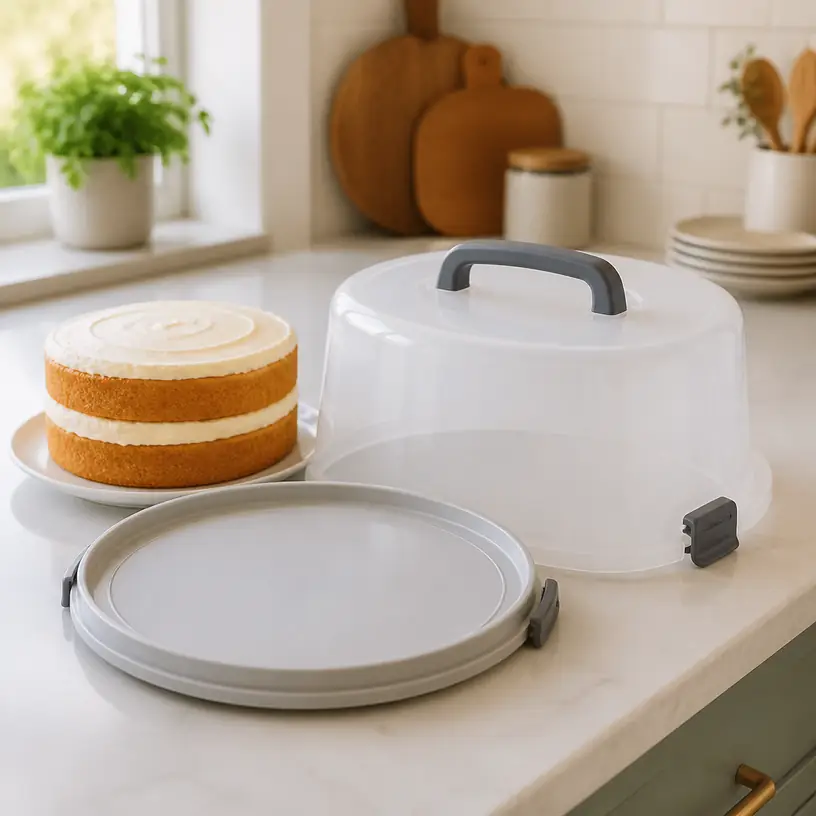
Illustrative image, not an official product photo.
Short answer
Measure the cake after frosting and decorating, not just the pan that baked it. A useful carrier needs spare room around the widest decoration and above the tallest swirl, topper, or stacked layer. Compare the carrier’s usable interior diameter and height with those finished measurements, then inspect how the base supports the cake board, where the latches sit, and whether the top handle transfers the load through a secure structure. A reversible base can add serving flexibility, while a flat interior is usually easier to clean and less likely to catch a thin board. For occasional trips, fit and dependable closure matter more than extra compartments. For frequent baking, also plan where the bulky dome will live between events.
Search reference
Cake carriers with lids
Compare usable interior dimensions, base profile, latch placement, handle support, care instructions, and storage footprint for the cakes you actually make.
View matching optionsDraw a box around the finished cake
A cake carrier is really a clearance decision. Start with a cake you make regularly and note four measurements: the diameter of the cake board, the widest frosting or decoration, the height from the bottom of the board to the top of the cake, and the tallest removable or permanent topper. If the cake is rectangular, measure both sides as well as the diagonal clearance needed to set it down without scraping an edge.
External product dimensions do not answer this question. The lid wall may taper inward, the handle may intrude into the dome, or a ridge around the base may reduce the flat area available to a cake board. Look for interior measurements and a diagram showing where those measurements were taken. If only overall dimensions are listed, there is not enough information to promise that a close-fitting cake will clear the lid.
Leave working room rather than matching the numbers exactly. Fingers or a cake lifter need space to lower and retrieve the board. Piped borders can extend beyond the sponge, and tall frosting can shift slightly during a warm trip. Extra clearance should not be confused with stability, though: a much larger base lets the board slide unless the carrier or your transport setup provides an appropriate restraint.
Who this is for
- Home bakers carrying layer cakes, cheesecakes, coffee cakes, or other round desserts to family gatherings, school events, and shared meals.
- Hosts who want one covered container that can move from kitchen counter to vehicle to serving table.
- People replacing improvised cardboard boxes that do not close over tall frosting or offer a reusable handle.
- Bakers who already use cake boards and can select a carrier around a repeatable board size.
- Households that have cabinet, pantry, or shelf space for a wide dome when it is not in use.
Who should skip it
- Skip a round carrier when sheet cakes, loaf cakes, or long rectangular bakes make up most of your transport needs.
- Choose a cupcake carrier when individual wells and vertical clearance for many frosted cupcakes are the main requirement.
- Do not rely on a basic plastic dome for multi-tier cakes, elaborate sugar work, or deliveries that require professional boxing and support.
- A low-profile keeper may be sufficient if the container will stay on the counter and never be lifted by its handle.
- Anyone short on storage should measure the empty cabinet first; a rigid dome can occupy more space than the bakeware it serves.
What to verify before buying
- Usable diameter: Confirm the flat area available to the cake board, excluding raised rims, latch housings, and decorative grooves.
- Usable height: Check clearance at both the center and the outer edge because some domes curve or taper.
- Base orientation: Determine whether the base is flat, recessed, footed, or reversible, and which side is intended to hold food.
- Board compatibility: Compare the flat surface with your usual cake-board diameter, thickness, and edge treatment.
- Latch arrangement: Count the latches, inspect how they engage, and check whether closure can be seen or felt from each side.
- Handle structure: Look at how the handle joins the lid and how the closed lid joins the base; the entire load depends on that path when carried from the top.
- Stated load guidance: If a load limit or carrying restriction is provided, compare it with the filled carrier rather than the empty container.
- Food-contact materials: Verify the current material description and intended contact surfaces instead of inferring suitability from appearance.
- Care instructions: Check dishwasher placement, hand-washing guidance, temperature limits, and whether latches or seals are removable.
- Storage dimensions: Measure the full diameter and height, including the handle when folded and when standing upright.
- Included pieces: Confirm whether cake boards, serving tools, trays, cupcake inserts, or cold packs shown in photos are actually included.
The base does more work than the dome
The base has to keep a cake level while providing room to lift or serve it. A shallow raised rim may help locate the dome, but it can conflict with a board that nearly fills the platform. Deep grooves and molded decoration can collect crumbs or press into an unboarded cake. A simple flat center is versatile, especially when the carrier will also hold pies, tarts, or unfrosted cakes.
Some carriers advertise a reversible base: one side may be flatter for cake while the other has divided sections or molded supports for another food. Inspect both configurations. Reversing the tray can alter the available height, change how the lid engages, or place feet and ridges near the cake board. Versatility only helps when the cake side still provides the dimensions and closure you need.
A cake board is worth planning into the system. It gives you a surface for decorating, moving, and serving without sliding a spatula directly under soft cake at the event. The board should be stiff enough for the finished cake and should sit fully on the carrier base. A board that bridges a raised center or hangs over the flat area can rock even if it technically fits under the dome.
Read the closure before trusting the handle
A top handle is convenient because it leaves the other hand free for a door or bag, but it also encourages the user to suspend the whole cake from the lid. The handle, lid, latches, and base all become part of one load path. A comfortable handle cannot compensate for latches that are only partly engaged.
Look for product photos that show each latch both open and closed. The closure should be accessible without pushing against frosting through the dome, and its engaged position should be easy to confirm. Several distributed latches can help draw the lid down evenly, provided each one is closed. A single missed latch can let the base hang unevenly when the carrier is lifted.
Before the first real trip, practice with the empty carrier and then with a nonfragile, evenly distributed load that stays within the maker’s guidance. Close every latch on a level counter, lift only a short distance, and observe whether the base remains seated. This is a setup check, not a reason to exceed a stated limit or imitate the weight of an unsupported tall cake.
Carry the container level and support it from below whenever conditions are uncertain. A handle does not turn the carrier into a swing-proof case. Keep the other hand ready under the base on stairs, over thresholds, and during transfers into or out of a vehicle.
A carrier cannot correct a warm, unstable cake
The cake itself needs to be ready to travel. Cool and set it according to the recipe before enclosing it. Warm cake can soften frosting and create condensation inside a closed dome. Decorations that lean before departure are unlikely to improve on the road, no matter how strong the carrier looks.
Check whether the dessert requires refrigeration and follow the recipe’s food-storage guidance. A cake dome is an enclosure, not automatically an insulated cooler. If the carrier supports a cold pack, verify where it sits and whether it changes interior height or creates direct contact the recipe does not permit. Do not assume that an optional insert can maintain a safe temperature for a particular duration.
Odors and residual moisture also matter. Wash and dry the carrier before the event, especially if it previously held savory food. Clear plastic makes it easy to see presentation damage, but it may also show condensation. Venting the carrier should only be done when consistent with the recipe, environment, and transport needs.
Plan the vehicle space before departure
The safest available vehicle location is usually a clean, level, stable surface where the carrier cannot slide, tilt, or be struck by other cargo. A soft seat slopes and compresses; a lap moves with the passenger; a trunk may become hot; and the floor may be uneven or dirty. Conditions vary, so inspect the actual vehicle rather than assuming a familiar spot will work.
Measure the carrier’s full footprint and lid height against the intended space. Make sure a door, seatback, parcel shelf, or hatch will not strike the handle. Keep groceries, drink bottles, and loose serving pieces separate so they cannot roll into the dome. Drive smoothly and avoid abrupt turns or stops where possible, but treat physical placement—not careful driving alone—as the primary defense against movement.
At arrival, open the vehicle and clear a path before lifting the cake. Ask another person to handle doors and carry accessories. Place the carrier on a level serving surface before releasing any latch. Open closures gradually and lift the dome straight up so its rim does not drag across decorations.
Tall domes, low domes, and adjustable designs
A low dome stores more easily and may be adequate for unfrosted cakes, pies, or a single modest layer. It is less forgiving of piped tops and center decorations. A tall dome provides options but raises the center of gravity, needs more vehicle clearance, and occupies more cabinet space.
Some products use collapsible, telescoping, or multi-position lids. These can reduce storage height or adapt to several bakes, but seams and moving sections add areas to inspect and clean. Verify whether the lid is meant to travel in every position and how the selected height locks. A collapsible wall that stays stable on a shelf may behave differently when the filled container is lifted.
Opaque carriers protect the cake from view and may hide scuffs, while transparent domes let you monitor clearance and presentation. Visibility does not reveal whether a latch is structurally engaged unless the closure itself is visible. Choose the material and shape around care, fit, and closure rather than appearance alone.
Cleanup and the awkward question of storage
Frosting tends to reach the lid rim, latch recesses, handle joints, and grooves in the base. Review cleaning directions for every piece. “Dishwasher safe” may apply only to a certain rack or component, and a tall dome may not fit without blocking a spray arm. Hand washing is often easier in a large sink, but the dome can be slippery when wet; support it rather than holding it only by the handle.
Dry latch cavities and nested surfaces before reassembly. Closing a damp dome for long storage can trap odors and moisture. If pieces nest, place a soft barrier only if the maker permits it and make sure the lid is not distorted by a heavy object stacked on top.
Measure storage with the handle in its normal resting position. A folding handle can reduce height, but wide latch tabs still add to the footprint. The top of a refrigerator may seem convenient, yet heat, dust, and difficult lifting can make it a poor everyday location. A low shelf where the carrier can be moved with two hands is easier to manage.
Limitations
- Seller dimensions may describe the exterior rather than the usable cake space, and curved walls reduce clearance near the top.
- A secure-looking dome does not establish a load capacity or guarantee that every latch is fully engaged.
- Rigid round carriers are bulky and do not efficiently fit rectangular cakes or mixed dessert assortments.
- A cake can still slide inside an oversized carrier if the board and base do not provide an appropriate, stable fit.
- Plastic surfaces may scratch, cloud, stain, retain odors, or deform when cleaned or stored outside their stated limits.
- A covered carrier does not automatically provide refrigeration, insulation, leak resistance, or protection from severe impact.
- Tall decorations and tiered structures may need a specialized box, internal supports, or professional transport methods.
- Product photos cannot show how comfortably a handle feels at the actual filled weight.
Alternatives to compare
A bakery-style cake box and matching board is lightweight, available in many sizes, and easier to store flat, though it may not offer a reusable top handle or moisture-resistant surface. A pie keeper suits lower desserts and may take less cabinet space. A rectangular food carrier accommodates sheet cakes and mixed trays but can leave unused space around a round cake. A cupcake carrier uses individual supports to separate small cakes. A cake stand with a dome works well for serving and counter storage when portability is secondary. Complex stacked cakes may call for tier-specific boxes, supports, and delivery equipment rather than a general household carrier.
FAQ
How much larger should a cake carrier be than the cake?
There is no single allowance that works for every decoration. Measure the cake board and the widest frosting detail, then choose a usable interior diameter that leaves room for fingers or a lifter without letting the board move freely. For height, include all layers, frosting, and permanent toppers, and remember that a curved dome may narrow near the top.
Can I carry the container only by its top handle?
Only as allowed by the current product instructions and load guidance, with every latch completely engaged. Test the closure before the event, keep the carrier level, and support the base with your other hand during uncertain transfers. A top handle is not evidence that the container can tolerate swinging, impact, or an unspecified heavy cake.
Will a standard cake board fit inside a cake carrier?
It depends on the carrier’s flat usable base, not its outside diameter. Compare the board’s actual diameter and thickness with the interior platform, raised rim, and latch housings. If the listing does not provide usable dimensions, ask for them rather than assuming a named cake size proves compatibility.
Can a cake carrier keep a frosted cake cold in the car?
A basic carrier should not be treated as a cooler unless the maker describes an insulated system and explains how it is used. Follow the recipe’s refrigeration guidance, limit exposure as appropriate, and verify any cold-pack placement. The lid’s presence alone does not establish temperature control.
What is the easiest way to store a large cake dome?
Measure a low cabinet or pantry shelf before buying and include the handle and latch tabs. A reversible base or folding handle may help, while a collapsible dome can reduce height if its design and cleaning requirements suit you. Store all pieces clean and dry without placing weight that could distort the lid or closure.