A Kitchen Utensil Holder That Fits the Counter—and the Tools
Product links are for reference. Verify current details on the retailer page before buying.
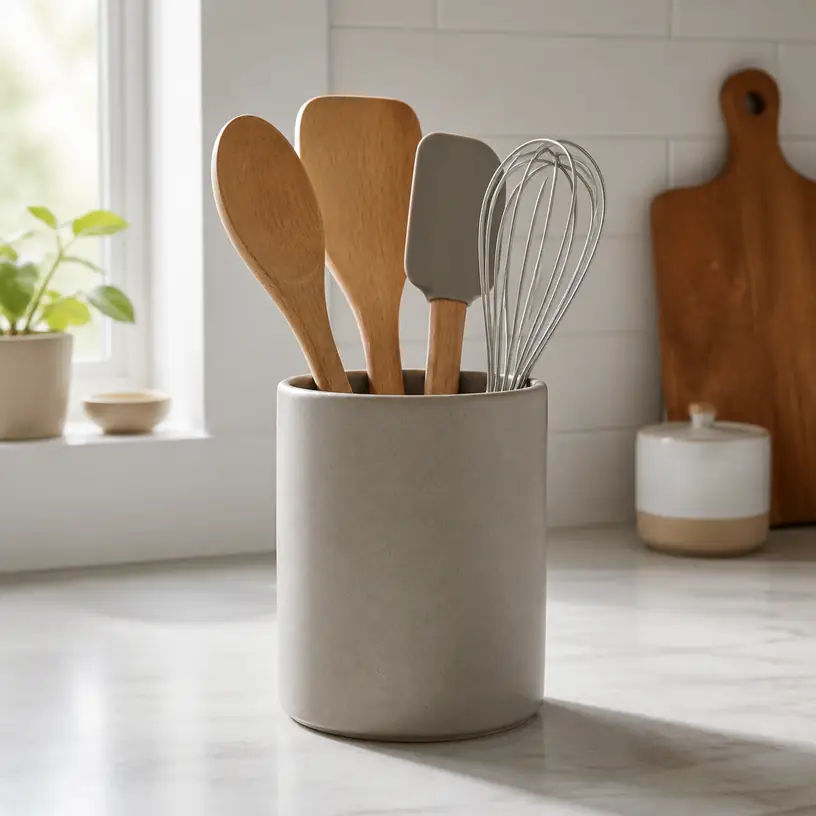
Illustrative image, not an official product photo.
Short answer
A countertop utensil holder works well when it keeps the tools used at the stove within one-handed reach without becoming an overcrowded catchall. Gather the utensils you actually want beside the range, then compare their bundle width and handle lengths with the holder’s usable opening and depth. A broad, weighted base helps with long or unevenly loaded tools; an open, removable, or uncomplicated interior is easier to clean after cooking. Before choosing a tall crock, also measure the space below upper cabinets and confirm that whisks and spatulas can be lifted out without striking a shelf or hood.
Search reference
Countertop kitchen utensil holder options
Compare crocks, divided containers, and rotating holders after measuring your everyday tool bundle, the available counter footprint, and the clearance needed to pull out the longest utensil.
View matching optionsStart with a working set, not the whole drawer
The purpose of a countertop holder is quick access during cooking. It does not need to absorb every ladle, peeler, skewer, and specialty gadget in the kitchen. Pull out the tools used in an ordinary week and divide them into two groups: tools that are comfortable to grab by the handle, and tools better protected or stored flat. Long spoons, solid spatulas, turners, and a whisk often suit upright storage. Sharp blades, heavy tools, and items with delicate edges may require a block, drawer, rail, or other storage method intended for them.
Stand the countertop group together in a jar or measuring jug and observe how much room the handles need. If the bundle is already tightly packed, selecting a holder with nearly the same internal width will not make retrieval easier. Handles should spread enough to be identifiable, yet not so far that a utensil leans into a burner, walkway, or cabinet door.
Tool shape matters as much as count. A balloon whisk occupies more space at the top than a wooden spoon. A wide turner can bridge a narrow opening, while a heavy ladle may pull the bundle to one side. Measuring the widest heads and longest handles reveals more than a generic capacity claim.
Who this is for
- Home cooks who repeatedly reach for the same group of spoons, spatulas, turners, whisks, or ladles.
- Kitchens with usable counter space close to food preparation but safely away from direct heat and splatter.
- Households that want to move frequently used long tools out of a crowded drawer.
- Shared kitchens where a visible, limited working set is easier to return after washing.
- Renters who prefer movable storage rather than a wall-mounted rail or permanent installation.
Who should skip it
- Keep utensils in a drawer when the counter is already scarce or when upper cabinets leave poor lifting clearance.
- A wall rail or cabinet-mounted system may be more useful when tools have hanging holes and there is a suitable installation area.
- Do not use a general-purpose crock as a substitute for storage designed to protect sharp knives or other hazardous edges.
- People who rarely cook may find that one or two tools fit more neatly in a drawer divider.
- A single large holder is not ideal if allergy management or another household practice requires certain cooking tools to remain distinctly separated.
What to verify before buying
- Usable interior dimensions: Look for inner width and depth, not only the outer measurements or a styled capacity image.
- Opening shape: Compare round, oval, and divided openings with wide turners, bulky whisks, and utensils that have hooked or textured handles.
- Overall height: A holder should support long tools without swallowing shorter handles or letting the bundle become excessively top-heavy.
- Base and stability: Review footprint, weight distribution, feet, and anti-slip details, especially for long or heavy utensils.
- Counter clearance: Measure under cabinets, shelves, and the range hood, including the vertical path needed to remove the longest tool.
- Interior access: Check whether a hand, brush, or cloth can reach the bottom and whether liners, dividers, or drainage pieces are removable.
- Material and care instructions: Confirm the current construction wording, washing method, heat limitations, and finish care rather than inferring them from appearance.
- Included components: Determine whether the pictured divider, insert, drip pad, turntable, or utensil set comes with the current option.
- Placement guidance: Follow current safety and care directions, and choose a stable location away from open flame, hot cookware, and traffic at the counter edge.
Height should support without hiding
A low container makes short handles easy to see, but long tools can fan outward and create leverage at the rim. A very deep vessel may support those tools better while hiding a pastry brush or small spatula below the surrounding handles. There is no universal ideal height because utensil collections vary, so compare the shortest handle you need to retrieve with the holder depth and the tallest tool with the cabinet clearance.
An uneven bundle can tilt even when the holder itself is stable. Broad utensil heads collect on one side, and a heavy tool added last can shift the center of gravity. Test the intended mix in a temporary container: remove a tool from the front and then from the side. If the container moves, the final holder may need a wider or heavier base, fewer tools, or a non-slip contact surface.
Upper cabinets create a second height constraint. The holder may fit neatly against the backsplash yet leave no room to lift out a whisk. Measure from the counter to the obstruction, subtract the holder height, and compare the remaining space with the portion of the longest tool inside the vessel. A paper mock-up or temporary jar can expose this problem before the counter is rearranged.
One compartment or several?
A single open crock is forgiving when the collection changes. Wide items can rotate, and cleaning usually involves fewer corners. The tradeoff is that tools lean together, so a small spatula can disappear behind ladles. An oversized opening also allows handles to spread until they consume more visual and working space than the base suggests.
Dividers create categories such as wooden tools, silicone-tipped tools, and serving utensils. They can make a broad holder feel orderly, but each section must fit the widest intended head. Fixed dividers reduce flexibility and add seams where flour, oil mist, or crumbs can settle. A removable insert offers another arrangement but should be easy to lift without snagging handles.
Rotating holders can bring a rear compartment forward when the vessel sits in a corner. Rotation needs free space around the widest point, and the mechanism should remain stable under an uneven load. Check whether the base is meant to rotate while full, how it should be cleaned, and whether nearby bottles or appliances would block the turn. A turntable is not automatically useful when every tool is already reachable from an open side.
Choose the counter position deliberately
Convenient does not have to mean immediately beside a burner. Cooking grease and steam can coat both the holder and exposed handles, while a crowded range area increases the chance of a tool leaning toward hot cookware. Look for a stable section of counter that can be reached during preparation without crossing over heat. Keep the vessel away from the counter edge and from paths used for hot pans.
A backsplash corner saves central workspace but can make the rear tools difficult to see. Near a dishwasher, the holder is easy to reload but may be too far from the stove. If the work zones are separated, two small groups can be more functional than one overloaded crock: cooking tools near the preparation area and serving tools nearer the table or dish storage.
Check the surface underneath during routine cleaning. A narrow foot, rough base, or trapped debris can affect a finished counter, and a broad base can conceal splatter. Follow the holder’s current care guidance and any applicable instructions for the countertop. Being able to lift the loaded vessel safely matters if the area must be wiped often.
Cleaning is part of the storage plan
Even a holder that never touches food sits where airborne grease, dust, and crumbs can collect. Simple walls and a reachable bottom make routine washing easier. Interior ridges, permanently fixed dividers, and narrow drainage openings require more attention. If the option includes a mat or liner, confirm that it can be removed and dried before being returned.
Utensils should be clean and dry before storage according to their own care instructions. A general countertop holder is not a drying rack unless its design and current directions specifically support that use. Water trapped at the bottom can be difficult to notice in an opaque vessel, particularly when it is always full.
Set a realistic reset routine: empty the crock, inspect the tools that have migrated into it, clean the interior and exterior, wipe the counter below, and reload only the active set. This prevents gradual crowding and gives damaged or seldom-used utensils a chance to return to more suitable storage.
Limitations
- Capacity claims do not account for the width and shape of a particular combination of whisks, turners, ladles, and spoons.
- A stable empty holder may behave differently when several long or heavy utensils lean to one side.
- Upright storage exposes handles to kitchen splatter and requires enough overhead room for removal.
- Dividers improve separation but reduce flexibility and can add corners that take longer to clean.
- A utensil crock organizes appropriate blunt cooking tools; it does not provide edge protection for knives.
- Search results may include holders bundled with utensils, so the pictured tool set should not be assumed to be included.
- Material appearance alone does not establish washing instructions, heat tolerance, surface protection, or durability.
Alternatives to compare
A drawer organizer keeps tools out of sight and away from airborne kitchen residue, provided the drawer is long and deep enough for the largest heads. A wall rail with hooks frees counter space and separates tools, but it needs compatible utensils, a suitable mounting surface, and careful positioning. A cabinet-door organizer can use hidden vertical space if door clearance and hardware allow it. A narrow bin inside a deep drawer groups long tools without placing every handle in an individual slot. For a small set, a single drawer compartment near the preparation area may be simpler than adding another countertop object.
FAQ
How many utensils should go in a countertop holder?
Use the number that can stand with enough room to identify, grip, and replace each handle without forcing the bundle. Tool shape matters more than a universal count; one large whisk or turner can use the space of several narrow spoons.
How tall should a kitchen utensil holder be?
It should support the longest tools while leaving shorter handles visible and reachable. Compare interior depth with your shortest handle, then check the full holder-and-tool height against the lifting space below cabinets or shelves.
Are divided utensil holders easier to use?
Dividers can keep categories visible and prevent small handles from disappearing, but each section must accept the widest tool assigned to it. Removable dividers usually provide more flexibility and easier cleaning than narrow fixed compartments.
Can wet utensils go directly into the holder?
A general utensil holder should not be assumed to function as a drying rack. Follow the utensil and holder care instructions, and make sure tools are clean and appropriately dried so unnoticed water does not collect at the bottom.
Where should a utensil crock sit on the counter?
Choose a stable, reachable place near food preparation but away from open flame, hot cookware, the counter edge, and busy walkways. Also leave enough overhead space to remove the longest utensil without striking a cabinet or hood.