Pot Lid Organizers for Cabinets: Match the Rack to Your Cookware
Product links are for reference. Verify current details on the retailer page before buying.
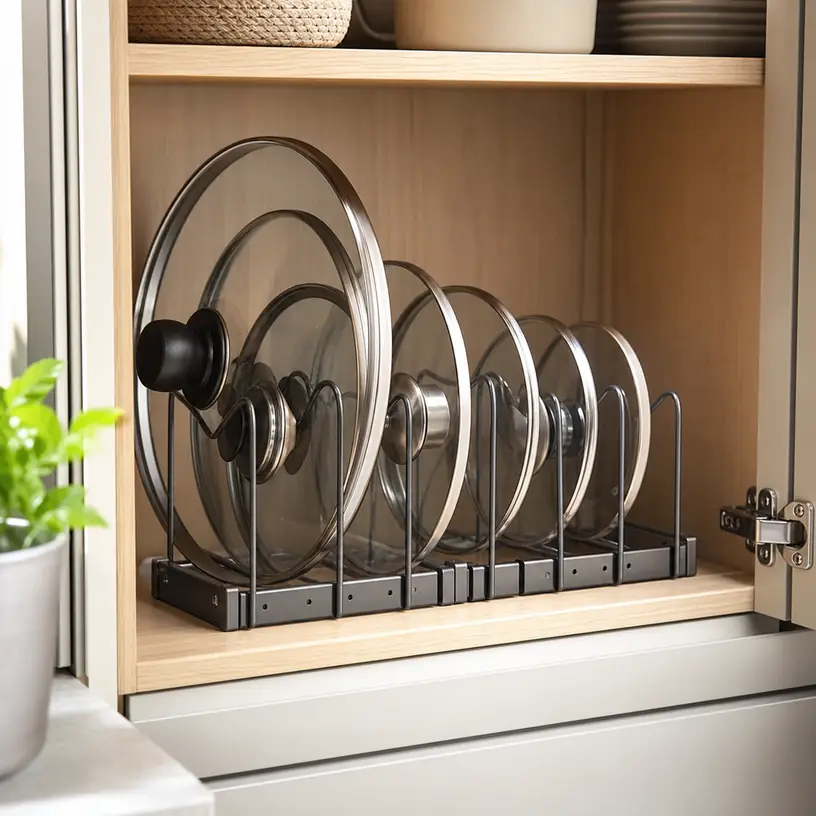
Illustrative image, not an official product photo.
Short answer
A pot lid organizer works when its dividers fit the actual handles, rims, and diameters in your cookware collection. Before choosing one, place every lid you expect to store on the counter and measure the tallest handle, the widest lid, and the depth of the intended cabinet. A freestanding rack is easy to move and requires no installation; an adjustable rack handles mixed lid thicknesses; and a door-mounted holder can preserve shelf space only if the door, hinges, and nearby cookware leave enough clearance. The goal is not to create the most slots—it is to let you remove one lid without lifting or scraping three others.
Search reference
Pot lid organizer options for cabinets
Compare divider spacing, usable rack dimensions, installation method, and handle clearance against your own lids and cabinet layout.
View matching optionsBegin with the lids, not the organizer
Cookware lids are awkward because they are thin in one direction and bulky in another. A glass lid may have a wide loop handle, a saucepan lid may have a tall knob, and a flat metal lid may slip through a divider designed for thicker rims. Counting lids tells only part of the story. The combination of handle shape, rim thickness, and diameter determines whether a rack will hold them securely.
Make a quick inventory before browsing. Set aside lids that stay on their pans, lids that belong to rarely used cookware, and any universal lid that replaces several separate pieces. Then arrange the lids you genuinely need to reach during an ordinary week. This often reveals that a household with ten lids only needs six stored in the main cooking zone.
Try the proposed storage shelf with a temporary setup. Stand the lids in a file holder or between small boxes, then open and close the cabinet and remove the largest lid. This simple test exposes problems that dimensions alone may miss, such as a shelf above the rack blocking a tall handle or a cabinet frame narrowing the opening.
Who this is for
- Cooks who currently stack loose lids under pans and have to unpile cookware to find the right one.
- Kitchens with a lower cabinet, deep drawer, pantry shelf, or island shelf that can hold lids vertically.
- Households with several lid sizes that are used often enough to justify a dedicated storage zone.
- Renters who want a freestanding or adhesive-free solution that can move to another cabinet.
- Anyone reorganizing cookware around a smaller set of frequently used pots and pans.
Who should skip it
- Skip a separate rack if each lid can rest upside down on its matching pot without wasting useful cabinet space.
- Avoid a door-mounted style when the cabinet has shallow hinges, an inset panel, or crowded shelves that leave no room behind the closed door.
- A narrow fixed-slot rack may be a poor match for lids with thick rims, oversized knobs, or long handles.
- If the main problem is too many unused pieces rather than disorganized storage, edit the cookware collection before adding another organizer.
What to verify before buying
- Measure cabinet width, depth, opening height, and any space lost to a face frame, center stile, hinge, pipe, or shelf support.
- Compare slot spacing with the thickest rim and widest handle base among the lids you plan to store.
- Check whether dividers are fixed, removable, or adjustable and whether unused sections can be shortened.
- Confirm the largest supported lid size and remember that a large lid may lean beyond the rack footprint.
- For vertical storage, make sure knob and loop handles will clear the shelf above and the cabinet opening during removal.
- For door installation, verify the mounting method, required hardware, panel thickness, screw length, and closed-door clearance.
- Review base design, feet, coating, care guidance, and current material details on the retailer page.
- Check what is included; cookware, extra dividers, mounting hardware, and accessories shown in styled images may not all be part of the package.
Fixed slots or adjustable dividers?
Fixed-slot racks are straightforward: place the rack on a shelf and slide one lid into each divider. They work best when the collection is fairly consistent and the spacing comfortably accepts every rim. The tradeoff is that a tight slot may reject a thick lid while a wide slot can let a slim lid tilt. Look at the usable gap rather than relying on the total number of advertised positions.
Adjustable organizers let you assign more room to thick glass lids and less to flat metal ones. That flexibility is useful for mixed cookware or for storing a skillet vertically beside the lids. It also makes the rack easier to revise when a pan is replaced. Check how the dividers attach: a flexible layout is less useful if a divider pulls free every time a heavy lid is removed.
Expandable frames can fit several cabinet widths, but expansion may create a joint or an unsupported section. Compare the dimensions in both the compact and extended configurations. If the cabinet has a face frame, make sure the expanded rack can still pass through the narrower opening even when the shelf behind it is wider.
Shelf, drawer, or cabinet door
A shelf rack is the lowest-commitment arrangement. It can sit beside stacked pans, at the back of a deep cabinet, or in a pantry. The rack needs enough weight and grip to remain in place when a lid is pulled forward. If the base slides, a removable cabinet liner may help, provided it is suitable for the shelf surface.
Deep drawers offer excellent visibility because the lids come out toward you rather than hiding behind cookware. Measure drawer height at the lowest obstruction, not just at the drawer box. Tall knobs can collide with the countertop rail, and large lids may lean into the drawer sides. Also consider whether the rack and lids will shift when the drawer opens quickly.
Door-mounted holders use otherwise empty vertical space, but they demand the most careful fit check. Close the cabinet slowly with the proposed lid position mapped using cardboard. A lid can clear the shelf edge and still hit a pan handle, hinge arm, or center divider. Screws may not suit a thin or framed door, while adhesive mounting depends on the product instructions and the door surface. Renters should not assume that any mount is damage-free.
A layout that makes cooking easier
Put everyday lids where they can be removed with one hand and without moving the heaviest pot. Larger, less frequently used lids can go at the back of a deep rack, while small saucepan lids usually deserve the easiest positions. If two lids look nearly identical, store them next to their pans or label the shelf rather than testing both during dinner preparation.
Orientation affects access. Handles facing upward are easy to grab, but tall handles require more headroom. Handles angled toward the cabinet opening may improve reach in a low shelf, yet they can consume extra depth. For deep drawers, alternating handles can prevent them from crowding one another. There is no universal arrangement; use the one that lets each lid leave the rack independently.
Do not pack every available divider simply because it exists. An empty slot can provide finger room and keep glass or coated edges from rubbing. It also leaves space for a future replacement lid without forcing a complete cabinet reorganization.
Stability, surfaces, and care
Glass lids can be heavy, especially when several lean in the same direction. A broad base, connected frame, or secure mounting method helps keep an organizer steady. Check the maker’s current guidance for capacity and intended use rather than assuming a small rack can support baking sheets, cast-iron pieces, or cutting boards as well as lids.
Coated metal, plastic, wood, and other materials each have different cleaning needs. Kitchen storage collects dust and cooking residue even inside a cabinet, so consider whether the dividers are easy to wipe and whether the rack can be removed without unloading an entire shelf. Deep intersections and closely spaced wires may take more effort to clean than an open frame.
Pay attention to contact points. Rough edges or exposed hardware can mark a shelf or cookware finish. Soft feet may reduce movement, but their suitability depends on the cabinet surface and care instructions. If lids are stored while damp, trapped water can affect the rack, shelf, or cookware rim; let washed pieces dry before returning them to enclosed storage.
Limitations
- No rack can compensate for a cabinet opening that is smaller than the lids passing through it.
- Advertised slot counts do not guarantee that the organizer will hold the same number of thick glass lids.
- Vertical racks may trade shelf width for faster access, so very small cabinets can lose useful pan space.
- Door-mounted storage can interfere with hinges or interior cookware even when the door itself is large enough.
- An organizer reduces stacking and searching, but it does not solve duplicate, mismatched, or rarely used cookware.
Alternatives to compare
- Store each lid upside down on its matching pot when the handle sits safely inside and the pots do not need to nest deeply.
- Use a wide deep-drawer divider system when lids, pans, and cutting boards all need vertical storage in one place.
- Consider a wall rail or hanging system only where installation is appropriate and lids can hang without crowding the work area.
- Use a sturdy file-style rack for lids and sheet pans if its dimensions, stability, and intended load suit both.
- Reduce the collection with a compatible universal lid if it genuinely fits several commonly used pans and meets your cooking needs.
FAQ
How much space should I leave between pot lids?
Leave enough room for the thickest part of each rim plus finger access. Glass lids and wide loop handles often need more space than flat metal lids, so adjustable dividers can be useful for a mixed collection.
Can a pot lid organizer hold frying pans too?
Some racks are designed for both lids and cookware, but a frying pan adds more weight and leverage than a lid. Verify the organizer’s intended uses, divider strength, base stability, and current capacity guidance before combining them.
Is a door-mounted lid holder safe for cabinet doors?
It can be suitable when the mounting method matches the door construction and the loaded holder clears hinges and interior shelves. Check panel thickness, hardware length, installation instructions, and the weight of your lids before drilling or applying a mount.
Should pot lids be stored vertically or flat?
Vertical storage usually makes individual lids easier to see and remove, while flat storage can work when a lid rests securely on its matching pot. The better method is the one that fits the cabinet and does not require unstable stacking.
How do I measure a cabinet for a lid organizer?
Measure the inside shelf and the narrower cabinet opening, then note the face frame, hinges, shelf above, and nearby cookware. Add the height of your tallest lid handle and test whether the largest lid can enter and leave at a comfortable angle.