Car Trunk Organizers: Fit, Dividers, and Everyday Cargo
Product links are for reference. Verify current details on the retailer page before buying.
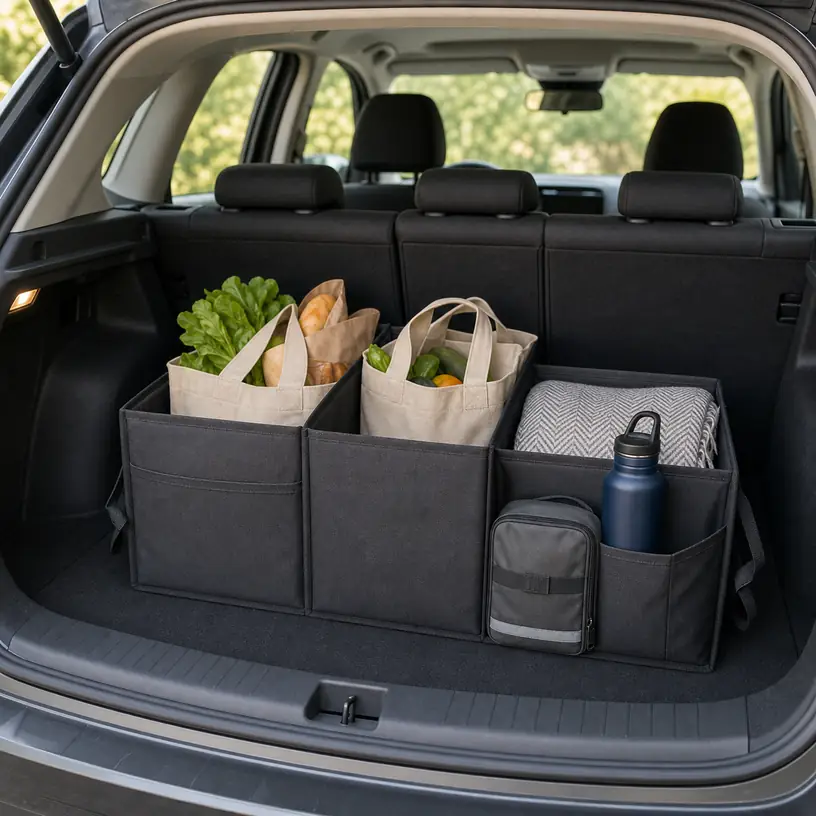
Illustrative image, not an official product photo.
Short answer
A car trunk organizer is most useful when its open size matches both the cargo floor and the loads you carry repeatedly. Measure the narrowest usable width, the depth left behind groceries or luggage, and the height below a cargo cover or hatch. Then compare compartment shape, removable dividers, handle placement, folding method, and the maker’s attachment instructions. A large box with many pockets is not automatically more practical: it can consume the exact floor space needed for a stroller, suitcase, mobility equipment, or emergency access.
Search reference
Car trunk organizer options
Compare open and folded dimensions, divider layouts, handle construction, base design, attachment method, and care instructions for your vehicle.
View matching optionsMap the cargo area before choosing a shape
Start with the vehicle empty and the rear seats in the position you normally use. Trunk and cargo-area dimensions are rarely a perfect rectangle. Wheel housings, sloped seatbacks, liftgate trim, side pockets, tie-down points, and a raised threshold can all reduce the space available to a box-shaped organizer. Measure the clear floor at several points rather than relying on a vehicle’s overall cargo-volume figure.
Next, identify the areas that must remain reachable. Some vehicles place a spare tire, charging equipment, tools, a battery compartment, or other service items below the cargo floor. An organizer that is easy to lift when empty may become awkward once filled. Access to seat releases, cargo hooks, power outlets, vents, and hatch controls should also remain clear according to the vehicle manual.
Height deserves its own check. In a sedan, an organizer may fit the floor but collide with the trunk lid or its hinges. In a hatchback or SUV, tall contents may interfere with a retractable cover or sit too close to the rear glass. Measure with the cover installed if you intend to keep purchases out of sight, and account for objects that extend above the organizer’s rim.
Who this is for
- Drivers who routinely carry grocery bags, cleaning supplies, sports accessories, pet-walk items, or small work gear that otherwise shifts around an open cargo floor.
- Households that want a removable container for transferring a group of lightweight items between a vehicle, garage, and home.
- Owners of hatchbacks, sedans, SUVs, or wagons who have measured a dedicated cargo-floor area for an organizer.
- People who need separate compartments for clean, damp, fragile, or frequently used items without installing permanent cabinetry.
- Drivers who want a collapsible storage option and already know where the folded organizer will go when the full cargo floor is needed.
Who should skip it
- Skip a freestanding organizer if the goal is certified cargo restraint; an ordinary storage box should not be assumed to secure objects during sudden braking or a collision.
- A rigid lidded bin may suit dirty tools, leaky containers, or loose materials better when wipe-clean containment is the priority.
- A vehicle-specific side bin or under-floor tray may preserve more open floor space in a small cargo area.
- People who almost always carry large suitcases, mobility equipment, strollers, or bulky work materials may find that another box only creates an obstacle.
- Do not place an organizer where it blocks required equipment, vehicle controls, airflow, visibility, or safe hatch operation.
What to verify before buying
- Open dimensions: Compare exterior length, width, and height with the narrowest usable part of the cargo area and the space needed by regular loads.
- Folded dimensions: Check whether the organizer collapses flat, in half, or into separate sections, and measure the place where it will be stored.
- Compartment layout: Confirm which dividers are fixed, removable, adjustable, or merely shown as styling props.
- Bottom construction: Read how the base is supported and whether stiff panels can be removed for folding or cleaning.
- Attachment method: Verify included straps, hooks, buckles, or grip surfaces and follow both product and vehicle guidance for compatible attachment points.
- Handle placement: Look for handles on the sides you can actually reach inside the vehicle, especially if you expect to carry the organizer while loaded.
- Care directions: Check whether panels must be removed before spot cleaning and whether the assembled organizer can tolerate water, detergent, or heat.
- Pocket closure: Determine whether exterior pockets are open, elasticated, zipped, or covered, and whether their contents could catch when loading other cargo.
- Stated load guidance: Review any current maker limits, but do not treat a storage organizer as vehicle safety equipment.
- Included pieces: Confirm whether dividers, lids, cooler-style inserts, straps, or smaller bins pictured in a listing are part of the selected configuration.
Build compartments around recurring loads
An organizer works better when each section has a repeatable job. For a weekly grocery run, two broad compartments may be more useful than a grid of small cells: bags can remain upright, while bottles or jars occupy a separate section. For sports or pet gear, a removable divider can isolate a damp towel or walking accessories from clean reusable bags. Tiny mesh pockets are convenient for lightweight items, but they do not replace a stable compartment for heavy containers.
Make a short list of what is already in the trunk on an ordinary day. An emergency pouch, ice scraper, reusable bags, paper products, and charging cable can quietly fill most of a compact organizer before new cargo arrives. Decide which items truly need to stay in the vehicle and which can use existing side or under-floor storage. This avoids buying a larger organizer merely to hold things that do not need to travel every day.
Divider stiffness affects how a compartment behaves. Soft walls may fold easily but bow when neighboring sections are unevenly loaded. Reinforced panels may hold a clearer shape, yet they add bulk and can complicate cleaning. Product photos often show perfectly balanced contents, so check the assembly description and current dimensions rather than inferring support from a staged image.
A lid can hide contents and reduce visual clutter, but it also changes access. If you reach for reusable bags at every stop, opening a full-width lid can become inconvenient when other cargo is stacked on top. Partial lids, open compartments, or an external pocket may serve frequently used lightweight items better. Keep valuables out of an unattended vehicle regardless of whether an organizer has a cover.
Carrying handles need a realistic load test
Side handles suggest that the organizer can double as a tote, but the practical question is what you plan to lift. A container that is manageable with towels and grocery bags may be uncomfortable with bottles, tools, or several dense packages. Check the maker’s stated guidance, inspect how handles connect to the body, and divide heavy loads into smaller trips when appropriate.
Handle location also affects removal from a deep trunk. End handles can be hard to reach when the organizer fits tightly between the wheel housings. Long-side handles may be blocked by adjacent luggage. If one person usually unloads the vehicle, picture the sequence: open the hatch, move surrounding cargo, grip both sides, clear the threshold, and carry the load without the dividers collapsing.
Do not use a loaded organizer as a step, seat, child carrier, pet carrier, or lifting device. Its walls, base, and handles may be intended only to group ordinary cargo. Sharp tools, unsealed chemicals, fuel containers, and other hazardous items require purpose-appropriate storage and transport practices rather than a general fabric organizer.
Folding is valuable only when the folded box has a home
Collapsible organizers often use hook-and-loop tabs, buckles, zippers, or removable base panels to hold a reduced shape. Compare the actual folded form, not just the word “collapsible.” Some designs compress to a narrow slab; others close one compartment while leaving another open; a model with a rigid lid may still occupy substantial space.
Think through two modes. In everyday mode, perhaps one section holds permanent supplies while the second remains folded. In full-cargo mode, the entire organizer might move to a side recess or garage shelf. If the folded unit slides loose on the floor, it can become another object to manage, so use only the storage and attachment arrangements recommended for the product and vehicle.
A modular design can make changing modes easier. Removable dividers allow one long object to span the interior, while separate compartments can prevent a small load from occupying the whole trunk. More pieces also mean more parts to misplace, clean, or reinstall. Choose the simplest configuration that matches your routines rather than the one with the highest visible pocket count.
Think about movement without confusing storage with restraint
Groceries tipping during ordinary turns are a common reason to consider an organizer. A broad base, appropriate compartment size, and balanced loading may help keep everyday items upright. Some products also describe straps, floor-gripping surfaces, or hook-and-loop features. Their compatibility depends on the vehicle’s trim and approved attachment locations, so verify the current instructions before use.
Cargo restraint is a separate issue. A fabric box, pocket, divider, or lid should not be assumed to protect occupants from heavy objects in a sudden stop. Consult the vehicle manual for loading, weight distribution, tie-down points, and cargo-securing guidance. Use task-appropriate restraint equipment where required, and keep heavy items low and positioned according to applicable instructions.
Balance the organizer instead of loading one tall, heavy item against a soft wall. Close bottles and containers fully, keep fragile items away from harder gear, and avoid filling exterior pockets with objects that could fall out. Before driving, close the hatch carefully and confirm that nothing interferes with latches, seats, visibility, or moving cargo-area components.
Cleanup and material choices
Fabric organizers can collect sand, leaf fragments, grocery residue, pet hair, and moisture. A removable bottom panel may simplify spot cleaning, but it may also contain a material that should not be soaked. Check the product’s care label before washing the body or applying household cleaners. If spills are likely, a separate washable liner or purpose-built sealed bin may be easier to manage.
Dark fabric can conceal small marks, although it does not eliminate the need to inspect seams and the floor underneath. Light interiors may make loose items easier to see. Mesh pockets expose their contents and can release dirt through the openings; closed fabric pockets provide more separation but can hide forgotten items. Select for the cleanup routine you will actually maintain.
Let damp equipment dry before closing it inside a lidded compartment. After a spill, remove the organizer when safe, clean the cargo surface according to the vehicle maker’s instructions, and allow all parts to dry as directed. Do not assume a fabric wall, insulated insert, or water-resistant description makes the entire assembly leakproof.
Limitations
- An organizer consumes cargo volume even when its compartments are partly empty.
- Exterior dimensions do not reveal how much space dividers, stiff panels, folded walls, or lids take from the interior.
- Soft-sided models may lose shape with uneven loads, while rigid models are usually less compact when stored.
- Floor-gripping features may behave differently on carpet, rubber liners, and smooth cargo mats.
- Open pockets and compartments do not secure heavy objects for emergency maneuvers or collisions.
- A tall organizer can interfere with cargo covers, hatch glass, trunk hinges, seat releases, or rear visibility.
- Fabric and internal panels may require different cleaning methods, and not every component is washable.
Alternatives to compare
- A lidded plastic tote for easier wipe-down and more defined containment.
- Vehicle-specific side bins that use recesses while preserving the center of the cargo floor.
- Under-floor storage for rarely accessed items when the vehicle provides a suitable compartment.
- Reusable grocery crates for shopping loads that move directly between the trunk and kitchen.
- Cargo nets, bars, or approved tie-down systems for uses described by their makers and the vehicle manual.
- Individual zip pouches for compact emergency, charging, or pet-walk kits that do not need a shared outer box.
FAQ
What size car trunk organizer should I get?
Measure the usable floor at its narrowest and check available height beneath the lid, hatch, or cargo cover. Subtract space needed for routine luggage, a stroller, mobility equipment, or other large items. Choose an organizer around the remaining rectangle and verify both open and folded dimensions on the current listing.
Is a collapsible trunk organizer worth choosing over a rigid bin?
A collapsible model is useful when you regularly reclaim the cargo floor and have somewhere to store the folded unit. A rigid bin may be preferable for easy wipe-down, defined walls, or messy loads. Compare the real folded shape, cleaning instructions, base support, and your usual cargo rather than treating either format as universally better.
How do I keep a trunk organizer from sliding?
Start with balanced loading and follow the organizer’s instructions for its straps, hooks, grip surface, or other included features. Confirm that any attachment point is approved for the intended use in the vehicle manual. Surface behavior varies across carpet, rubber, and smooth liners, and an organizer should not be mistaken for certified cargo restraint.
Can I leave a car trunk organizer set up all the time?
You can keep one in place if it does not block required access, controls, equipment, ventilation, visibility, or normal hatch operation. Periodically remove it to inspect and clean the organizer and the floor below. Reconsider the setup when carrying passengers, folding seats, or loading large cargo.
Can a trunk organizer hold groceries and emergency supplies together?
It can separate them when the compartments fit both loads, but permanent supplies reduce the space available for shopping. Keep food away from dirty or leaky gear, verify that bottles and containers are closed, and use purpose-appropriate storage for hazardous items. A removable emergency pouch can make the shared space easier to reconfigure.