Over-the-Cabinet Towel Bars: Fit the Hook Before You Hang the Towel
Product links are for reference. Verify current details on the retailer page before buying.
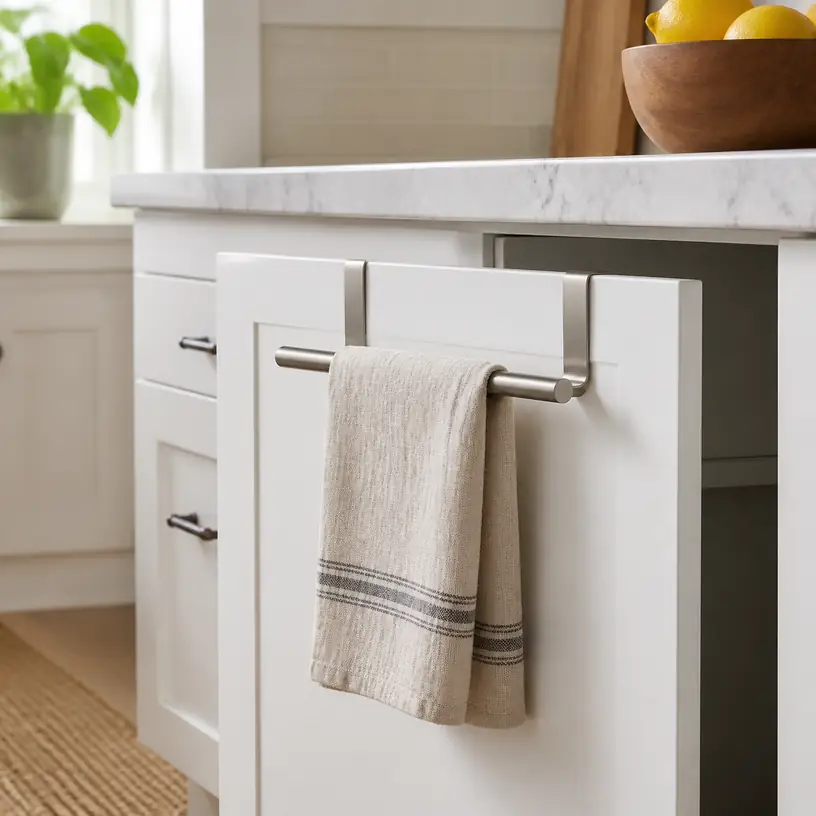
Illustrative image, not an official product photo.
Short answer
An over-the-cabinet towel bar can put a dish towel within reach without drilling, but the hook must fit the actual door before the bar style matters. Measure the door thickness and the gap above it, then inspect the space behind the door for shelves, drawer boxes, plumbing, and stored items. Compare the hook’s usable depth, protective lining, bar length, and distance below the door top. A good match should let the door close normally, keep the towel clear of the floor and nearby heat or food-preparation areas, and avoid concentrating pressure on a delicate cabinet finish.
Search reference
Over-the-cabinet towel bar options
Compare hook dimensions, door-clearance requirements, bar length, padding, inside-cabinet projection, and towel drop against the cabinet you plan to use.
View matching optionsStart with one specific cabinet door
The useful installation spot is not simply “under the sink” or “near the stove.” Choose the exact door, open it, and look at all four edges. Some doors sit below a countertop with a visible gap; others close into a narrow reveal or overlap a face frame. An accessory that slips easily over one door may scrape the countertop, prevent an adjacent drawer from opening, or leave another door slightly ajar.
Measure the door itself rather than relying on a general cabinet description. Record its thickness at the top edge, the vertical clearance between that edge and the counter or frame, and the distance from the top edge to the lowest point of the towel bar. If the door has a routed panel or curved upper rail, check whether the hook would rest on a flat, structurally suitable section instead of a bevel or decorative edge.
Next, close the empty door slowly while watching the hook from the side. The part that wraps inside needs room between the door and cabinet structure. A shelf placed close to the top, a drawer box behind a false-looking front, or the rim of a pull-out bin can occupy that space. Under a sink, supply lines and cleaning bottles may not touch the hook when the door is still, yet could catch it as the door swings.
Who this is for
- Renters and homeowners who want a removable place for a hand towel or dish towel without making holes.
- Small kitchens where counter space is limited but a compatible base-cabinet door is available.
- Households that can dedicate one door to towel storage without blocking a walkway, drawer, appliance, or second cabinet door.
- Buyers willing to measure both the outside and inside of the door instead of choosing by bar length alone.
- People who prefer a towel to hang from a bar rather than bunching it through a cabinet pull.
Who should skip it
- Skip this format when the cabinet maker advises against hanging accessories over the door or applying pressure to its top edge.
- A door with almost no closing gap, a thick decorative top, an angled edge, or an unusually fragile finish may not accept a generic hook.
- Look elsewhere if the only available door puts the towel beside a burner, oven vent, open flame, trash opening, pet bowl, or heavily splashed work zone.
- Do not use a bar that interferes with child locks, soft-close hardware, a pull-out shelf, plumbing, or the normal operation of an appliance.
- A towel that would drag on the floor, become trapped between doors, or brush against stored chemicals needs a different location.
- If the household routinely pulls hard on towels or hangs heavy wet items, a properly installed fixed solution may be more appropriate.
What to verify before buying
- Door thickness: Compare the measured top edge with the hook’s stated usable opening, not just its overall outside width.
- Top clearance: Confirm the metal and any protective liner can pass beneath the counter, rail, or drawer above without scraping.
- Inside projection: Check how far the hook extends behind the door and whether it conflicts with shelves, bins, hinges, or plumbing throughout the swing.
- Bar length: Make sure the bar fits on a flat section without crossing a neighboring door, handle, corner, or appliance front.
- Towel drop: Calculate where the bottom of your usual folded towel will land after it is placed on the bar.
- Surface protection: Read what contacts the front, top, and back of the door, and whether pads or liners are included and replaceable.
- Finish and care: Verify cleaning instructions for the bar and compatibility guidance for painted, laminated, veneered, or wood cabinet surfaces.
- Load wording: Check the current stated use and limit; a dish towel is a different load from a bath towel, damp apron, or filled bag.
- Installation orientation: Some designs may be intended for a particular door direction or bar position, so follow the exact instructions.
Hook fit has three dimensions
Product photos tend to show the visible bar, while the hidden hook determines whether the accessory works. Its first critical dimension is the opening that receives the door. Too narrow and it will not seat fully; much wider and the bar may tilt, rattle, or shift unless the design includes a suitable spacer. Do not bend a rigid hook to force a new fit unless the maker explicitly describes that adjustment.
The second dimension is the material stacked above the door. Even when the hook opening matches the thickness, the top bridge must fit through the closing gap. Include attached pads in this calculation. Compressing a liner to make the door close can transfer pressure to the finish and may keep the door from sitting in its intended position.
The third dimension is the leg hidden inside the cabinet. A longer inner leg may help locate the hook on a compatible door, but it also reaches farther toward shelf contents. Observe the entire door swing, not only the closed position. The hook should not sweep across a tall bottle, catch the edge of a pull-out container, or press a bag against a hinge.
Cabinet pairs deserve extra attention. A bar mounted near the meeting edge can collide with the second door or cover its finger pull. Corner cabinets and doors beside dishwashers may create similar conflicts. A short piece of removable painter’s tape can mark the proposed bar width during measurement, but do not leave adhesive on a finish longer than its instructions allow.
Put the towel where kitchen work actually happens
Placement determines whether the bar is convenient or perpetually in the way. Near the sink, a hand towel is easy to reach, but repeated splashes may keep it damp. Near a prep area, it may be convenient for drying clean hands, yet it should not brush food, knife handles, cabinet contents, or the floor. Near an oven or cooktop, heat, steam, grease, and open flames make proximity a poor default; follow appliance clearances and choose a safer location.
Open the selected cabinet while someone stands in the normal work position. A long towel can swing into knees or catch on a projecting handle. In a narrow galley kitchen, a bar that adds only a small amount of depth can still snag clothing as people pass. The towel should remain reachable without requiring the user to lean across a hot, wet, or busy surface.
Consider which towel will live there. A small hand towel folded once over the bar has a different drop from a full-size kitchen towel hanging from one end. Measure the towel in its intended fold and add the distance from the cabinet top to the bar. If the calculated bottom is too low, choose a shorter towel, a higher bar geometry, or another door rather than relying on the product image.
Bar shape, stops, and usable width
Overall width and usable hanging width are not always the same. End caps, bends, hook brackets, or raised stops can take up part of the bar. A narrow bar may hold one folded towel neatly, while a longer one can allow more airflow or accommodate two small towels if its stated use permits. Extra length is not automatically useful when it crosses a door seam or invites the towel to slide into a walkway.
An open-ended arm can make it quick to slide a towel on and off, but the towel may also work its way off if the cabinet door moves briskly. A capped or closed bar can retain it more predictably, though threading a thick folded towel may take more room. Look at how the bar meets the hook: a connection that projects outward may change the effective depth more than a straight profile.
A smooth bar is easier to wipe than one with deep decorative joints. If the location is close to the sink, examine current care guidance and whether water can collect around seams, pads, or end caps. Finish names alone do not establish resistance to scratches, moisture, or cleaners, so use the recommended cleaning method and dry the accessory as directed.
Protect the door and check it over time
Pads are helpful only when they remain clean, aligned, and compatible with the surface. Dust, grit, or dried kitchen residue trapped beneath a pad can mark a finish as the bar shifts. Inspect every contact point before installation, wipe the door according to the cabinet care instructions, and make sure no sharp edge or exposed fastener touches it.
Install the accessory without forcing the door. Close it gently the first time and check the reveal around neighboring fronts. The latch or soft-close action should work as it did before. If the door springs open, sits proud, rubs the counter, or needs pressure to latch, remove the bar rather than treating that behavior as normal.
During routine cleaning, lift the bar off and inspect the top edge, front, and back of the door. Check for trapped moisture, pad movement, discoloration, abrasion, rust-like spots, loose joints, or bending. A damp towel adds moisture directly beside the cabinet, so allow both towel and contact area to dry. Follow the maker’s instructions about cleaning the accessory and replacing any protective parts.
Limitations
- “No drilling” does not mean every cabinet finish or door profile is compatible.
- A hook can match door thickness while still being too tall for the closing gap or too deep for the cabinet interior.
- The bar uses part of the door edge and may interfere with paired doors, drawers, pull-outs, or countertop overhangs.
- Wet towels can transfer moisture to the accessory and nearby cabinet surfaces.
- A removable bar may shift or rattle when the towel is pulled or the door is opened quickly.
- Long towels can hang into walkways, touch the floor, or swing into adjacent storage.
- Generic search photos cannot confirm the fit of a specific cabinet; measurements and current product instructions remain necessary.
Alternatives to compare
- A self-standing countertop towel holder when counter space is available and a movable location is useful.
- A wall-mounted or cabinet-mounted bar installed with hardware appropriate for the surface and expected load.
- A towel ring placed away from heat and splashes when only one small hand towel is needed.
- A compatible appliance-handle towel clip that helps keep a towel from sliding, provided it does not affect appliance operation.
- A removable hanging hook approved for the chosen surface, with enough surrounding airflow for the towel.
- Keeping clean towels in a nearby drawer and placing the in-use towel at a dedicated sink-side drying point.
FAQ
How do I measure a cabinet door for an over-the-door towel bar?
Measure the thickness at the exact top section where the hook will sit, then measure the gap above the closed door and the unobstructed space behind it. Also mark the proposed bar width and calculate the bottom of the folded towel. Compare every measurement with the current product diagram and installation instructions.
Will an over-the-cabinet towel bar stop the door from closing?
It can if the top bridge and padding are thicker than the available gap or if the inner hook contacts cabinet structure. A compatible bar should not require force or change the door’s alignment. Remove it if the door rubs, sits open, or no longer closes normally.
Can I use this type of bar on a painted cabinet?
Only when the product guidance and cabinet care instructions indicate that the contact materials and mounting method are suitable. Inspect pads and edges, keep contact areas clean and dry, and check periodically for marks or finish changes.
Where should a cabinet towel bar go in a kitchen?
Choose a compatible door near the task but away from burners, open flames, oven vents, food-contact areas, trash openings, and crowded walkways. Test the door swing and make sure the towel cannot touch the floor, stored chemicals, or adjacent appliances.
Is a longer towel bar always better?
No. A longer bar offers more hanging width only if it stays within a clear, flat section of the door. It may otherwise cross a cabinet seam, block a neighboring front, or project into traffic. Match usable width to the towel and the available door area.
Can I hang more than a dish towel on the bar?
Use it only for the item types and load described by the current instructions. Do not assume that a design intended for a light hand towel can support a wet bath towel, apron, cleaning tools, or a filled bag.