Kitchen Sink Caddies That Keep the Wet Zone Manageable
Product links are for reference. Verify current details on the retailer page before buying.
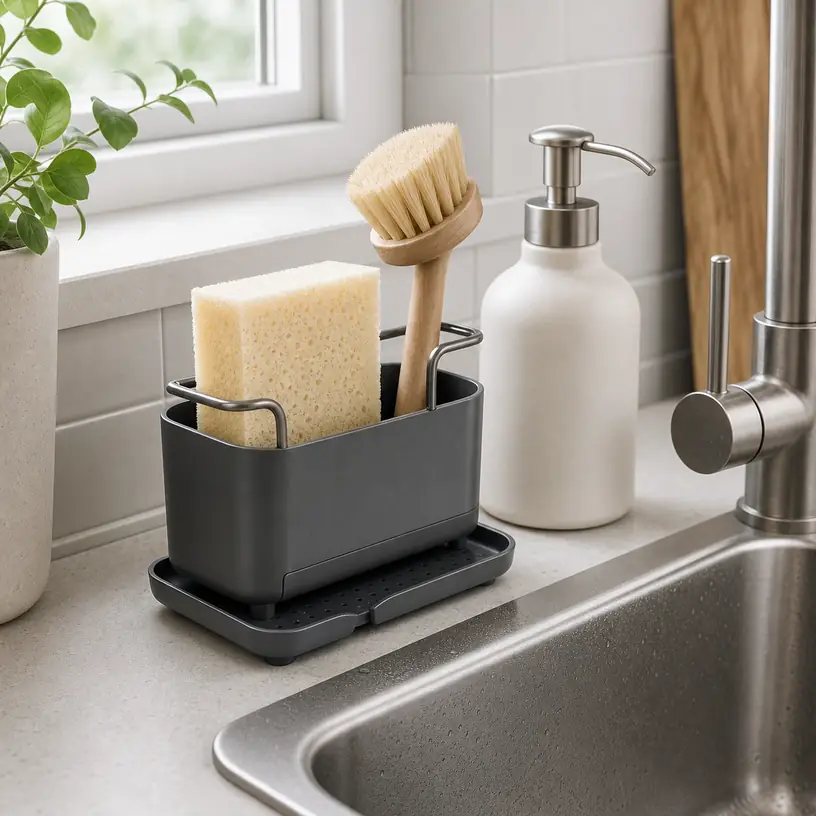
Illustrative image, not an official product photo.
Short answer
A useful kitchen sink caddy gives damp sponges and brushes a defined place without turning the counter into a harder-to-clean obstacle course. Start with placement: decide whether the caddy should sit on the counter, attach inside the sink, bridge the faucet area, or hang over a divider. Then compare drainage direction, ventilation, capacity, and how easily every wet component can be removed and washed. The right model should suit the tools already in your kitchen rather than encouraging you to store every cleaning item beside the faucet.
Search reference
Compare kitchen sink caddy layouts
Look across counter, suction-mounted, saddle, and faucet-area designs while checking dimensions, drainage details, removable parts, and the number of tools each option is intended to hold.
View matching optionsBegin with the sink, not the organizer
A caddy occupies one of the busiest and wettest spots in a kitchen. Before choosing a shape, watch what happens during a normal cleanup. Notice where the faucet handle travels, where the spray lands, whether a cutting board rests across the basin, and which side of the sink remains accessible when a large pan is soaking. A compact holder can still be annoying if it blocks a soap dispenser or must be moved every time the faucet is cleaned.
Countertop caddies are easy to reposition and do not depend on a perfectly smooth sink wall. Their main drawback is the surface underneath: trapped water and soap residue can collect if the base is broad or difficult to lift. In-sink holders free the counter, but they take up basin space and need a secure attachment point. Saddle designs can work across a double-sink divider, while faucet-area trays use otherwise idle space but must fit around the fixture without interfering with controls.
Measure the proposed location with the faucet, backsplash, sink rim, and everyday supplies in place. Product dimensions alone do not show whether a tall dish brush will lean into a window ledge or whether a tray will drain toward the basin. A paper outline on the counter is a quick way to test the footprint before committing to it.
Who this is for
- Kitchens where a sponge, dish brush, bottle brush, or scraper tends to stay loose along the sink rim.
- Small households that need a focused drying spot but do not want a full countertop organizer.
- Shared kitchens where separating wet tools from soap bottles makes the cleanup routine easier to follow.
- Renters who want removable storage rather than drilling or making a permanent change around the sink.
- Anyone replacing an improvised dish or saucer that holds water instead of helping tools dry.
Who should skip it
- Minimal kitchens that use one washable cloth and already have a ventilated place to hang it.
- Households with no clear counter, basin, divider, or faucet space that can hold a caddy without disrupting washing.
- Anyone expecting a small caddy to organize cleaners, gloves, spare sponges, and full-size soap bottles at the same time.
- Buyers who cannot routinely remove and clean another object from the splash zone.
What to verify before buying
- Overall and usable dimensions: Check the outer footprint as well as the width of compartments, brush openings, rails, and sponge slots.
- Drainage destination: Determine whether water runs into the sink, collects in a tray, passes through an open base, or lands on the counter.
- Attachment method: For suction cups, adhesive parts, hooks, or clamps, confirm the intended surface and current installation guidance.
- Cleaning access: Look for removable trays, open corners, and parts that separate without requiring a complicated reassembly.
- Tool fit: Compare the caddy with the thickness of your sponge, the handles of your brushes, and any sink stopper or scraper you plan to store.
- Faucet clearance: Make sure tall tools will not obstruct a side lever, pull-down hose, sprayer, window, or wall-mounted fixture.
- Material and care wording: Review the listing’s current instructions rather than assuming a metallic finish, plastic body, or flexible insert has a particular care requirement.
- Included pieces: Confirm whether a drainage tray, soap rail, brush cup, towel bar, mounting hardware, or spare attachment is actually included.
Drainage matters more than extra compartments
A sink caddy is supposed to manage wet tools, so its water path deserves more attention than its compartment count. An open wire or perforated base can improve airflow, but only if the drips fall somewhere that is easy to rinse or wipe. A sloped tray may direct water into the basin when it sits close enough to the rim. Farther from the sink, that same tray may simply hold a shallow puddle.
Removable drip trays make water easier to carry away, yet they also introduce a hidden surface that needs regular washing. Look for a tray that slides out without lifting a fully loaded caddy and that does not have tight channels where residue can settle. If the entire organizer must be tipped to empty it, consider whether that action will send brushes and sponges onto the counter.
Ventilation and spacing are connected. A deep, solid-walled bin may conceal clutter, but damp tools pressed together can dry slowly. Separate zones for a sponge and upright brushes are often more useful than a single large compartment. Leave enough room for air instead of treating the listed capacity as a target that must be filled.
Match the holder to your actual cleanup kit
Lay out the items that genuinely live beside the sink. Many kitchens need space for only a sponge and one handled brush. Others rotate among a bottle brush, straw brush, pan scraper, dish wand, sink stopper, and cleaning cloth. The most suitable format depends on the tallest handle, widest brush head, and dampest item—not the total number of accessories shown in a styled image.
For upright brushes, check whether the base is broad and stable enough to resist tipping when a tool is pulled out from one side. A divided brush cup can prevent handles from tangling, while an open rail may better accommodate unusually shaped heads. Sponge slots should hold the sponge without squeezing it tightly; a narrow slot can be less useful once a scrubber absorbs water and expands.
Soap storage is optional rather than automatically beneficial. A combined soap-and-tool station can make the area look coordinated, but a heavy pump can shift the organizer or make the base harder to rinse. If you refill soap frequently, verify that the bottle can be lifted without knocking over wet tools. In a cramped corner, keeping the dispenser separate may make both items easier to clean around.
Attachment choices and their tradeoffs
Freestanding designs ask the least of the sink surface. They can move to either side and are simple to remove before deep cleaning. Stability depends on the base, feet, load distribution, and counter conditions, so check whether the design remains practical when brushes lean outward.
Suction-mounted holders can preserve counter space, but installation depends on the material, texture, curve, and cleanliness of the mounting area. Do not assume a suction cup will work equally well on every sink. Adhesive mounts may offer a different hold but can be less convenient to reposition. For either style, follow current preparation and load instructions and keep a fallback storage spot in mind if the attachment loosens.
Saddle caddies drape over a divider or edge and suit certain double-basin sinks. Measure divider width, height, and clearance on both sides. Flexible designs can still interfere with stacked dishes or get splashed from both basins. Faucet-neck or faucet-deck organizers need close attention to fixture diameter, hose movement, control access, and the direction in which water drains.
A simple maintenance routine
Treat the caddy as part of sink cleaning, not as permanent scenery. Empty it, wash or wipe the base and tray, clean the surface underneath, and let components dry before reloading. Rinse trapped food particles from sponge slots and brush cups rather than waiting for visible buildup. Follow the current care directions for the specific materials and removable pieces.
Reducing inventory makes maintenance easier. Store replacement sponges and less-used brushes in a dry cabinet, then reserve the caddy for items in active rotation. Retire worn tools on their own schedule; an organizer can improve airflow and contain drips, but it cannot make a neglected sponge sanitary.
Limitations
- A caddy organizes wet tools but does not clean, sanitize, or fully dry them on its own.
- Search results may mix counter, basin, saddle, adhesive, and faucet-mounted formats with very different installation needs.
- Suction and adhesive performance depends on the surface and preparation, so compatibility cannot be inferred from appearance alone.
- Open drainage can move water to the counter if the caddy is not positioned carefully.
- Added soap holders and towel rails increase capacity but can also increase the footprint and cleaning effort.
- A compact organizer will not solve broader under-sink or countertop storage problems.
Alternatives to compare
- A simple ventilated sponge dish if only one scrubber needs a landing place.
- A clip-on sponge holder for a basin with a compatible rim and enough interior clearance.
- A wall or cabinet-door rail for brushes that benefit from hanging separately.
- A narrow absorbent sink mat when several irregular tools need temporary drying space.
- An under-sink bin for dry replacements and occasional-use cleaning accessories.
- A compact dish rack when cups, lids, and small dishes—not just cleaning tools—also need to air-dry.
FAQ
Should a sink caddy drain into the sink or into a tray?
Direct-to-sink drainage reduces the need to empty a tray, but it works only when the caddy sits close enough and the slope reaches the basin. A removable tray is more flexible on distant counters, provided you are willing to empty and clean it regularly.
Are suction-cup sink caddies reliable?
They can be practical on a compatible, clean, smooth mounting surface. Sink material, texture, curves, moisture, preparation, and load all matter, so check the current attachment guidance and avoid assuming universal compatibility.
What should I keep in a kitchen sink caddy?
Keep the small wet tools used in the daily routine, such as one sponge, a dish brush, or a scraper. Store spare supplies and seldom-used tools elsewhere so air can circulate and the caddy remains easy to clean.
Is stainless steel automatically better for a wet sink area?
No material label removes the need for drainage, cleaning, and care. Review the exact material and finish wording, construction details, and care instructions for the current option instead of choosing on appearance alone.
How often should I clean the caddy?
Clean it often enough that water, soap film, and debris do not accumulate. The practical interval varies with use, but adding the caddy and its underside to the regular sink-cleaning routine is easier than waiting for visible buildup.