Finding Room for a Cat Scratching Pad in a Small Apartment
Product links are for reference. Verify current details on the retailer page before buying.
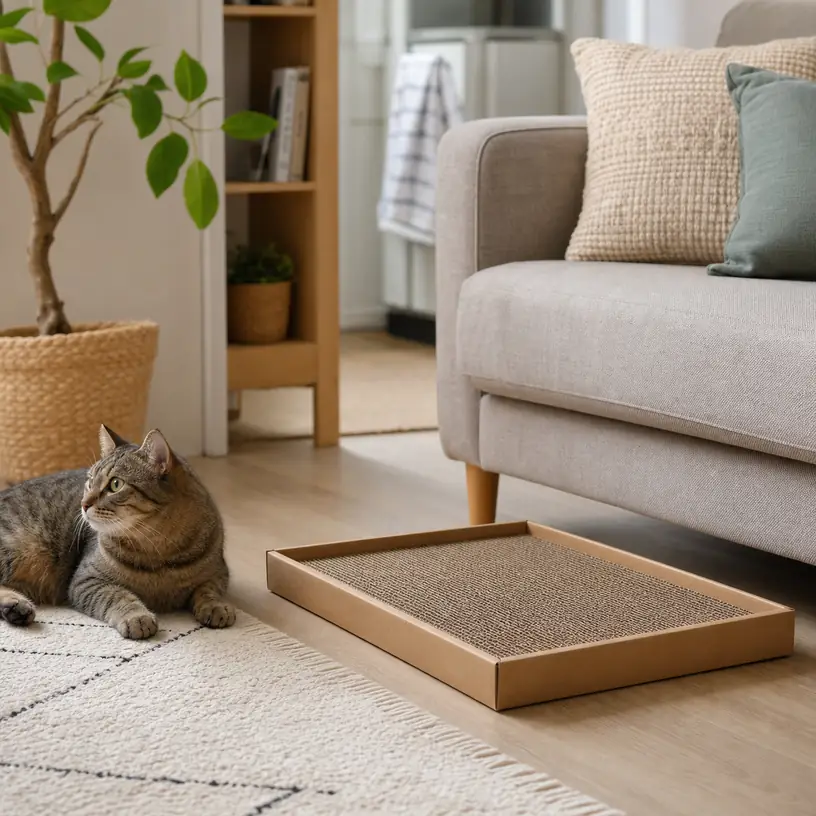
Illustrative image, not an official product photo.
Short answer
In a small apartment, the most useful scratching pad is not always the one with the smallest footprint. It needs enough usable length for the cat to brace, pull, and stretch, while its base or tray stays put. Begin with the direction the cat already prefers—horizontal, inclined, or upright—then compare the actual scratching area, not just the outer dimensions. A low cardboard pad can slide under a table and is easy to replace, but it may shed fragments. A denser mat or compact incline may create less loose debris, though texture and care can differ. Plan the location before buying: a stable pad placed beside a familiar scratching spot will usually be more practical than a tiny pad hidden in a corner the cat does not visit.
Search reference
Cat scratching pad options for indoor spaces
Compare orientation, usable scratch length, base grip, replaceable inserts, material wording, cleanup, and overall dimensions for the room you have.
View matching optionsStart with the cat’s scratching direction
A product can fit the floor plan and still go unused if it asks for the wrong movement. Watch where and how the cat currently scratches. A cat that works at the flat edge of a rug may accept a horizontal pad. One that reaches up a sofa arm is showing an interest in a taller or angled surface. Some cats switch between directions, which may call for more than one modest scratching surface rather than a single elaborate piece.
Body position is more informative than a generic size label. Notice whether the cat stands over the surface, plants the back feet behind it, or reaches upward before pulling down. The pad should allow that movement without rocking, folding, or scooting away. For a horizontal model, usable length includes only the exposed scratchable insert—not a decorative border or tray. For an incline, check both the slope length and the room needed for the base. A vertical panel needs enough height and secure support for the cat to extend without tipping it.
Do not assume a more complicated shape offers more value. Curves, lounges, tunnels, and combination furniture can be appealing, but their exterior volume may be much larger than the area the cat can actually scratch. In a one-room apartment, a simple rectangle in the right place can be easier to live with and easier to replace.
Measure the place, then leave room to use it
Choose a likely location before comparing products. Measure the clear floor area and note nearby doors, drawers, floor vents, heating equipment, cables, and walking paths. Add working space around the listed product dimensions: the cat needs an approach, and people need to pass without catching a foot on the tray. A pad that technically fits behind a door is not useful if the door sweeps across it.
Location is also behavioral context. Scratching often happens near a resting area, a transition between rooms, or an existing target such as a sofa corner. Placing the pad close to that spot can be more sensible than storing it wherever there is an empty patch of floor. If it must sit beside furniture, confirm that the base cannot scrape the flooring and that loose cardboard will not fall into a hard-to-clean gap.
An under-furniture location deserves special care. Check actual clearance and make sure the item remains visible and reachable rather than becoming a dust trap. Avoid compressing an inclined model beneath a shelf or table in a way that changes its angle or blocks the cat’s posture. Keep any supplied fasteners, elastic straps, adhesives, or loose accessories out of reach unless the instructions explicitly place them in the assembled product.
Orientation changes the real footprint
A horizontal insert is generally the easiest shape to tuck along a wall or beneath an open table, but it still needs friction underneath. A shallow tray can catch fragments and define the edge. Check whether the insert fits tightly enough that it will not seesaw inside the tray and whether both sides can be used.
An inclined scratcher trades some floor length for height. Compare the footprint at its widest point, not only the scratch panel width. Folding joints and support pieces should lock or seat as directed. If the incline collapses or shifts under pulling force, its compact storage dimensions are irrelevant during use.
A wall-mounted pad preserves floor space, but installation becomes the main buying decision. Verify the mounting method, wall compatibility, required hardware, pad weight, and whether the lease permits holes or adhesive products. Adhesive mounting can affect paint and may perform differently on textured or dusty surfaces. A freestanding upright panel avoids wall attachment but needs a base broad and heavy enough for its intended use. Do not improvise a mount from a product that is designed to lie flat.
Who this is for
- Indoor cats that already show a preference for horizontal, inclined, or compact upright scratching surfaces.
- Apartment households that can dedicate one stable, accessible spot near a resting area or an existing scratching route.
- Buyers prepared to measure usable scratch length as well as the product’s full footprint.
- People who prefer a replaceable insert or lightweight pad over a large cat tree.
- Homes willing to vacuum or collect fibers and cardboard fragments as the surface wears.
- Multi-cat households that can provide enough well-placed resources to reduce competition over a single small pad.
Who should skip it
- Skip an undersized pad that prevents the cat from taking its normal scratching posture, even if it fits the available gap.
- Avoid a lightweight model that cannot be stabilized on the intended flooring or that repeatedly tips, folds, or slides.
- A cat that chews and swallows cardboard, fibers, foam, adhesive, or detached pieces needs closer supervision and a different material or setup.
- Do not use an unfamiliar scratching pad to explain a sudden change in claw use, movement, posture, or behavior; seek appropriate veterinary guidance when a change is concerning.
- Skip wall-mounted options when the mounting method is incompatible with the wall, the lease, or safe installation.
- A single compact pad may be insufficient when several cats compete for it or have clearly different scratching orientations.
What to verify before buying
- Usable dimensions: Find the exposed scratchable length and width, not only the size of the tray, frame, or shipping package.
- Orientation: Confirm whether the model stays horizontal, forms a fixed incline, converts between positions, mounts to a wall, or stands independently.
- Stability method: Look for base width, weight, feet, non-slip backing, tray fit, mounting hardware, or another clearly described way to resist movement.
- Material wording: Verify the current description for cardboard, sisal, fabric, wood-based panels, adhesives, backing, and any frame components rather than identifying them from a photo.
- Insert design: Check whether the scratch surface is replaceable, reversible, sold separately, or permanently attached to the frame.
- Wear debris: Consider where loose fragments or fibers will land and whether the holder contains them.
- Edges and openings: Inspect the delivered item for sharp areas, exposed fasteners, loose layers, splinters, damaged corners, or gaps that could catch a claw.
- Included extras: Determine whether catnip, toys, balls, feathers, straps, or mounting pieces are removable and appropriate for supervised use.
- Cleaning instructions: Confirm whether the tray can be wiped, vacuumed, or separated from the insert and how every section should be kept dry.
- Replacement plan: Check insert availability and dimensions; a proprietary shape may limit replacements even when the frame remains usable.
- Complete footprint: Include protruding feet, curved ends, ramps, and the cat’s approach space when measuring the room.
- Assembly and mounting: Read the current instructions and verify that the intended floor or wall can support the exact design.
Cardboard, sisal, and fabric do not wear the same way
Corrugated cardboard pads expose narrow cut edges that many cats can pull across. They are often light, reversible, and available as simple inserts. Their practical tradeoff is visible wear: torn paper fragments may spread beyond the tray, and moisture can deform the surface. Compare thickness, exposed area, tray depth, and whether replacement inserts use a common rectangle or a product-specific curve. A surface that arrives crushed, damp, separated, or with hardened protruding adhesive should not be put into use.
Sisal surfaces may be woven fabric or wound rope, and those constructions can feel and wear differently. A listing should make the structure clear. Examine how the material is fixed to its base and what happens when fibers loosen. A compact sisal mat may shed differently from cardboard, but it still needs inspection and eventual replacement. If the edges curl or the backing slides, the small footprint can become a tripping problem.
Carpet-like or textile pads vary widely in pile, weave, backing, and care. They may resemble household upholstery or rugs, which can be either convenient or confusing when trying to offer a distinct scratching target. Confirm the actual fiber and backing descriptions, attachment method, edge finish, and cleaning limits. No material is automatically mess-free or universally preferred. Choosing based on the cat’s observed texture and orientation preferences is more grounded than relying on a decorative finish.
Stability matters more in a narrow room
A sliding pad can migrate into a doorway or traffic lane. Test it on the intended surface while supervising the cat’s first uses. Smooth flooring may need a purpose-designed non-slip base, while thick carpet can make a shallow tray rock. Any separate underlay should fit completely beneath the product, lie flat, and be compatible with both the flooring and the manufacturer’s instructions.
Weight alone does not guarantee stability. The force of an upward pull can tip a narrow vertical panel even if it feels substantial when lifted. Similarly, a horizontal pad can move when its tray has hard, smooth feet. Compare the direction of the cat’s movement with the way the product is supported. A long low base helps in a different way from a wall anchor.
Recheck the setup as the insert wears. A once-snug cardboard block may become thinner at its center and lift at the ends. Fasteners can loosen, non-slip surfaces can collect dust, and a folding support can shift. Replace or repair only as the instructions allow; improvised tape, exposed staples, or loose weights can create new hazards.
Plan for fragments before they spread
A tray with a raised lip can keep some cardboard pieces nearby, but it cannot contain material kicked out during energetic use. Place the scratcher where the surrounding floor is easy to vacuum or sweep. A washable floor protector may help if it lies flat and does not let the product skate, yet its compatibility should be tested rather than assumed.
Vacuum loose debris from around the pad and inspect the scratching surface at the same time. For cardboard, look for separated layers, large loose chunks, dampness, and exposed adhesive. For fabric or sisal, check for long pulled strands, detached edges, and visible backing. Follow the product’s cleaning directions; soaking a paper-based insert or applying household sprays can damage it or leave residues.
Replacement timing depends on condition, not a promised calendar interval. Turn a reversible insert only when the product is designed for it and the second side sits securely. Retire the surface when it no longer provides stable resistance, releases pieces the cat may ingest, develops sharp or loose areas, or cannot be kept acceptably clean.
Make the pad part of the room rather than clutter
Small-space purchases work better when each item has a permanent home. A pad near the sofa may also define a place to redirect attention from an upholstery corner, but access should remain open throughout the day. Moving it into a closet whenever guests arrive can make the resource inconsistent. If visual appearance matters, choose a simple holder whose replacement insert remains easy to source; an attractive frame has limited value when the worn center cannot be replaced.
A combination lounge-and-scratcher can serve more than one observed activity, but only if its curve and size actually support both. It may occupy more volume than a flat insert and collect fur in recessed areas. A scratcher with a toy track also adds parts that require inspection. In a compact home, fewer functions executed well may be preferable to a bulky object with unused features.
For multiple cats, avoid treating one small pad as a space-saving substitute for all scratching resources. Cats may prefer different rooms, heights, textures, or times of use. Several simple surfaces distributed through the apartment can be easier to place than one oversized structure, provided each is stable and does not block circulation.
Limitations
- A listed size cannot predict whether an individual cat will use a particular texture or orientation.
- Small exterior dimensions may also mean an inadequate stretch length or a base that shifts under load.
- Cardboard can create loose fragments, while fabric and sisal can develop pulled fibers or detached edges.
- Reversible and replaceable inserts are useful only when replacements fit securely and remain available.
- Non-slip claims depend on flooring, dust, moisture, wear, and the direction of the cat’s movement.
- A tray can collect some debris but will not eliminate routine sweeping, vacuuming, and inspection.
- Catnip or a dangling toy does not guarantee acceptance and may introduce removable parts that need supervision.
- Wall mounting can save floor space but adds installation, wall-condition, lease, and removal considerations.
- A scratching pad does not replace veterinary assessment for a concerning change in movement, claw condition, posture, or behavior.
Alternatives to compare
A compact scratching post offers a vertical pull, but its height and base must support a full stretch without tipping. A wall-mounted scratching panel frees the floor when the wall and installation method are suitable. A sisal floor mat may suit cats that scratch horizontally and can be practical if its backing stays flat and secure. A small cat tree combines scratching with an elevated perch, though the complete footprint, assembly, anchoring, and access routes need more planning. Furniture guards can protect a specific surface, but they should be compatible with that furniture and should not replace an accessible scratching option. When the preferred direction is unclear, two basic surfaces in different orientations may reveal more than one expensive multipurpose unit.
FAQ
How long should a cat scratching pad be?
It should provide enough usable scratch surface for the cat’s normal braced or stretched posture. Measure the cat’s movement at a familiar scratching spot and compare that with the exposed insert length, excluding the tray border. There is no single length that fits every cat or orientation.
Is a horizontal or inclined scratching pad better for a small apartment?
Horizontal pads are easier to place under open furniture or along a wall, while inclined pads may suit a cat that reaches upward and can reduce the straight floor length. The better choice matches the cat’s observed direction and remains stable in the measured location.
How can I keep a cardboard cat scratcher from sliding?
Use the stability method specified for the product, such as a fitted tray or integrated non-slip base, and test it on the intended clean, dry floor. Do not rely on improvised tape or weights that expose sticky surfaces, sharp parts, or loose objects. If the pad still moves during normal use, choose a wider or more secure design.
When should I replace a cat scratching pad?
Replace it when the surface no longer stays stable, the usable area is deeply worn, layers or fibers detach in concerning pieces, sharp or loose components appear, or it cannot be kept clean and dry. Check the holder and base as well as the replaceable insert.
Can one scratching pad work for two cats?
It may be used by both, but one small pad may create competition or fail to match different orientation and texture preferences. Observe access and consider several stable scratching surfaces in separate useful locations, especially when one cat blocks or avoids the shared pad.